Air-Cooled Chiller Maintenance Checklist
A maintenance checklist for air-cooled chillers — condenser coil condition and cleaning technique, fan and VSD health, ambient derating, head pressure control at low load, and the corrosion and airflow problems that come with outdoor siting.
Also available as editable Excel and Word — with asset, sign-off and findings columns.
What is an air-cooled chiller maintenance checklist?
A air-cooled chiller maintenance checklist is a structured list of the 16 preventive maintenance tasks — covering visual, functional, cleaning, safety and record-keeping checks — that keep an air-cooled chiller running safely and reliably. It groups routine checks by frequency, from daily inspections to annual servicing, so FM teams and building engineers can plan and evidence preventive maintenance.
Core air-cooled chiller checks
- Inspect the full condenser coil face for fouling
- Record fan motor running current on each phase and compare against nameplate full load amps
- Clean condenser coils with a manufacturer-approved fin-friendly cleaner at low pressure, washing against the normal airflow direction so debris exits the way it entered
- Check crankcase heaters are energised and functioning before any extended shutdown period
- Identify the coil type before cleaning
What is an air-cooled chiller?
An air-cooled chiller rejects heat straight to ambient air through fin-and-tube or microchannel condenser coils, driven by a bank of axial fans. There is no cooling tower, no condenser water pump and no water treatment regime — which is why they dominate small and medium commercial buildings and why they are usually sited outdoors, on a roof or in an external compound.
That simplicity moves the entire maintenance burden onto the airside. Condensing temperature floats with ambient air temperature rather than with a controlled water loop, so an air-cooled machine's head pressure, capacity and efficiency all track the weather. Rated capacity is quoted at a specific ambient dry-bulb; as ambient rises above it the machine derates, and on the hottest afternoon of the year — exactly when the building needs the cooling — it delivers least. Anything that further impedes heat rejection stacks on top of that derating.
In practice this means condenser coil condition is not one task among eighteen, it is the dominant maintenance variable. A fouled or damaged coil raises condensing pressure, which raises compressor power draw for the same cooling output, trips the unit on high pressure in hot weather, and shortens compressor life. Most of what follows is about keeping the coil, the air path through it, and the fans that pull air across it in the condition they were commissioned in.
This checklist is one of 34 in our HVAC maintenance checklists, covering air handling units, fan coils, chillers, VRF, ductwork and extract systems — filters, coils, refrigerant and damper checks.
Typical Air-Cooled Chiller maintenance checklist
A practical starting point for planned preventive maintenance. Always refer to the manufacturer's O&M manual and site-specific requirements.
Visual Checks
- Inspect the full condenser coil face for fouling — pollen, seed, dust, insects and any debris drawn onto the fins
- Check fin condition across each coil bank for bent, flattened or hail-damaged fins and comb straight where practical
- Inspect coils for corrosion — check for white aluminium oxide bloom, galvanic corrosion at tube-to-fin joints, and coating breakdown on coated coils
- Check the air path around the unit for recirculation — confirm discharge air is not short-circuiting back to the coil face off walls, louvres, parapets or adjacent plant
- Confirm manufacturer's minimum clearances to walls and neighbouring units are still met after any recent works or plant additions
- Check each condenser fan for blade damage, imbalance, guard security and bearing noise or play
- Inspect for refrigerant leaks around service valves, schrader cores, brazed joints and coil returns — look for oil staining at the coil headers
Functional Checks
- Record fan motor running current on each phase and compare against nameplate full load amps
- Verify fan staging and speed control operates correctly through the load range — check EC fan or VSD response against the control signal
- Verify head pressure control at low ambient — confirm the unit holds condensing pressure via fan speed or staging rather than tripping or hunting
- Record ambient dry-bulb alongside cooling output and compare against the manufacturer's capacity table to confirm derating is as expected, not excessive
- Record suction and discharge pressures and calculate superheat and subcooling against the manufacturer's target range
Cleaning & Housekeeping
- Clean condenser coils with a manufacturer-approved fin-friendly cleaner at low pressure, washing against the normal airflow direction so debris exits the way it entered
Safety Checks
- Check crankcase heaters are energised and functioning before any extended shutdown period
Record Keeping
- Identify the coil type before cleaning — microchannel aluminium coils need gentler treatment and different cleaners to round-tube plate-fin
- Log condensing temperature against ambient and trend the difference — a widening gap is coil fouling before it becomes a high-pressure trip
Download the free Air-Cooled Chiller maintenance checklist PDF
Get all 16 tasks as a printable PDF — free, no signup needed. Keep a copy in the plant room, attach it to work orders, or share it with your maintenance contractor.
The PDF is free and needs nothing. The Excel and Word versions add asset details, sign-off and findings columns so you can record the work as you do it — we ask for an email address for those.
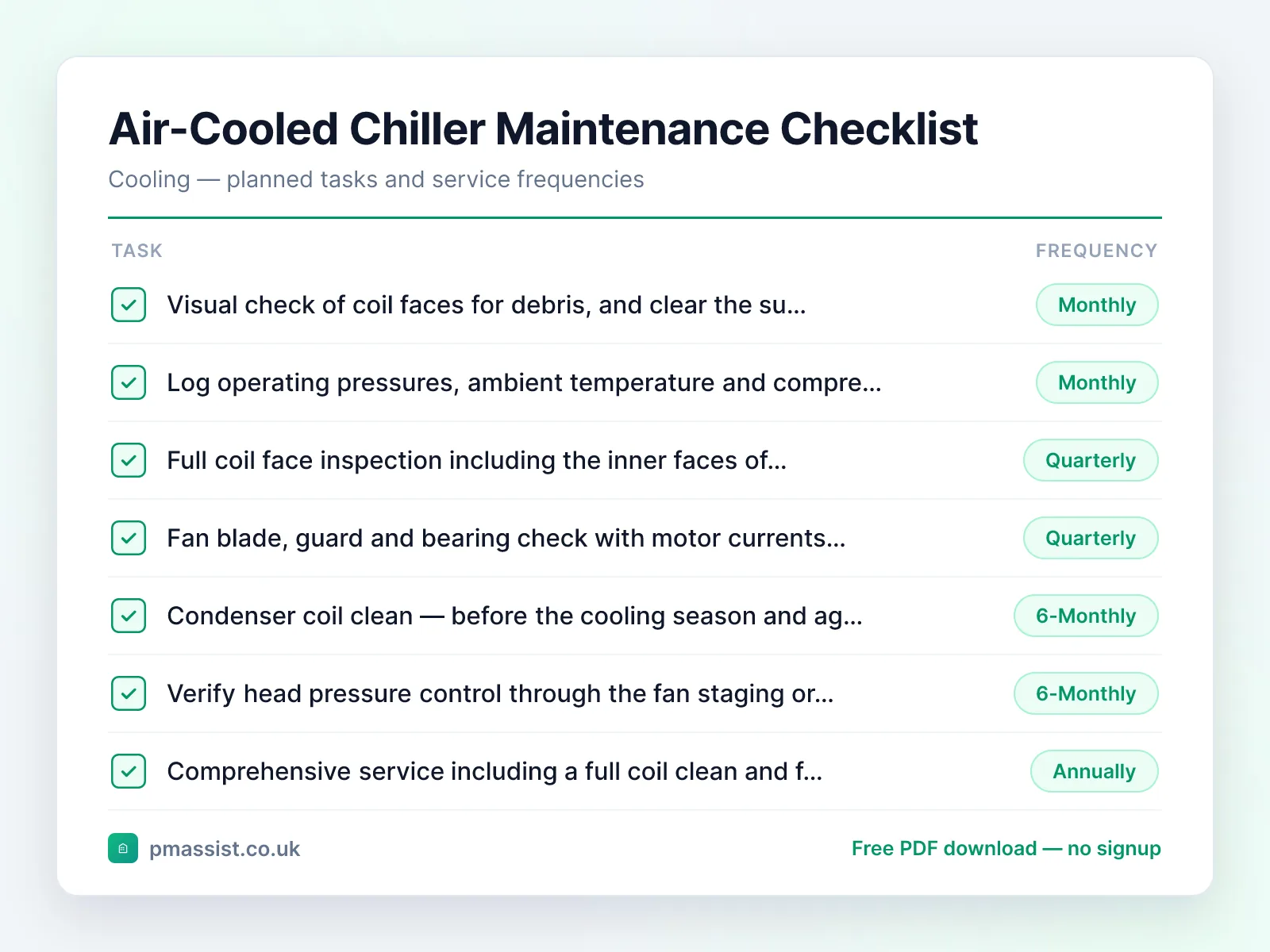
Typical maintenance frequency
Suggested intervals for air-cooled chiller maintenance. Actual frequencies should follow manufacturer guidance and site-specific risk assessments.
Monthly
- •Visual check of coil faces for debris, and clear the surrounding area of leaf litter and rubbish
- •Log operating pressures, ambient temperature and compressor currents
- •Check for oil staining that would indicate a developing refrigerant leak
Quarterly
- •Full coil face inspection including the inner faces of V-block coil arrangements
- •Fan blade, guard and bearing check with motor currents recorded
- •Test safety controls including the high pressure cutout
Every 6 Months
- •Condenser coil clean — before the cooling season and again after it where the local environment is dirty
- •Verify head pressure control through the fan staging or speed range
- •F-Gas leak check where the charge places the unit on a six-monthly interval
Annually
- •Comprehensive service including a full coil clean and fin combing
- •Coil corrosion survey, with particular attention to coastal and urban sites
- •Electrical thermography of the panel, fan motor and compressor terminations
- •Confirm crankcase heater operation ahead of the winter shutdown
- •F-Gas leak check and logbook update at the interval set by the CO₂e charge
Common faults and issues
Issues to be aware of when maintaining air-cooled chiller equipment.
Safety and compliance notes
Key safety considerations for air-cooled chiller maintenance. This is general guidance only — always follow OEM instructions, statutory requirements, and your organisation's safe systems of work.
Reference standards and frameworks
- United Kingdom
- SFG20, CIBSE Guide M, and the UK F-Gas Regulations for refrigerant plant
- North America
- ASHRAE/ACCA Standard 180, plus EPA Section 608 refrigerant handling rules
- Middle East
- Dubai Municipality's Green Building Regulations require commissioning to CIBSE Commissioning Code R (refrigeration systems)
Frameworks commonly referenced when planning air-cooled chiller maintenance programmes. Always confirm the requirements that apply to your site and jurisdiction.
Managing Air-Cooled Chiller documentation with PM Assist
PM Assist helps FM and building operations teams search their O&M manuals and building drawings in seconds. Upload your air-cooled chiller documentation and ask questions like “What is the rated cooling capacity?” or “When was the last F-Gas leak check?” — and get source-cited answers instantly.
The checklist tells you what to check. The manual tells you the numbers.
Ask a air-cooled chiller manual a question and get the answer back with the page it came from. No signup, and you can drop in your own PDF instead of the sample.
“What is the rated cooling capacity?”Runs against a sample chiller manual so you can see the shape of the answer — then try it on one of yours.
Take this checklist with you
Download the branded PDF, generate a custom version for your asset, or run AI search across all your building documentation.
Related maintenance checklists
Chiller maintenance checklist
Cooling · 18 tasks
Water-Cooled Chiller maintenance checklist
Cooling · 17 tasks
Process Chiller maintenance checklist
Cooling · 16 tasks
Condenser maintenance checklist
Cooling · 10 tasks
Dry Air Cooler / Adiabatic Cooler maintenance checklist
Cooling · 10 tasks
Variable Speed Drive (VSD / Inverter) maintenance checklist
Controls & BMS · 10 tasks
Further reading on air-cooled chiller maintenance
Compliance topics for air-cooled chiller maintenance
Refrigerants used in air-cooled chiller
GWP, the charge in kg at which leak checks start, and the Great Britain and Northern Ireland figures side by side.
Compliance & CAFM
Run air-cooled chiller maintenance in PM Assist
This checklist is also a planned maintenance programme in PM Assist, included in every paid plan alongside the compliance register and mobile inspections.
- Add an air-cooled chiller to a building's asset register and this maintenance programme is created for you, with each task on its frequency in the planner.
- Air Conditioning Inspection (TM44) and F-Gas Leak Check are tracked on the compliance register, with the date last done, the date next due and the certificate.
- Contractors can be given a login to see their jobs and upload certificates.
Frequently asked questions
How often should air-cooled chiller condenser coils be cleaned?
What is the correct way to clean an air-cooled condenser coil?
Why does my air-cooled chiller trip on high pressure in hot weather?
What is ambient derating on an air-cooled chiller?
How does coastal siting affect air-cooled chiller maintenance?
What causes airflow recirculation and why does it matter?
What superheat and subcooling should an air-cooled chiller run at?
How should an air-cooled chiller be prepared for winter shutdown?
Manage your building documentation with AI
PM Assist gives FM teams instant access to O&M manuals, drawings, and maintenance knowledge — all searchable with AI.
- Upload and organise building documentation
- AI-powered search across all your manuals
- Source-cited answers for maintenance queries
- Team collaboration and access control
- No credit card required to start