Search Building System & Maintenance Records with AI
Beyond certificates and drawings, a building generates a continuous operating record: PPM completion sheets, contractor service reports, LEV examinations, BMS points lists and strategies, energy certificates and audits. That record holds the answers to most operational questions — if you can get into it. PM Assist indexes it all, so maintenance history, control logic and performance data are retrievable in plain English.
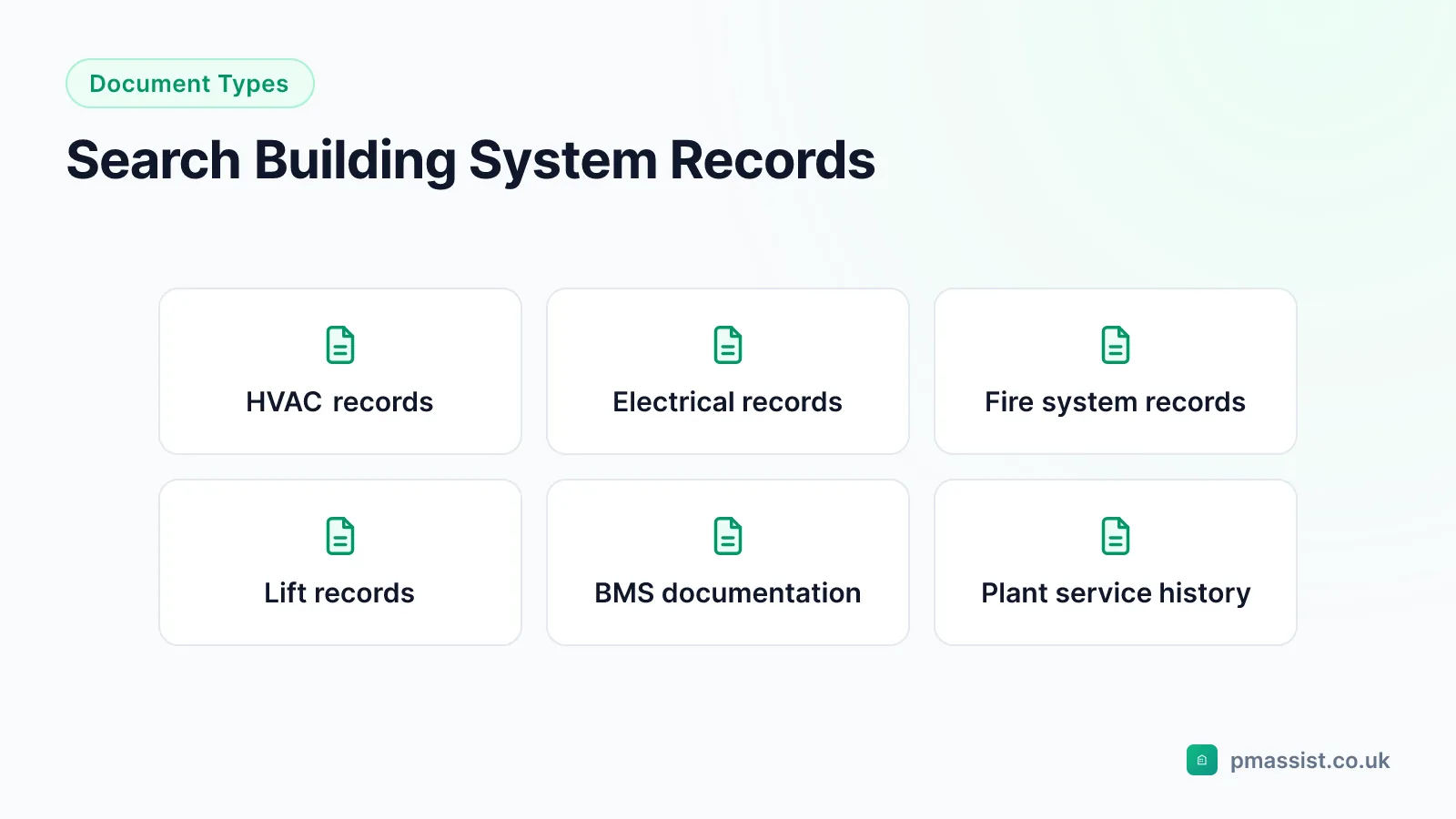
The operating record of the building
Maintenance records serve three masters at once: compliance (evidence that statutory and scheduled maintenance happened), warranty (proof that manufacturer requirements were followed), and operations (the history that tells you what an asset has done and what it will need next). Patterns in service findings are often the earliest signal of deteriorating condition, and they feed directly into lifecycle and replacement planning.
In practice this record arrives as PDFs from many contractors in many formats, and its value stays locked up: the answer to "when was the chiller last serviced and what did they find?" exists, but nobody can produce it in a meeting. Indexed, the same record answers that question in seconds — with the service report cited.
What was done versus what the O&M manual requires
The highest-value question maintenance records can answer is comparative: does what we are doing match what the manufacturer says we should do? Answering it means holding the PPM records and the O&M manuals side by side — which is exactly what searching both in one platform makes practical.
Contract reviews sharpen the same comparison: evidence of delivery against the maintenance specification, service report findings against remedial invoices, frequencies delivered against frequencies promised. Teams that can query the record directly negotiate from the documentation, not from memory.
Ventilation: airflow data, LEV examinations and ductwork records
Ventilation documentation spans design air-change rates and fresh-air quantities, commissioning records of measured flows, ductwork cleanliness reports and indoor air quality assessments. Where local exhaust ventilation is installed, COSHH requires thorough examination and testing at least every 14 months, each producing a report that must be retained and retrievable.
This set earns its keep during investigations. An air quality complaint is diagnosed by comparing what the system was designed to do, what it achieved at commissioning and what maintenance has found since — three documents, one search. The same applies when preparing for an LEV examination or planning ventilation modifications.
BMS and controls documentation
Controls documentation is the densest and least accessible material in a building's records: points lists running to thousands of rows, control strategies describing complex sequences, and cause-and-effect schedules defining how systems behave in normal and fire conditions. Engineers often interrogate the live BMS instead — but the head-end shows what the system is doing now, not what it was designed to do or why.
Indexed controls documentation restores the design intent to daily use: find a point reference and its description, retrieve the documented strategy for a plant item, confirm the cause-and-effect behaviour for a fire scenario, check a documented setpoint against what the BMS is actually holding. For troubleshooting and modification planning, that documented-versus-actual comparison is the whole game.
Energy performance: EPCs, DECs, TM44 and ESOS
Energy documentation accumulates across Energy Performance Certificates, Display Energy Certificates, TM44 air conditioning inspection reports, ESOS audits and monitoring data — each holding ratings, recommendations and benchmarks that surface repeatedly in stakeholder reporting and improvement planning. With Minimum Energy Efficiency Standards tightening, the EPC position and the recommendations behind it are questions owners ask more often, and expect answered quickly.
Searchable energy records mean "what is the building's EPC rating?", "what did the TM44 report recommend?" or "which ESOS recommendations are still open?" are answered with citations — and improvement measures get planned against the actual documented baseline, cross-referenced with the equipment specifications in the O&M manuals.
From records to decisions
Each of these record families supports a decision the building has to make: replace or maintain, recommission or modify, invest or defer. The records are where those decisions get their evidence. A condition assessment is only as good as the maintenance history behind it; an energy business case is only as good as the performance data underneath it.
Making the operating record searchable does not change what is in it — it changes how often it actually informs the decision, because retrieval stops being the reason it gets left out.
- Retrieve service history and findings for any asset
- Verify delivered maintenance against O&M requirements
- Pull LEV examination results and commissioning airflows
- Look up BMS points, strategies and documented setpoints
- Cite EPC, DEC and TM44 data in reports and business cases
Related guides
Free tools for this
Frequently asked questions
Can PM Assist search handwritten maintenance logs?
Does PM Assist replace a CAFM system?
Does PM Assist connect to the live BMS?
Can I search TM44 and other inspection reports?
Can I search records across multiple buildings?
Put Your Operating Record to Work
Upload service reports, controls documentation and energy certificates — and answer any maintenance-history or performance question in seconds.
- Upload and organise building documentation
- AI-powered search across all your manuals
- Source-cited answers for every query
- Team collaboration and access control
- No credit card required to start