Reactive vs Planned Maintenance Explained
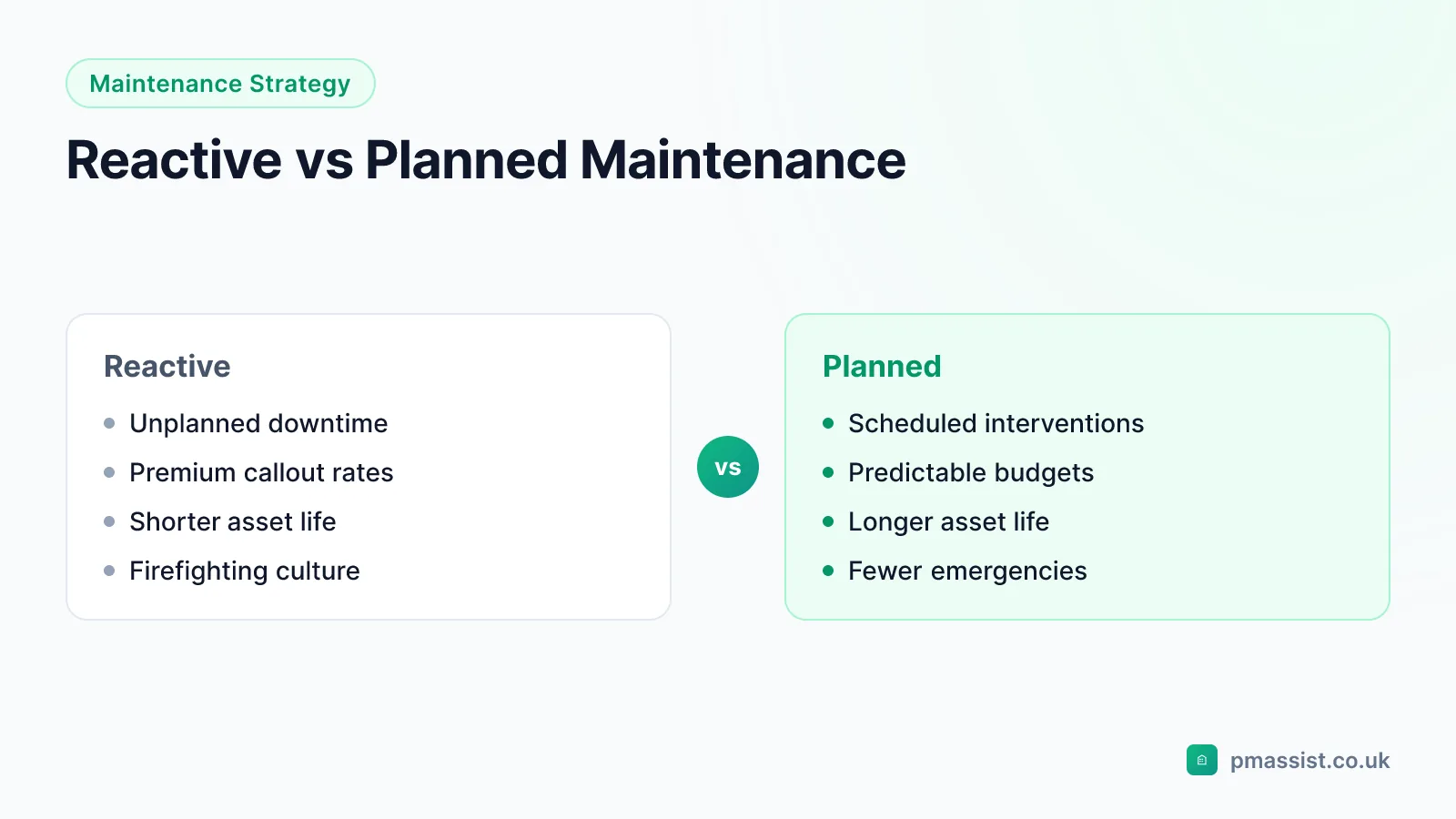
Every maintenance team sits somewhere on a spectrum between two extremes: fix things only when they break (reactive), or service everything on a schedule to stop them breaking (planned preventive). Neither extreme is right. The art of good facilities management is finding the balance — and then shifting it deliberately toward planned work over time.
What is reactive maintenance?
Reactive maintenance is work done after something has gone wrong: an asset fails or a fault is reported, and an engineer is sent to put it right. It is also called breakdown maintenance, corrective maintenance or, where the decision is deliberate, run-to-failure. The defining feature is that the asset chooses the timing, not you.
Reactive maintenance examples from a typical commercial building:
- A chiller trips on high pressure on the hottest afternoon of the year and the top floor overheats until someone cleans the condenser coils.
- A pump seal fails, floods the plant room floor and takes the duty pump out until a new seal is fitted.
- A fan coil unit's condensate drain blocks and drips through a ceiling tile onto a desk — the first anyone hears of it is the occupant's complaint.
- An emergency light is found dead during a fire risk assessment, rather than during the monthly function test that should have caught it.
- A lift stops between floors with people inside and the contractor attends on the entrapment call-out rate.
Not all reactive work is a failure of planning. A low-value asset with no safety or business consequence — a small extract fan in a store cupboard, say — is often cheaper to replace when it stops than to service on a schedule. The problem is reactive maintenance by default rather than by decision: critical plant left to fail because nobody had a schedule for it.
A reactive maintenance procedure that actually works
Even in a mostly planned regime, breakdowns happen, and the way they are handled decides whether they cost a repair or a repair plus a flooded floor. A simple procedure:
- Log it properly. Location, asset reference, symptoms, who reported it and when. "Heating not working on level 3" is a complaint; "LTHW secondary pump P-03 tripped, level 3 radiators cold" is a job.
- Triage by consequence. Life safety first, then statutory, then business-critical, then comfort. The priority sets the response time.
- Make safe and contain. Isolate, stop the leak, put the standby on duty. Secondary damage is where reactive costs run away.
- Diagnose from the documentation. The asset's O&M manual and fault-finding guide, not memory. Commissioning values are the baseline to compare against.
- Repair, test, hand back. Confirm the fix under load and tell the occupier.
- Close with the cause. Root cause, parts, hours. This is the data that tells you which failures belong in the planned schedule.
What is planned preventive maintenance?
Planned preventive maintenance (PPM) is scheduled inspection and servicing at set intervals — weekly, monthly, quarterly, annually — designed to find wear before it becomes failure. The tasks and frequencies come from the manufacturer's instructions and an industry standard such as SFG20, and every completed task is recorded. Our library of free PPM maintenance checklists shows what those tasks look like asset by asset.
The table below is the short version of the comparison the rest of this article expands on.
| Reactive maintenance | Planned maintenance | |
|---|---|---|
| When it happens | After a failure or fault report | On a schedule, before failure |
| Who chooses the timing | The asset | The FM team |
| Cost per job | Lower labour, higher call-out and damage | Higher labour, predictable |
| Budgeting | Unpredictable | Forecastable |
| Compliance evidence | None unless recorded after the fact | Built in — every task is a record |
| Best suited to | Low-criticality, cheap-to-replace assets | Statutory, life-safety and business-critical plant |
What reactive maintenance really costs
Reactive maintenance looks cheap because you only spend when something fails. But the headline labour cost hides a tail of expensive consequences: emergency call-out premiums, secondary damage when a small fault escalates, downtime and disruption to occupants, and the compliance risk of relying on equipment failing to tell you it needs attention. A purely reactive regime also makes budgeting impossible — costs arrive unpredictably, always at the worst time. And the pattern scales: across the UK's public estate alone, the National Audit Office puts the backlog of deferred maintenance at more than £49 billion — one of the headline figures in our UK FM statistics.
There is a subtler cost too. Reactive teams live in a permanent state of firefighting, which leaves no capacity to improve. The busier they are, the less time they have to prevent the next failure, and the cycle reinforces itself.
What planned preventive maintenance delivers
Planned preventive maintenance (PPM) services and inspects equipment on a schedule, catching wear before it becomes failure. It costs more in scheduled labour, but it buys predictability, longer asset life, fewer emergencies, and — critically — the records that demonstrate statutory compliance. You control the timing, so work happens during planned windows rather than at 4pm on a Friday.
PPM is not about servicing everything as often as possible, though. Over-maintenance wastes money and can even introduce faults (every intervention carries a small risk). The goal is the right task at the right frequency for each asset, which is exactly what standards like SFG20 are designed to define.
Why the answer is a blend
No regime eliminates failure. Even immaculately maintained equipment fails occasionally, and some low-criticality assets genuinely are cheaper to run to failure. So every sensible regime is a blend: a strong PPM core for critical and statutory assets, with reactive cover for genuine breakdowns and for low-risk items where planned servicing would not pay back.
The question is not "reactive or planned?" but "where should each asset sit, and how do we move the balance toward planned over time?" Criticality is the deciding factor: the more a failure would cost in safety, compliance, or disruption, the more it belongs in the planned regime.
How to shift the balance toward planned
- Build an accurate asset register. You cannot plan maintenance for assets you do not know you have. Start by knowing what is installed and where.
- Prioritise by criticality. Put life-safety and statutory assets — fire systems, lifts, pressure systems — firmly in the planned regime first.
- Use a recognised standard. Base task content and frequencies on SFG20 rather than guesswork, and adjust for each asset's condition and duty.
- Capture the knowledge to do the work. A PPM schedule tells you a task is due; the asset's O&M documentation tells you how to do it. Make both accessible.
- Learn from reactive work. Every breakdown is data. Recurring failures are candidates to move into the planned regime.
Running planned and reactive maintenance in one regime
The practical question for a contract manager is not which to choose but how to run both without the reactive work quietly eating the planned schedule. Three habits keep them honest:
- One system, one job type field. PPM jobs come off the schedule; reactive jobs come from the helpdesk; both live in the same CAFM system (or the same spreadsheet on a small estate) with a job type against every work order. If they live in different places you cannot see the ratio.
- Report the ratio and the repeat offenders. Monthly: planned versus reactive hours, PPM completion against schedule, and the top five assets by reactive call-outs. A well-run commercial building sits around 80:20 planned to reactive by hours; a slide toward 60:40 on a particular asset class means its PPM is not catching what it should.
- Feed reactive findings back into the schedule. A pump that has needed three seal changes in a year needs its alignment and its bearing checks added to the PPM, not a fourth seal. Every closed reactive job with a root cause is a candidate change to the planned regime.
The role of accessible documentation
Both reactive and planned maintenance depend on information. Reactive work needs it fast, under pressure, in front of a fault. Planned work needs it to define the right tasks and to record that they were done. In both cases, if the documentation is buried, the regime suffers — engineers waste time hunting, tasks get skipped, and the records that prove compliance go missing.
This is the quiet enabler of a good maintenance balance: making your O&M documentation instantly searchable. With it, planned maintenance is easier to specify and evidence, and reactive work is faster and safer when it does occur. PM Assist carries the planned maintenance programme and the compliance register alongside the equipment maintenance checklists it generates them from — so the schedule and the technical knowledge behind every task are one question apart.
Conclusion
Reactive versus planned is not a binary choice but a balance to manage. Aim for a planned core that covers everything critical and statutory, reactive cover for genuine breakdowns and low-risk assets, and a deliberate drift toward planned work as you learn from failures. Underpin it all with accessible documentation, and you get a maintenance regime that is cheaper, safer, and far less stressful to run.
Try PM Assist free and give your maintenance team the knowledge behind every job.
Reactive vs planned maintenance: frequently asked questions
What is reactive maintenance?
Reactive maintenance is work carried out after an asset has failed or a fault has been reported — a repair in response to a breakdown rather than a scheduled service. It is also called breakdown, corrective or run-to-failure maintenance. Typical examples in a building are resetting a tripped chiller, replacing a failed pump seal after a leak, clearing a blocked FCU condensate drain that has dripped through a ceiling, or attending a lift entrapment.
What is planned preventive maintenance (PPM)?
Planned preventive maintenance is scheduled inspection and servicing carried out at set intervals — weekly, monthly, quarterly, annually — to find wear and correct it before the asset fails. Task content and frequency usually come from the manufacturer's O&M manual and an industry standard such as SFG20, and each completed task is recorded as evidence of compliance.
What is the difference between reactive and planned maintenance?
Timing and control. Planned maintenance happens on a schedule you set, before failure, during a window you choose; reactive maintenance happens after failure, at a time the asset chooses. Planned work costs more in scheduled labour but is predictable and generates compliance records; reactive work looks cheaper per job but carries call-out premiums, secondary damage, downtime and no evidence trail. Most regimes are a blend of both.
What should a reactive maintenance procedure include?
A usable reactive procedure has six steps: log the fault with location, asset reference and symptoms; triage it by safety and business impact to set a response time; make safe and contain any secondary damage; diagnose and repair using the asset's O&M documentation and fault-finding guides; test and hand back to the occupier; and close the job with the cause, parts used and time taken recorded. The final step matters most — it is the data that tells you which failures should move into the planned regime.
How do you track planned and reactive work on a single contract?
Run both through the same system with a job type on every work order. PPM jobs are generated from the schedule; reactive jobs are raised from the helpdesk. Report monthly on the ratio of planned to reactive hours, the top recurring reactive faults by asset, and PPM completion against schedule. A rising reactive share on a particular asset type is the trigger to review its PPM frequency or task content. Most CAFM systems do this out of the box; a spreadsheet with a job-type column does it for a small estate.
What is a good ratio of planned to reactive maintenance?
There is no single right number, but a commonly cited target for a well-run commercial building is roughly 80% planned to 20% reactive by labour hours, and anything below 60:40 usually means the PPM regime is not catching what it should. New buildings and critical environments (data centres, hospitals) sit higher; low-criticality assets are often deliberately run to failure and pull the ratio down without that being a problem.
Get the FM AI digest
One short email a month with the most useful new guides, tools and changes from PM Assist. Unsubscribe anytime.
We use your email only to send the digest. No spam, unsubscribe anytime. See our privacy policy.
Compliance & CAFM
Put this into practice with PM Assist
PM Assist's building compliance software tracks every statutory duty across your buildings, plans the maintenance behind them and keeps the evidence searchable.
- A compliance register for each building, with the date each duty was last done and when it is next due.
- Planned maintenance and inspection forms generated from your asset register.
- AI reads your certificates and proposes the dates and remedial actions; a person checks them against the source document before they count.