Facilities management has always been a profession grounded in practical knowledge. Keeping buildings operational, safe, and efficient requires an enormous breadth of expertise — from mechanical and electrical systems to health and safety regulations, supplier management, and occupant satisfaction. Yet despite the complexity of the role, many FM teams still rely on manual processes, paper-based documentation, and reactive maintenance strategies that have changed little in decades.
Artificial intelligence is poised to change that. AI is not a futuristic concept for facilities management — it is a practical technology that is already being deployed across the industry to solve real operational challenges. From making O&M manuals searchable in seconds to predicting equipment failures before they occur, AI offers FM professionals tools that genuinely reduce workload and improve building performance.
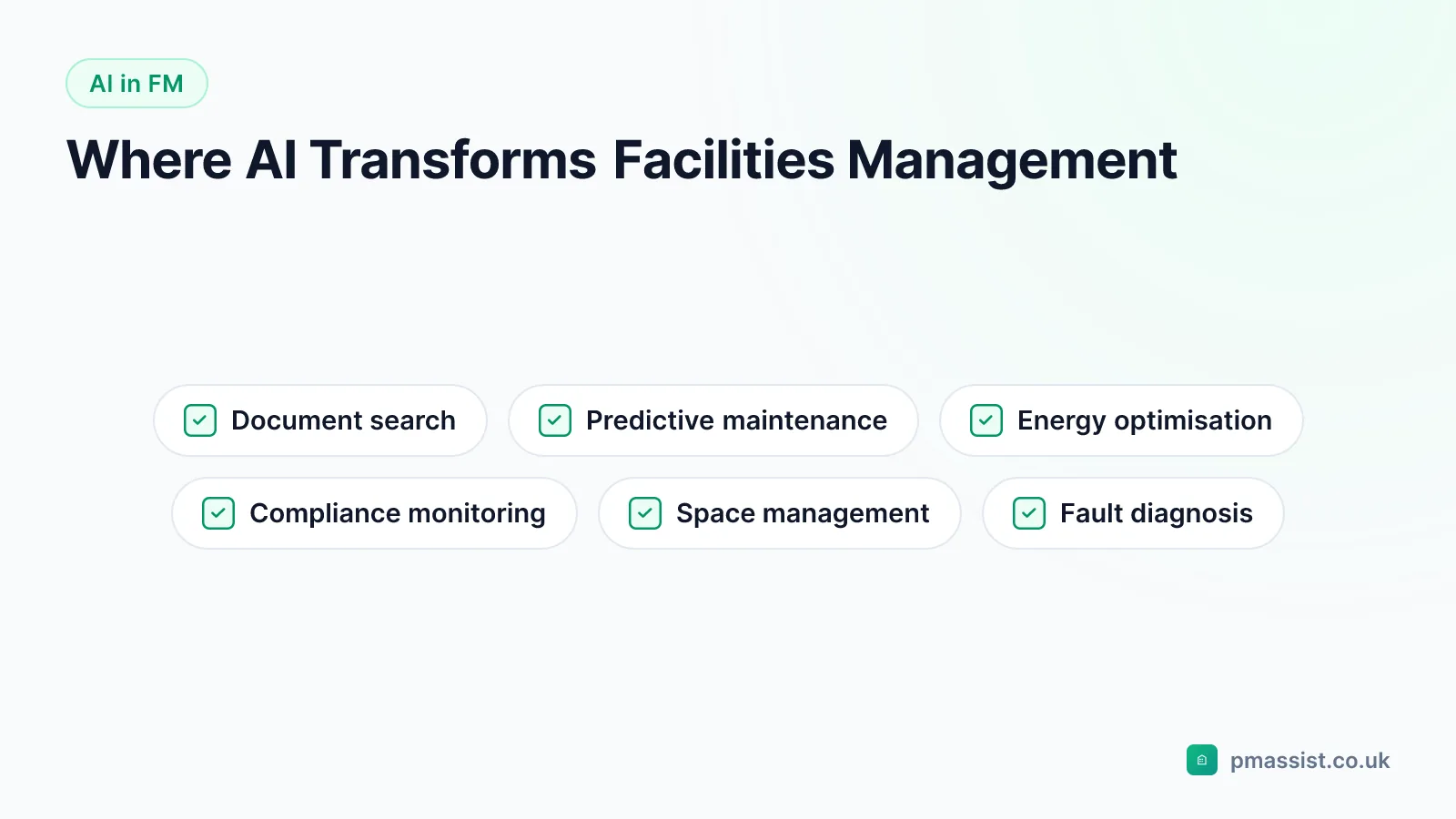
This article explores five key areas where AI is transforming facilities management: document management, predictive maintenance, energy optimisation, space planning, and compliance. For each, we will examine the current challenges, how AI addresses them, and what practical benefits FM teams can expect.
1. Document Management and Knowledge Access
Facilities management is one of the most document-intensive professions in the built environment. A single commercial building can generate thousands of pages of O&M manuals, as-built drawings, commissioning records, test certificates, and maintenance logs. These documents contain critical information that FM teams need daily — equipment specifications, maintenance schedules, emergency procedures, warranty details, and manufacturer contact information.
The challenge is that this information is almost always difficult to access. O&M packs are typically delivered as collections of PDF files with inconsistent formatting, varying naming conventions, and no unified search capability. When a site engineer needs to find the maintenance schedule for a specific piece of equipment, they often spend fifteen to thirty minutes locating the correct document and navigating to the right page. Multiply this across dozens of daily queries and the productivity cost becomes significant.
How AI Solves Document Access
AI-powered document search fundamentally changes how FM teams interact with their documentation. Tools like PM Assist use semantic search technology to understand the meaning behind a question, not just the keywords. When an engineer asks "What is the filter replacement interval for the Level 5 AHU?", the AI understands this question and finds the relevant information even if the document uses different terminology such as "air handling unit filtration maintenance frequency".
This capability transforms O&M manuals from static archives into active knowledge bases. Instead of being files that sit on a shared drive and are consulted only when absolutely necessary, building documentation becomes an accessible resource that team members consult routinely. The result is better-informed maintenance decisions, fewer errors caused by guesswork, and faster response times when issues arise.
Source citation is a critical feature of AI document search for FM applications. Every answer traces back to a specific document, page, and section, allowing engineers to verify the information against the original manufacturer documentation. This traceability is essential in an industry where incorrect information can have serious safety and compliance consequences. You can learn more about this approach in our guide on how to search O&M manuals with AI.
2. Predictive Maintenance
Traditional maintenance strategies in facilities management fall into two categories: reactive maintenance (fixing equipment when it breaks) and preventive maintenance (servicing equipment on a fixed schedule regardless of condition). Both approaches have significant limitations. Reactive maintenance leads to unexpected downtime, emergency call-out costs, and potential safety risks. Preventive maintenance, while more structured, often results in unnecessary servicing of equipment that is functioning well, wasting both time and money.
Predictive maintenance represents a third approach that uses data analysis and machine learning to determine when equipment actually needs attention. Rather than waiting for a failure or servicing on a fixed calendar, predictive maintenance monitors equipment condition in real time and flags anomalies that suggest a failure is developing.
How Predictive Maintenance Works in Practice
AI-powered predictive maintenance systems collect data from building management systems (BMS), IoT sensors, and smart meters. This data includes temperature readings, vibration measurements, energy consumption patterns, pressure differentials, and motor current draws. Machine learning algorithms analyse this data to establish normal operating patterns for each piece of equipment.
When the system detects a deviation from normal patterns — such as a gradual increase in vibration amplitude on a fan motor, or a slow rise in discharge air temperature from a chiller — it generates an alert. Crucially, these alerts come with context: the AI can estimate the likely cause, the urgency of the issue, and the recommended action, often referencing the relevant maintenance procedures from the building's O&M documentation.
The financial case for predictive maintenance is compelling. Industry research consistently shows that predictive maintenance reduces unplanned downtime by 30 to 50 per cent and extends equipment lifespan by 20 to 40 per cent. For a large commercial building with annual maintenance costs of several hundred thousand pounds, these savings are substantial.
Barriers to Adoption
Despite its benefits, predictive maintenance adoption in FM remains relatively low. The primary barriers are data availability (many older buildings lack the sensor infrastructure needed), integration complexity (connecting disparate BMS and IoT systems), and the skills gap (FM teams need support in interpreting AI-generated insights). However, these barriers are falling as sensor costs decrease, integration platforms mature, and AI interfaces become more intuitive.
3. Energy Optimisation
Energy management is one of the areas where AI can deliver the most immediate and measurable return on investment for facilities management teams. Buildings account for approximately 40 per cent of total energy consumption in the United Kingdom, and a significant portion of that energy is wasted through inefficient HVAC operation, poor scheduling, and suboptimal control strategies.
Traditional energy management relies on static schedules and fixed setpoints. HVAC systems run according to predetermined timetables, regardless of actual occupancy levels, weather conditions, or energy pricing. Building managers make periodic adjustments based on complaints or energy bills, but these adjustments are reactive and often based on incomplete information.
AI-Driven Energy Management
AI energy optimisation systems take a fundamentally different approach. They continuously analyse data from multiple sources — occupancy sensors, weather forecasts, energy tariff information, BMS trend data, and historical consumption patterns — to make real-time adjustments to building systems. These adjustments happen automatically, dozens of times per day, optimising comfort while minimising energy waste.
For example, an AI system might learn that a south-facing office zone heats up rapidly on sunny afternoons and pre-emptively increase cooling before occupants notice any discomfort. It might reduce ventilation rates in zones that occupancy sensors show are unoccupied, or shift non-critical loads like hot water heating to off-peak tariff periods. Each individual adjustment may save a small amount of energy, but collectively they typically achieve energy reductions of 15 to 25 per cent.
AI energy systems also provide valuable analytics that help FM teams understand their buildings better. Heat maps showing energy consumption by zone and time period reveal patterns that would be invisible in raw BMS data. Anomaly detection identifies equipment that is consuming more energy than expected, which often indicates a developing fault or suboptimal control settings.
4. Space Planning and Utilisation
The way commercial buildings are used has changed dramatically in recent years. Hybrid working patterns mean that office occupancy is less predictable than ever, yet many organisations are still managing space based on assumptions about how many people will be in the building on any given day. The result is frequently either wasted space (entire floors heated, lit, and serviced for a handful of occupants) or overcrowding (meeting rooms booked out weeks in advance while desk areas sit empty).
AI-Powered Space Analytics
AI space utilisation tools combine data from multiple sources — desk booking systems, access control logs, Wi-Fi connection counts, and dedicated occupancy sensors — to build a detailed picture of how space is actually being used. Machine learning algorithms identify patterns in this data: which teams come in on which days, which meeting rooms are consistently underused, which floors could be consolidated.
These insights enable FM teams to make data-driven decisions about space allocation, cleaning schedules, and building services operation. If AI analysis shows that the fourth floor is consistently below 30 per cent occupancy on Fridays, the FM team can redirect occupants to other floors, reduce cleaning frequency, and scale back HVAC operation on that floor — saving energy and service costs without affecting occupant experience.
Space utilisation data also provides valuable evidence for strategic property decisions. When a lease renewal or office consolidation is being considered, AI-generated utilisation reports give leadership teams objective data about how much space the organisation actually needs, rather than relying on estimates or anecdotal evidence.
5. Compliance and Risk Management
Compliance is one of the most critical and time-consuming aspects of facilities management. FM teams must track and manage a complex web of statutory obligations — fire damper drop tests, legionella testing, electrical inspections, lift maintenance, asbestos management, and dozens more. Missing a compliance deadline can result in legal liability, insurance invalidation, and most importantly, risk to building occupants.
Most FM teams manage compliance using spreadsheets, calendar reminders, or basic CAFM systems. These approaches work, but they are fragile. They rely on manual data entry, they do not adapt when regulations change, and they provide limited visibility into overall compliance status across a property portfolio.
AI-Enhanced Compliance Management
AI can enhance compliance management in several ways. Intelligent scheduling systems track certification expiry dates and automatically generate work orders for required inspections and tests, ensuring nothing falls through the gaps. When an engineer needs to locate a test certificate or risk assessment from years of archived documentation, AI search finds it in seconds rather than minutes. Natural language processing can monitor regulatory updates and flag changes that affect your buildings, reducing the risk of non-compliance due to regulatory changes you were not aware of.
Document AI is particularly valuable for compliance. When a new fire risk assessment or test certificate is uploaded, AI can automatically extract key information — the assessment date, the next review date, any remedial actions required — and populate compliance tracking systems without manual data entry. This is closely related to the digitisation of O&M manuals, which makes compliance documentation searchable and auditable.
For FM teams managing multiple buildings, AI compliance tools provide portfolio-level dashboards that show compliance status at a glance. Instead of checking individual spreadsheets for each property, managers can see which buildings have overdue inspections, which certificates are approaching expiry, and where remedial actions are outstanding. This visibility is invaluable for managing risk across a large estate.
Getting Started with AI in Facilities Management
The prospect of implementing AI across all five of these areas simultaneously can seem daunting, but the reality is that most FM teams start with a single use case and expand from there. Document management is often the most accessible starting point because it delivers immediate value, requires no hardware installation, and is relevant to every FM team regardless of building type or size.
Platforms like PM Assist are designed specifically for facilities management document search. You upload your O&M manuals, and the AI makes them searchable using natural language questions. There is no complex integration, no sensor installation, and no training required. Your team can start getting value from AI within minutes of uploading their first document.
From this foundation, FM teams can progressively adopt AI capabilities in other areas as their confidence and requirements grow. The key is to start with a use case that solves a genuine daily pain point, demonstrate value quickly, and build from there.
The Practical Reality of AI in FM
It is important to have realistic expectations about what AI can and cannot do in facilities management today. AI is excellent at processing large volumes of data, identifying patterns, and providing rapid access to information. It is not a replacement for the professional judgement, practical experience, and interpersonal skills that make a good facilities manager.
The most effective AI implementations in FM are those that augment human decision-making rather than attempting to automate it entirely. An AI system that tells an engineer which document to read is more useful than one that tries to make the maintenance decision itself. An energy optimisation system that explains its recommendations is more trustworthy than one that makes changes without transparency.
This principle — AI as a tool that empowers FM professionals rather than replaces them — is central to how the technology will be adopted in the industry. The buildings that perform best will be those managed by skilled FM teams equipped with AI tools that give them better information, faster.
Conclusion
Artificial intelligence is not a single technology but a collection of capabilities that, together, can transform how facilities management teams operate. From making building documentation instantly searchable to predicting equipment failures, optimising energy consumption, improving space utilisation, and streamlining compliance management, AI addresses many of the most persistent challenges in the profession.
The FM teams that embrace these technologies early will have a significant competitive advantage — they will operate more efficiently, respond to issues faster, and deliver better outcomes for building occupants and owners. The technology is mature enough to deliver real value today, and the barriers to adoption are lower than many FM professionals assume.
Try PM Assist free and start your AI transformation with the most practical first step: making your O&M manuals searchable in seconds.
Get the FM AI digest
One short email a month with the most useful new guides, tools and changes from PM Assist. Unsubscribe anytime.
We use your email only to send the digest. No spam, unsubscribe anytime. See our privacy policy.
Compliance & CAFM
Put this into practice with PM Assist
PM Assist's building compliance software tracks every statutory duty across your buildings, plans the maintenance behind them and keeps the evidence searchable.
- A compliance register for each building, with the date each duty was last done and when it is next due.
- Planned maintenance and inspection forms generated from your asset register.
- AI reads your certificates and proposes the dates and remedial actions; a person checks them against the source document before they count.