Why Building Engineers Waste Hours Searching Documentation
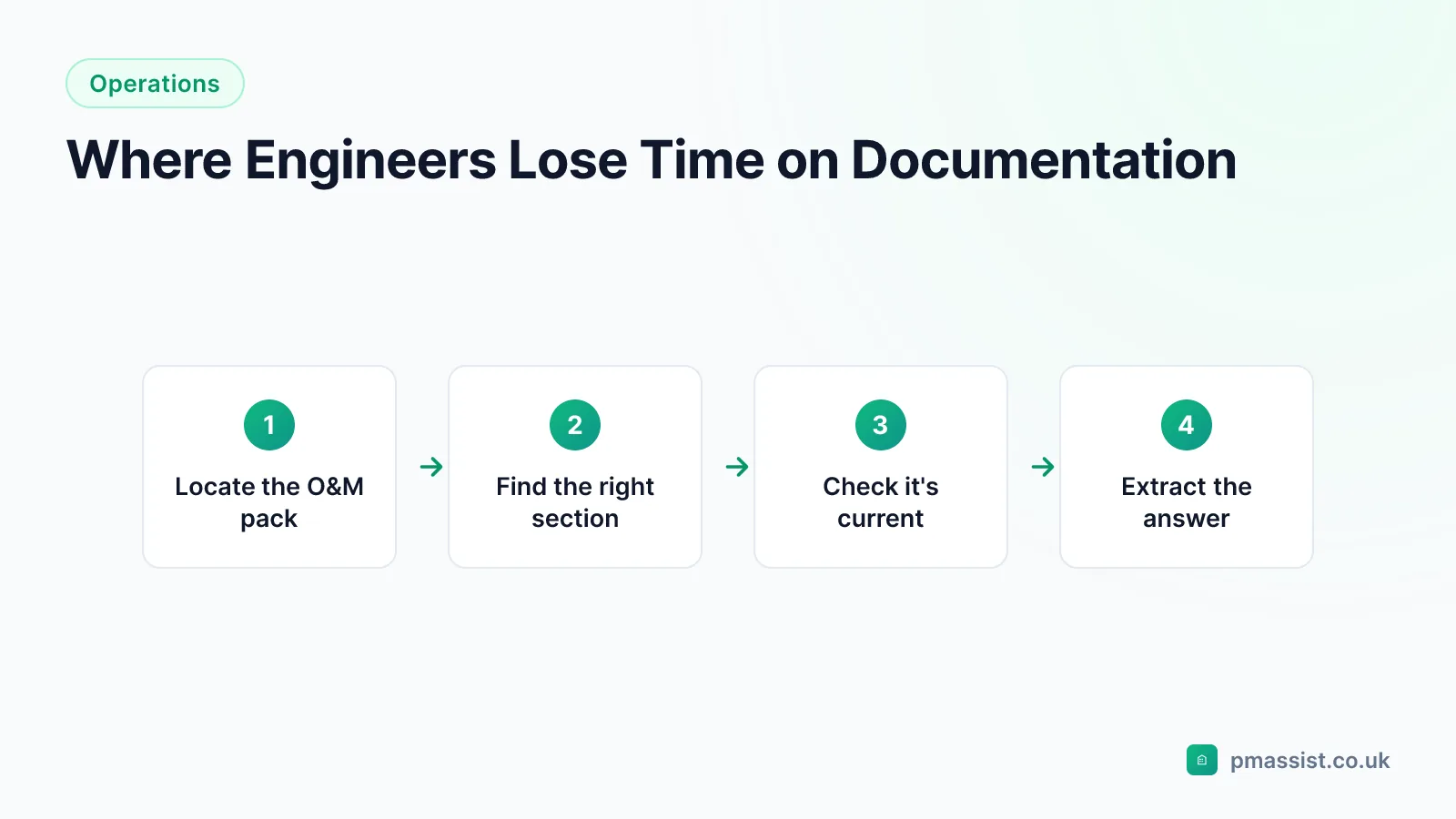
Every building engineer knows the feeling. A piece of equipment has faulted, a tenant has reported a problem, or a planned maintenance task requires specific manufacturer instructions. The information needed to resolve the situation exists somewhere in the building's documentation — but finding it is another matter entirely. What should take thirty seconds often takes thirty minutes, and sometimes the information is never found at all.
This is not a minor inconvenience. It is a systemic problem that costs the facilities management industry millions of pounds annually in lost productivity, extended equipment downtime, and unnecessary call-outs to specialists for information that was available in-house all along. Understanding why this problem exists — and how to solve it — is essential for any FM team that wants to operate more efficiently. For the wider picture across the industry — maintenance backlogs, compliance costs, and the state of building documentation — see our key facilities management statistics.
The Scale of the Problem
Research into knowledge worker productivity consistently shows that employees spend a significant portion of their working day searching for information. Studies by McKinsey and the International Data Corporation have found that the average knowledge worker spends 1.8 hours per day — nearly 20 per cent of the working week — searching for and gathering information. For building engineers, whose work depends on accessing technical documentation, the figure may be even higher.
Consider a typical day for a building services engineer on a large commercial site. They might need to look up a fault code from a BMS alarm, check the maintenance schedule for an air handling unit, find the emergency isolation procedure for a gas supply, verify the warranty status of a recently installed component, and locate the wiring diagram for a lighting control panel. Each of these tasks requires consulting the building's O&M documentation — and each search attempt carries a risk of failure.
If each search takes an average of fifteen minutes — and some take considerably longer — that represents over an hour of engineering time spent on documentation retrieval in a single day. Over a five-day working week, that amounts to more than five hours. Over a year, it adds up to roughly 250 hours per engineer — more than six working weeks — spent not maintaining equipment, not resolving issues, not improving building performance, but simply looking for information.
Why Finding Information Is So Difficult
The difficulty of finding information in building documentation is not the fault of individual engineers or FM teams. It is a structural problem caused by how O&M documentation is created, delivered, and managed throughout the building lifecycle.
Fragmented Documentation Sources
A typical commercial building involves dozens of specialist subcontractors during construction — mechanical contractors, electrical contractors, fire protection specialists, lift installers, controls engineers, and many more. Each subcontractor provides their own documentation, in their own format, with their own terminology and organisation. The result is an O&M pack that is not a single coherent document but a collection of disparate files from different sources, with no unified structure or index.
This fragmentation means that finding information requires knowing which subcontractor supplied the relevant equipment, which document they provided, and how they organised their manual. This institutional knowledge is often held by the engineer who was involved during the building's commissioning and handover — and when that person leaves, the knowledge goes with them. For a deeper exploration of this issue, see our article on the problem with traditional O&M packs.
Inconsistent Formats and Quality
O&M documentation varies enormously in format and quality. Some manufacturers provide excellent, well-structured manuals with clear tables of contents, logical section numbering, and comprehensive indices. Others provide minimal documentation — a few photocopied sheets stapled together, or a generic product datasheet that covers a range of models without specifying which variant is installed in your building.
The format problem is compounded by the transition from paper to digital. Older buildings may have documentation that was originally provided on paper and later scanned to PDF. These scanned PDFs are often image-only files — they look like text but are actually photographs of pages, which means they cannot be searched using Ctrl+F or any other keyword search tool. Without OCR processing to convert the images to searchable text, these documents are digital only in the sense that they are stored on a computer rather than in a filing cabinet.
Vocabulary Mismatches
Even when documents are genuinely searchable, keyword search has a fundamental limitation: it only works when you use the same words that appear in the document. In building services engineering, there is enormous variation in terminology. One manufacturer calls it an "air handling unit", another calls it an "air handler", and the BMS schedule might refer to it simply as "AHU". A "maintenance schedule" might be labelled as "service requirements", "planned preventive maintenance tasks", or "routine servicing intervals".
This vocabulary mismatch is particularly problematic for engineers who are new to a building or unfamiliar with a specific manufacturer's products. They search for terms they know, but the document uses different terms — and the search returns nothing, even though the information exists.
Poor Storage and Organisation
How O&M documentation is stored makes a significant difference to findability. In many organisations, documentation lives in shared network drives with folder structures that have evolved organically over years, with different naming conventions applied by different people at different times. Files might be stored under the building name, the system type, the contractor name, or the project number — and sometimes all four, creating duplicates that may or may not be identical.
Email is another common documentation repository. Test certificates, updated drawings, and manufacturer bulletins are often sent to individual engineers and remain buried in their personal email archives. When that engineer is unavailable — on holiday, on a different site, or no longer with the organisation — the information is effectively inaccessible.
The Real Cost of Poor Document Access
The consequences of poor document access extend well beyond lost productivity. They affect equipment reliability, maintenance quality, safety compliance, and organisational knowledge retention.
Extended Equipment Downtime
When a piece of critical equipment fails, the speed of response is paramount. If an engineer cannot quickly find the fault-finding guide or the correct spare parts reference, the equipment stays offline longer than necessary. For critical systems — chillers, lifts, fire alarm panels — every hour of downtime has a direct impact on building occupants and potentially on the building owner's revenue.
Unnecessary Specialist Call-Outs
When engineers cannot find the information they need to resolve an issue themselves, the default action is to call the specialist contractor. Many of these call-outs result in the contractor consulting the same O&M manual that was available on site, applying the information, and charging several hundred pounds for the visit. If the in-house engineer had been able to access that information quickly, the call-out — and the cost — would have been unnecessary.
Suboptimal Maintenance
When maintenance schedules are difficult to access, engineers sometimes rely on general knowledge rather than manufacturer-specific instructions. While experienced engineers can often service common equipment from memory, this approach risks missing manufacturer-specific requirements, using incorrect service intervals, and invalidating warranties. Good maintenance depends on good information, and good information depends on good access.
Knowledge Loss
Facilities management teams experience regular staff turnover. When an experienced engineer leaves, they take with them years of accumulated knowledge about the building — which manual covers which system, where specific information is located, what the equipment quirks and history are. If this knowledge exists only in people's heads rather than in accessible documentation, each departure degrades the team's collective capability.
How AI Search Solves the Problem
AI-powered document search addresses the root causes of poor documentation access, not just the symptoms. Rather than requiring engineers to know which document to look in and which keywords to use, AI search allows them to ask questions in natural language and receive direct answers with source citations.
Semantic Understanding
AI search uses semantic understanding rather than keyword matching. It understands that "AHU filter replacement schedule" and "air handling unit filtration maintenance intervals" mean the same thing. This eliminates the vocabulary mismatch problem that makes traditional keyword search unreliable for technical documentation. Engineers can ask questions in their own words and find the information regardless of how the manufacturer chose to phrase it.
Cross-Document Search
AI search operates across your entire document library simultaneously. Instead of opening individual documents and searching each one, engineers ask a single question and get results from every relevant document. This is particularly valuable for queries that span multiple systems or contractors — for example, "What are all the quarterly maintenance requirements for this building?" returns a consolidated answer drawing from every relevant manual.
Source-Cited Answers
Every answer generated by AI search includes citations to the specific source document, page, and section. This is critical for facilities management, where engineers need to verify information against the original documentation. The AI provides the answer quickly, and the citation allows the engineer to consult the original source for full context when needed.
No Training Required
One of the most significant advantages of AI search is that it requires no training. Engineers simply type their question in plain English, just as they would ask a colleague. This means new team members can access building knowledge immediately, without the weeks or months it typically takes to learn where everything is filed and how the documentation is structured.
Quantifying the Savings
The productivity gains from AI-powered document search are substantial and measurable. If an engineer currently spends an average of fifteen minutes per documentation search, and AI search reduces that to thirty seconds, the saving is approximately fourteen and a half minutes per search. For an engineer conducting ten searches per day, that is over two hours saved daily — time that can be redirected to actual maintenance and operational tasks.
For an FM team of five engineers, this translates to over ten hours of recovered productivity per day, or more than fifty hours per week. At typical engineering labour rates, the financial savings far exceed the cost of an AI search platform. And this calculation does not include the secondary benefits — reduced specialist call-outs, shorter equipment downtime, better maintenance compliance, and improved knowledge retention.
Getting Started
Solving the documentation access problem does not require a major technology transformation. Platforms like PM Assist are designed to make the process as straightforward as possible. You upload your O&M manuals — in whatever format they exist — and the AI makes them searchable within minutes. There is no complex integration, no folder restructuring, and no metadata tagging required.
The first step is simply to gather the O&M documentation for one of your buildings and upload it. If your documents are still in paper format, our guide on how to digitise O&M manuals covers the scanning and preparation process. Once your documents are uploaded, your team can start searching immediately — and start saving the hours they currently waste searching for information that should be at their fingertips.
Try PM Assist free and give your engineers the instant documentation access they deserve.
Get the FM AI digest
One short email a month with the most useful new guides, tools and changes from PM Assist. Unsubscribe anytime.
We use your email only to send the digest. No spam, unsubscribe anytime. See our privacy policy.