Water-Cooled Chiller Maintenance Checklist
A maintenance checklist for water-cooled chillers — condenser tube fouling and approach temperature, brushing and eddy current testing, condenser water flow and treatment chemistry, and the legionella duties that come with an evaporative cooling system.
Also available as editable Excel and Word — with asset, sign-off and findings columns.
What is a water-cooled chiller maintenance checklist?
A water-cooled chiller maintenance checklist is a structured list of the 17 preventive maintenance tasks — covering visual, functional, cleaning, safety and record-keeping checks — that keep a water-cooled chiller running safely and reliably. It groups routine checks by frequency, from daily inspections to annual servicing, so FM teams and building engineers can plan and evidence preventive maintenance.
Core water-cooled chiller checks
- Inspect condenser tubes internally for scale, biofilm, silt and mud deposits at the tube ends
- Record condenser approach temperature
- Brush-clean condenser tubes with correctly sized nylon or brass brushes appropriate to the tube material
- Confirm cooling tower cleaning and disinfection is in date and recorded, and that the tower condition supports the chiller's design condenser water temperature
- Review microbiological monitoring results including dip slide or total viable count sampling and legionella sampling as set out in the control scheme
What is a water-cooled chiller?
A water-cooled chiller rejects heat into a condenser water circuit rather than to ambient air. That circuit carries the heat to a cooling tower or evaporative condenser, where it is dissipated largely through evaporation. Because evaporative heat rejection reaches a lower condensing temperature than an air-cooled machine can, water-cooled plant is substantially more efficient at full load, which is why it remains the choice for large commercial buildings, hospitals and data centres.
The efficiency comes at the cost of a whole additional system to maintain. A water-cooled installation adds a cooling tower, condenser water pumps, strainers, and a water treatment regime — and each of those has a direct effect on chiller performance. The chiller cannot be maintained in isolation from the circuit it rejects heat into, and a great many apparent chiller faults are actually condenser water faults.
It also brings a statutory dimension that air-cooled plant does not have. A cooling tower is an evaporative system creating an aerosol, so it falls within the legionella control duties set out in the HSE's Approved Code of Practice L8 and the detailed guidance in HSG274 Part 1. Cooling towers and evaporative condensers must also be notified to the local authority. Those duties sit with the operator regardless of who holds the maintenance contract, and the water treatment regime that satisfies them is the same regime that keeps the condenser tubes clean.
This checklist is one of 34 in our HVAC maintenance checklists, covering air handling units, fan coils, chillers, VRF, ductwork and extract systems — filters, coils, refrigerant and damper checks.
Typical Water-Cooled Chiller maintenance checklist
A practical starting point for planned preventive maintenance. Always refer to the manufacturer's O&M manual and site-specific requirements.
Visual Checks
- Inspect condenser tubes internally for scale, biofilm, silt and mud deposits at the tube ends
- Check tube ends for erosion, grooving and inlet-end wear caused by excessive water velocity or entrained solids
- Inspect condenser waterboxes, end covers, gaskets and any sacrificial anodes for corrosion and wastage
Functional Checks
- Record condenser approach temperature — the difference between leaving condenser water temperature and saturated condensing temperature — and trend it against commissioning data
- Record evaporator approach temperature and chilled water ΔT against design
- Arrange eddy current testing of the condenser tube bundle to detect wall thinning and pitting before a tube fails
- Verify condenser water flow rate against design and confirm condenser water pump duty and standby operation
- Check water treatment chemistry — conductivity, pH, inhibitor residual and biocide levels against the written control scheme
- Record refrigerant suction and discharge pressures and verify superheat and subcooling against the manufacturer's target range
- Check compressor oil level, colour and acidity, and take an oil sample for analysis on large machines
Cleaning & Housekeeping
- Brush-clean condenser tubes with correctly sized nylon or brass brushes appropriate to the tube material — never steel brushes in copper tubes
- Clean condenser water strainers and check the differential pressure across them
Safety Checks
- Confirm cooling tower cleaning and disinfection is in date and recorded, and that the tower condition supports the chiller's design condenser water temperature
- Test safety controls including high pressure cutout, low pressure cutout, condenser and chilled water flow switches and the freeze stat
Record Keeping
- Review microbiological monitoring results including dip slide or total viable count sampling and legionella sampling as set out in the control scheme
- Confirm the cooling tower or evaporative condenser is notified to the local authority and that the notification details remain current
- Update the F-Gas logbook with charge, any top-up, leak test result and the engineer's certificate number
Download the free Water-Cooled Chiller maintenance checklist PDF
Get all 17 tasks as a printable PDF — free, no signup needed. Keep a copy in the plant room, attach it to work orders, or share it with your maintenance contractor.
The PDF is free and needs nothing. The Excel and Word versions add asset details, sign-off and findings columns so you can record the work as you do it — we ask for an email address for those.
Typical maintenance frequency
Suggested intervals for water-cooled chiller maintenance. Actual frequencies should follow manufacturer guidance and site-specific risk assessments.
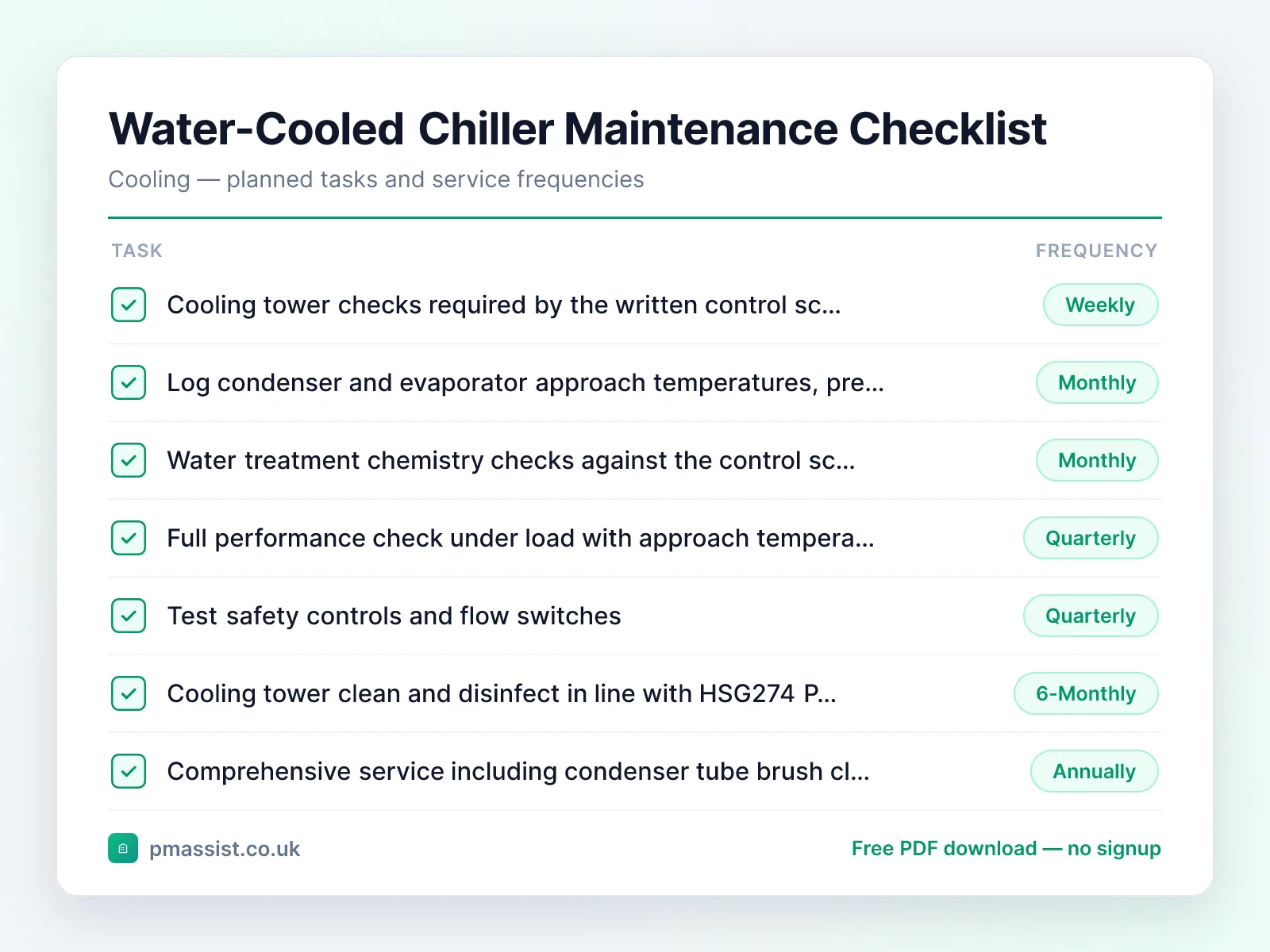
Weekly
- •Cooling tower checks required by the written control scheme, including visual condition and any automatic dosing confirmation
Monthly
- •Log condenser and evaporator approach temperatures, pressures and compressor currents
- •Water treatment chemistry checks against the control scheme parameters
- •Check condenser water strainer differential and clean where required
Quarterly
- •Full performance check under load with approach temperatures compared against commissioning data
- •Test safety controls and flow switches
- •Review microbiological monitoring trends and act on any adverse results
Every 6 Months
- •Cooling tower clean and disinfect in line with HSG274 Part 1 and the site's written control scheme
- •Condenser tube inspection at the tube ends and waterbox condition check
- •F-Gas leak check where the charge places the unit on a six-monthly interval
Annually
- •Comprehensive service including condenser tube brush cleaning
- •Eddy current test of the condenser tube bundle
- •Compressor oil and filter change with oil analysis
- •Electrical thermography of panel, starter and motor terminations
- •Review of the legionella risk assessment and written control scheme
- •F-Gas leak check and logbook update at the interval set by the CO₂e charge
Common faults and issues
Issues to be aware of when maintaining water-cooled chiller equipment.
Safety and compliance notes
Key safety considerations for water-cooled chiller maintenance. This is general guidance only — always follow OEM instructions, statutory requirements, and your organisation's safe systems of work.
Reference standards and frameworks
- United Kingdom
- SFG20, CIBSE Guide M, and the UK F-Gas Regulations for refrigerant plant
- North America
- ASHRAE/ACCA Standard 180, plus EPA Section 608 refrigerant handling rules
- Middle East
- Dubai Municipality's Green Building Regulations require commissioning to CIBSE Commissioning Code R (refrigeration systems)
Frameworks commonly referenced when planning water-cooled chiller maintenance programmes. Always confirm the requirements that apply to your site and jurisdiction.
Managing Water-Cooled Chiller documentation with PM Assist
PM Assist helps FM and building operations teams search their O&M manuals and building drawings in seconds. Upload your water-cooled chiller documentation and ask questions like “What is the rated cooling capacity?” or “When was the last F-Gas leak check?” — and get source-cited answers instantly.
The checklist tells you what to check. The manual tells you the numbers.
Ask a water-cooled chiller manual a question and get the answer back with the page it came from. No signup, and you can drop in your own PDF instead of the sample.
“What is the rated cooling capacity?”Runs against a sample chiller manual so you can see the shape of the answer — then try it on one of yours.
Take this checklist with you
Download the branded PDF, generate a custom version for your asset, or run AI search across all your building documentation.
Related maintenance checklists
Chiller maintenance checklist
Cooling · 18 tasks
Air-Cooled Chiller maintenance checklist
Cooling · 16 tasks
Process Chiller maintenance checklist
Cooling · 16 tasks
Cooling Tower maintenance checklist
Cooling · 12 tasks
Condenser maintenance checklist
Cooling · 10 tasks
Water Treatment Unit maintenance checklist
Water Systems · 10 tasks
Chemical Dosing Pot maintenance checklist
Water Systems · 8 tasks
Pump maintenance checklist
Pumps & Pressurisation · 12 tasks
Further reading on water-cooled chiller maintenance
Compliance topics for water-cooled chiller maintenance
Refrigerants used in water-cooled chiller
GWP, the charge in kg at which leak checks start, and the Great Britain and Northern Ireland figures side by side.
Compliance & CAFM
Run water-cooled chiller maintenance in PM Assist
This checklist is also a planned maintenance programme in PM Assist, included in every paid plan alongside the compliance register and mobile inspections.
- Add a water-cooled chiller to a building's asset register and this maintenance programme is created for you, with each task on its frequency in the planner.
- Air Conditioning Inspection (TM44) and F-Gas Leak Check are tracked on the compliance register, with the date last done, the date next due and the certificate.
- Contractors can be given a login to see their jobs and upload certificates.
Frequently asked questions
What is condenser approach temperature and why does it matter?
How often should condenser tubes be cleaned on a water-cooled chiller?
What is eddy current testing and does my chiller need it?
What legionella duties come with a water-cooled chiller?
Why is my water-cooled chiller losing efficiency when the chiller itself tests fine?
Are water-cooled chillers more efficient than air-cooled?
What water treatment does a condenser water circuit need?
What superheat and subcooling should a water-cooled chiller run at?
Manage your building documentation with AI
PM Assist gives FM teams instant access to O&M manuals, drawings, and maintenance knowledge — all searchable with AI.
- Upload and organise building documentation
- AI-powered search across all your manuals
- Source-cited answers for maintenance queries
- Team collaboration and access control
- No credit card required to start