Steam Trap Maintenance Checklist
Survey and maintenance of steam traps: identifying failed-open and failed-closed traps by ultrasonic and thermal methods, and quantifying the energy being lost.
Also available as editable Excel and Word — with asset, sign-off and findings columns.
What is a steam trap maintenance checklist?
A steam trap maintenance checklist is a structured list of the 12 preventive maintenance tasks — covering visual, functional, cleaning and record-keeping checks — that keep a steam trap running safely and reliably. It groups routine checks by frequency, from daily inspections to annual servicing, so FM teams and building engineers can plan and evidence preventive maintenance.
Core steam trap checks
- Inspect trap bodies, connections, and unions for leaks and corrosion
- Survey each trap by ultrasonic and thermal methods to determine its condition
- Check upstream strainers for blockage and clean where fitted
- Update the trap register with location, type, size, and condition
What is a steam trap?
A steam trap is an automatic valve that discharges condensate and non-condensable gases from a steam system while holding back live steam. Types include thermodynamic, float and thermostatic, and balanced pressure thermostatic, each suited to different duties. A steam system may contain dozens or hundreds of traps distributed across plant and distribution.
Steam traps matter disproportionately for energy. A trap that fails open passes live steam continuously, and because it makes no noise a maintenance team would notice and causes no process complaint, it can leak for years. Across a population of traps, a failure rate accumulating unchecked represents a substantial and entirely invisible energy cost — which is why trap surveys usually pay for themselves.
Failure the other way is operationally worse but easier to spot. A trap that fails closed backs condensate up into the plant it serves, causing waterlogging, poor heat transfer, and the risk of waterhammer, which can be violent enough to damage pipework and endanger people nearby.
This checklist is one of 15 in our heating maintenance checklists, covering boilers, calorifiers, heat exchangers, heat pumps and flues — combustion, controls and hot water safety checks.
Typical Steam trap maintenance checklist
A practical starting point for planned preventive maintenance. Always refer to the manufacturer's O&M manual and site-specific requirements.
Visual Checks
- Inspect trap bodies, connections, and unions for leaks and corrosion
- Inspect insulation on steam and condensate lines around each trap
- Check condensate return lines for signs of flooding or waterhammer
Functional Checks
- Survey each trap by ultrasonic and thermal methods to determine its condition
- Identify and tag traps that have failed open and are passing live steam
- Identify traps that have failed closed and are backing up condensate
- Verify isolation valves either side of each trap operate freely
- Check the trap type and size remain appropriate for the duty served
- Verify air vents and vacuum breakers operate where fitted
Cleaning & Housekeeping
- Check upstream strainers for blockage and clean where fitted
Record Keeping
- Update the trap register with location, type, size, and condition
- Estimate and record steam loss from failed traps for the energy case
Download the free Steam trap maintenance checklist PDF
Get all 12 tasks as a printable PDF — free, no signup needed. Keep a copy in the plant room, attach it to work orders, or share it with your maintenance contractor.
The PDF is free and needs nothing. The Excel and Word versions add asset details, sign-off and findings columns so you can record the work as you do it — we ask for an email address for those.
Typical maintenance frequency
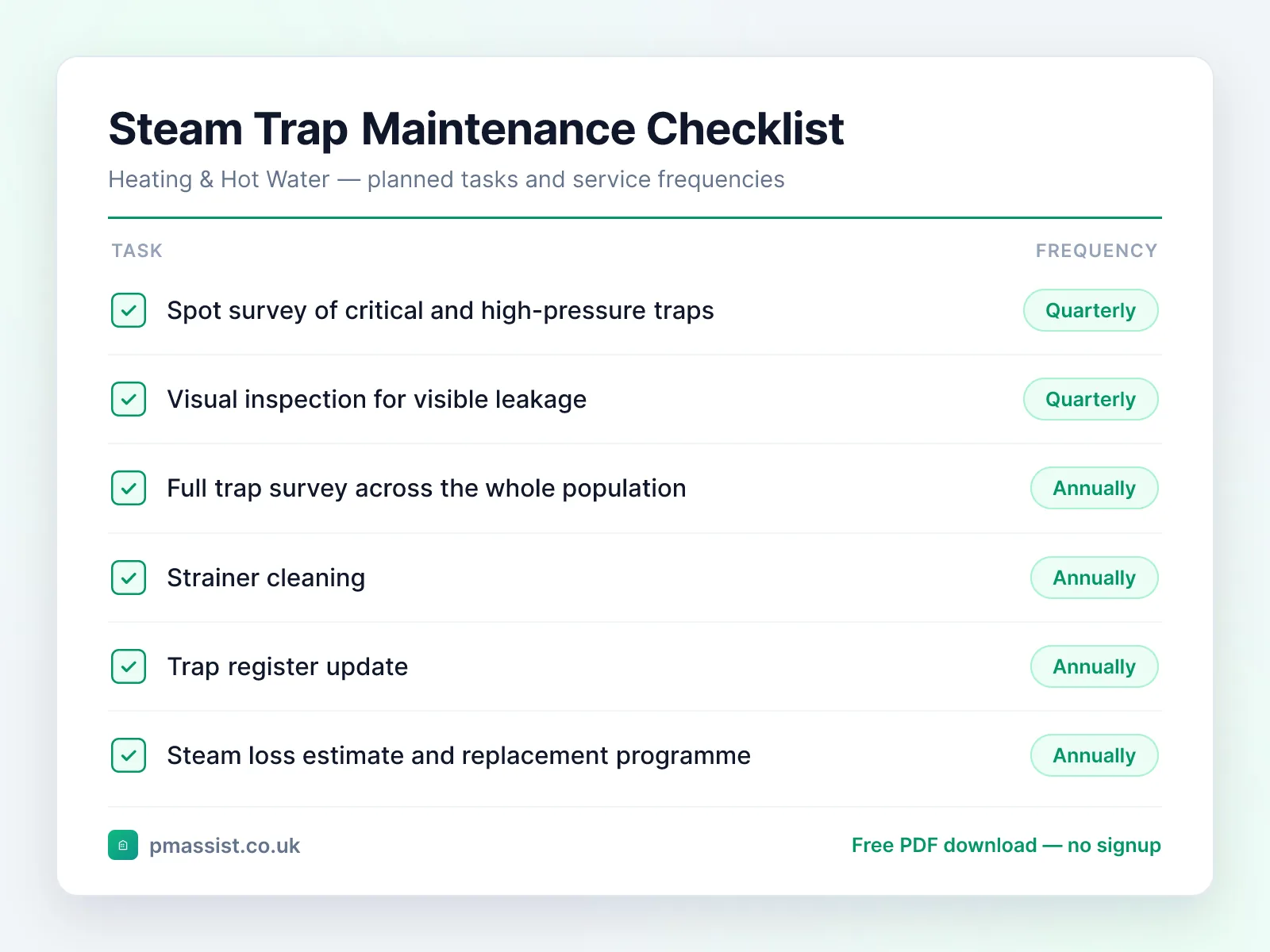
Suggested intervals for steam trap maintenance. Actual frequencies should follow manufacturer guidance and site-specific risk assessments.
Quarterly
- •Spot survey of critical and high-pressure traps
- •Visual inspection for visible leakage
Annually
- •Full trap survey across the whole population
- •Strainer cleaning
- •Trap register update
- •Steam loss estimate and replacement programme
Common faults and issues
Issues to be aware of when maintaining steam trap equipment.
Safety and compliance notes
Key safety considerations for steam trap maintenance. This is general guidance only — always follow OEM instructions, statutory requirements, and your organisation's safe systems of work.
Reference standards and frameworks
- United Kingdom
- SFG20, CIBSE Guide M, and Gas Safe requirements for gas-fired plant
- North America
- ASHRAE/ACCA Standard 180, plus ASME CSD-1 for automatically fired boilers
- Middle East
- Dubai Municipality's Green Building Regulations require commissioning to CIBSE Commissioning Code B (boilers)
Frameworks commonly referenced when planning steam trap maintenance programmes. Always confirm the requirements that apply to your site and jurisdiction.
Managing Steam trap documentation with PM Assist
PM Assist helps FM and building operations teams search their O&M manuals and building drawings in seconds. Upload your steam trap documentation and ask questions like “What type and size of trap is fitted here?” or “When was the last full trap survey?” — and get source-cited answers instantly.
The checklist tells you what to check. The manual tells you the numbers.
Ask a steam trap manual a question and get the answer back with the page it came from. No signup, and you can drop in your own PDF instead of the sample.
“What type and size of trap is fitted here?”Runs against a sample chiller manual so you can see the shape of the answer — then try it on one of yours.
Take this checklist with you
Download the branded PDF, generate a custom version for your asset, or run AI search across all your building documentation.
Related free tools
Related maintenance checklists
Steam Boiler maintenance checklist
Heating & Hot Water · 10 tasks
Pressure Vessel maintenance checklist
Heating & Hot Water · 12 tasks
Calorifier (Hot Water Storage Vessel) maintenance checklist
Heating & Hot Water · 11 tasks
Plate Heat Exchanger maintenance checklist
Heating & Hot Water · 10 tasks
Strainer (Y-type / Basket) maintenance checklist
Water Systems · 8 tasks
Further reading on steam trap maintenance
Compliance & CAFM
Run steam trap maintenance in PM Assist
This checklist is also a planned maintenance programme in PM Assist, included in every paid plan alongside the compliance register and mobile inspections.
- Add a steam trap to a building's asset register and this maintenance programme is created for you, with each task on its frequency in the planner.
- Visits are logged with notes and certificates, and overdue work is flagged before it becomes a finding.
- Contractors can be given a login to see their jobs and upload certificates.
Frequently asked questions
How do you test a steam trap?
How much does a failed steam trap cost?
How often should steam traps be surveyed?
Manage your building documentation with AI
PM Assist gives FM teams instant access to O&M manuals, drawings, and maintenance knowledge — all searchable with AI.
- Upload and organise building documentation
- AI-powered search across all your manuals
- Source-cited answers for maintenance queries
- Team collaboration and access control
- No credit card required to start