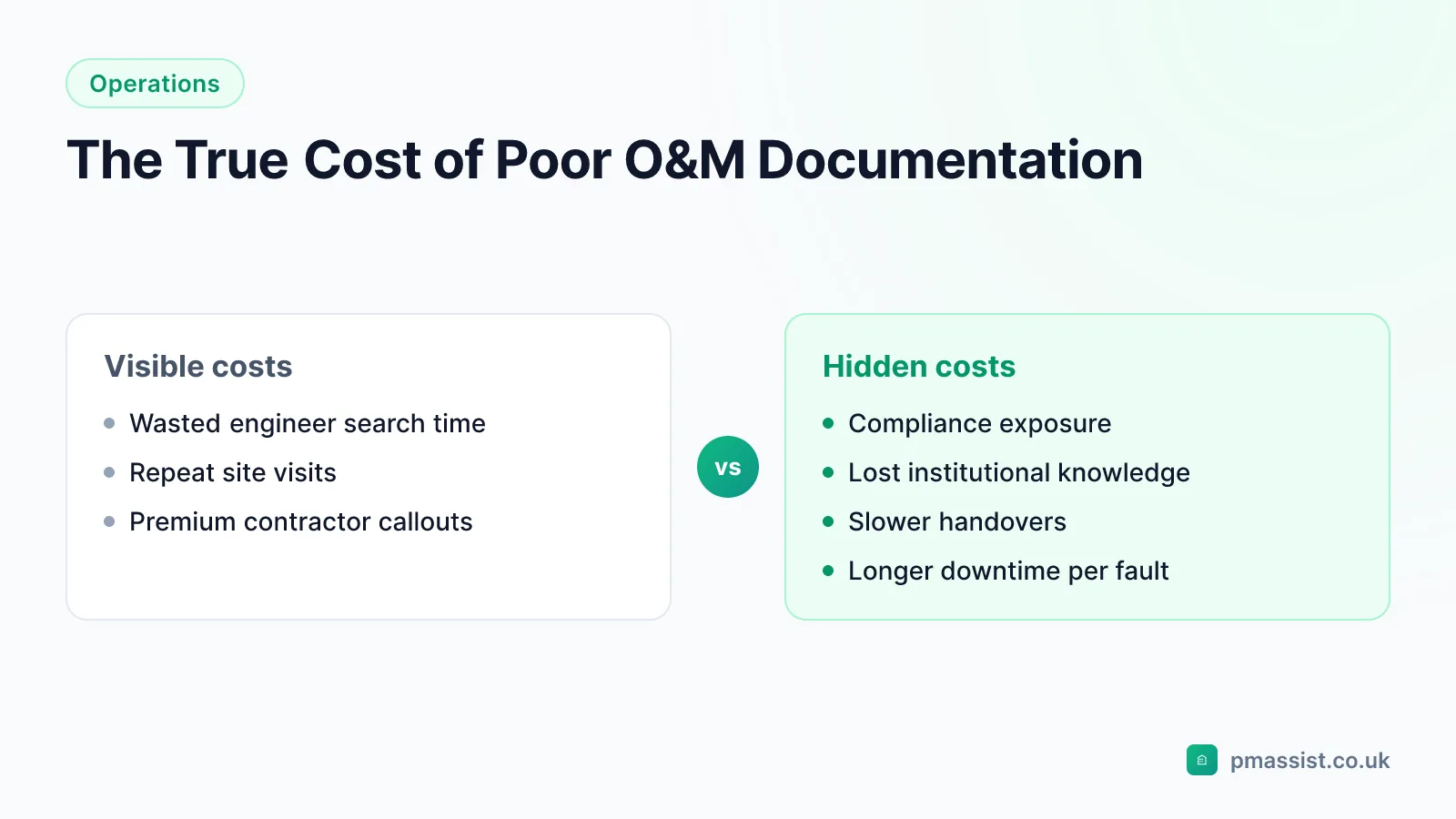
Poor O&M documentation rarely shows up as a line item on a budget. There is no invoice for "couldn't find the drawing". That invisibility is precisely why it persists — the cost is real but diffuse, paid in small increments across every fault, every audit, and every staff change. Add those increments up across a building's life and the total is substantial — nationally, deferred maintenance and missing building information add up to backlogs measured in the tens of billions (see our facilities management statistics). Here is where the money actually goes.
1. Slower repairs and longer downtime
When an engineer cannot quickly find a setpoint, an isolation point, or a manufacturer's procedure, the fault takes longer to fix. Multiply a twenty-minute document hunt across every reactive job in a year and the lost productive time is enormous. Worse, on critical plant, the delay is not just labour cost — it is downtime, comfort complaints, and sometimes business interruption. The information existed in the O&M manual all along; it just could not be reached in time to matter.
2. Repeated work and avoidable call-outs
Without accessible records, teams repeat work that has already been done — re-diagnosing a recurring fault because the history is lost, or calling out a specialist for something the documentation would have answered. Each avoidable call-out carries a premium, and the pattern compounds when the resolution is never written back into findable records.
3. Compliance and insurance risk
This is where poor documentation stops being an inconvenience and becomes a liability. If you cannot produce a compliance record on demand, the regulatory position is that the duty may not have been met — regardless of whether the work was actually done. Missing evidence can lead to enforcement, and in the worst case can undermine an insurance claim. The potential cost here dwarfs the day-to-day inefficiencies.
4. Lost institutional knowledge
Buildings increasingly run on the memory of long-serving engineers who "just know" where things are and how systems behave. When they retire or move on, that knowledge leaves with them — unless it was captured in findable documentation. Poor O&M records turn every staff departure into a knowledge loss, and every new starter into a slow, expensive ramp-up. This is one of the strongest hidden costs precisely because it is invisible until the person has gone.
5. Slower, riskier projects and transactions
When a building is refurbished, re-let, or sold, its documentation becomes part of its value and its risk profile. Incomplete or inaccessible O&M information slows due diligence, complicates handovers, and can reduce confidence in the asset. The golden thread requirements under the Building Safety Act have made this explicit for higher-risk buildings, but the principle — that accessible, accurate information is an asset — applies everywhere.
What good documentation is worth
Flip each of these costs around and you get the value of fixing the problem: faster repairs, fewer avoidable call-outs, defensible compliance, retained knowledge, and smoother projects. The striking thing is that capturing this value rarely requires creating much new documentation — most buildings already have the information. What they lack is access.
That is the cheapest part of the problem to fix. Centralising existing O&M documents and making them searchable in plain English converts a dead archive into a live knowledge base, without the cost of recreating the content. An engineer asks a question and gets a sourced answer; a manager produces compliance evidence in seconds; a new starter becomes productive in days rather than months. It also pairs naturally with structured maintenance — our equipment checklists define what to do, while searchable O&M data supplies the how.
Conclusion
The true cost of poor O&M documentation is not one big bill — it is a thousand small ones, paid quietly across the life of a building. Because the cost is hidden, it is easy to tolerate and hard to justify fixing. But the fix is unusually cheap relative to the return: make what you already have findable. Do that, and the small bills stop.
Try PM Assist free and turn your O&M documentation from a cost into an asset.
Get the FM AI digest
One short email a month with the most useful new guides, tools and changes from PM Assist. Unsubscribe anytime.
We use your email only to send the digest. No spam, unsubscribe anytime. See our privacy policy.
Compliance & CAFM
Put this into practice with PM Assist
PM Assist's building compliance software tracks every statutory duty across your buildings, plans the maintenance behind them and keeps the evidence searchable.
- A compliance register for each building, with the date each duty was last done and when it is next due.
- Planned maintenance and inspection forms generated from your asset register.
- AI reads your certificates and proposes the dates and remedial actions; a person checks them against the source document before they count.