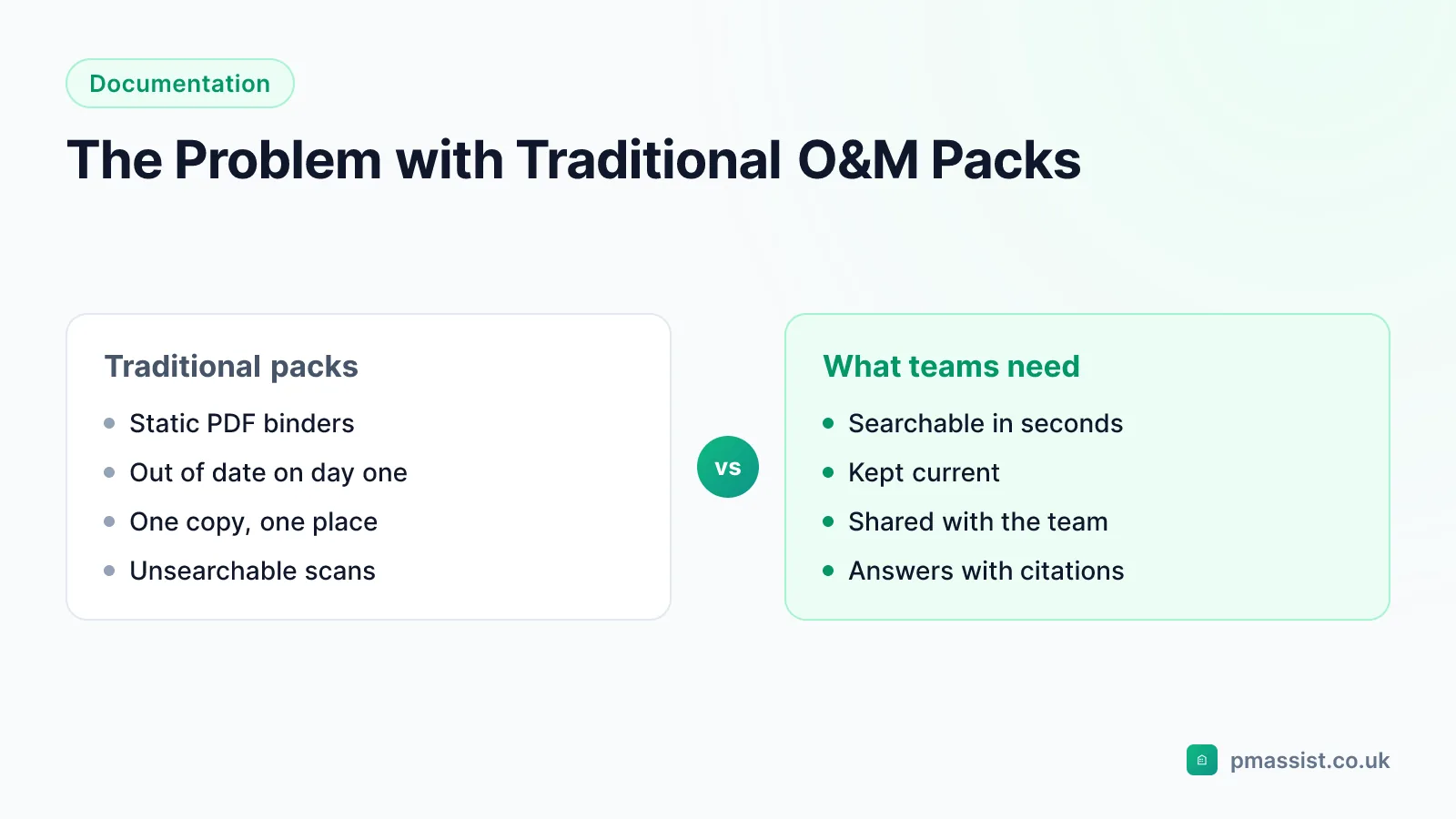
Every commercial building is handed over with a set of operations and maintenance documentation — the O&M pack. These documents represent a significant investment in time and money, compiled by contractors, subcontractors, and manufacturers to provide the building owner with everything they need to operate and maintain the building throughout its lifecycle.
Yet despite this investment, O&M packs are widely regarded as one of the most underutilised resources in facilities management. The documentation is there, but practically using it remains a challenge that most FM teams struggle with daily.
The Volume Problem
A typical commercial office building might have an O&M pack running to 5,000-10,000 pages across multiple volumes. For larger or more complex buildings — hospitals, data centres, mixed-use developments — the documentation can be significantly more extensive. This volume of information is simply too large for any individual to have a working knowledge of.
The documentation covers every installed system: HVAC, electrical, plumbing, fire systems, lifts, BMS, access control, and more. Each system has its own set of manufacturer literature, specifications, maintenance schedules, and operating procedures. When an FM team member needs to find a specific piece of information, they first need to identify which of potentially dozens of documents might contain it.
The Format Problem
O&M documentation arrives in inconsistent formats. Some documents are neatly formatted with clear tables of contents and section numbering. Others are photocopied manufacturer brochures with no indexing at all. Drawing sets follow different conventions depending on the originating firm. This inconsistency makes systematic searching extremely difficult.
Many O&M packs include a mix of native digital PDFs (with searchable text) and scanned documents (where text appears as an image). When half your documentation is unsearchable by even basic Ctrl+F, the practical utility of digital delivery is severely diminished.
The Accessibility Problem
Even when O&M documentation is well-organised and stored digitally, accessibility remains a challenge. The people who need the information most urgently — site engineers responding to equipment faults, maintenance technicians planning PPM tasks, or operations managers dealing with emergencies — often struggle to find what they need quickly enough.
There is a significant difference between information being available and information being accessible. A maintenance schedule buried on page 247 of a 400-page PDF is technically available, but practically inaccessible when a technician needs it urgently in a plant room with a mobile phone.
The Knowledge Dependency Problem
In most FM operations, knowledge of where to find specific information lives in the heads of experienced team members. The senior building manager knows that the chiller maintenance schedule is in the blue folder (or the third PDF in the Mechanical subfolder). When that person leaves, retires, or is simply on holiday, the knowledge goes with them.
This creates a fragile knowledge infrastructure where the team's ability to access critical building information depends on specific individuals being available. New team members face a steep learning curve, often spending their first months simply learning where to find things rather than applying their technical skills.
The Maintenance of Maintenance Documentation
O&M packs are typically compiled during the construction phase and delivered at practical completion. But buildings change. Equipment is replaced, systems are modified, and new installations are added over the building's lifecycle. Keeping the O&M documentation current with these changes is a task that few organisations do well.
The result is that O&M packs gradually become less reliable as the building ages. Information about decommissioned equipment sits alongside current documentation, creating confusion about what is still relevant. New equipment may have been installed without its documentation being integrated into the existing O&M pack.
Real-World Consequences
These problems have tangible consequences for building operations:
Extended equipment downtime: When a critical system fails, the time spent searching for the correct fault-finding procedure or reset instruction directly extends the downtime. In commercial buildings, this can mean lost productivity, tenant complaints, and emergency callout costs.
Missed maintenance: If maintenance schedules are difficult to find and consolidate, there is a higher risk of planned preventative maintenance being missed or delayed. This leads to premature equipment failure, higher energy costs, and reduced equipment lifespan.
Safety risks: In time-critical situations — a gas leak, an electrical fault, a fire system activation — delays in accessing the correct emergency procedure can have serious safety implications.
Compliance gaps: Building regulations require that O&M information is maintained and accessible. If documentation is disorganised or incomplete, this creates compliance risks during audits and inspections.
The Solution: Making O&M Packs Searchable
The fundamental problem with traditional O&M packs is not the content — it is the interface. The documentation contains valuable, often critical information. The challenge is making that information accessible to the people who need it, when they need it.
AI-powered document search addresses this by creating a natural language interface to your existing documentation. Instead of navigating folder structures, opening individual PDFs, and using keyword search, your team can ask questions in plain English and receive source-cited answers in seconds.
This approach has several advantages over traditional document management:
Semantic understanding: AI search understands the meaning of questions, not just keywords. It can find relevant information even when the terminology differs between the question and the document.
Cross-document search: AI searches across your entire documentation library simultaneously. A single question can return answers drawn from multiple manuals, drawings, and specifications.
Source citations: Every answer includes references to the original documents, enabling verification and creating an audit trail for compliance.
No training required: Team members can start using the system immediately by typing questions naturally. There is no learning curve beyond what they already know about their buildings.
Moving Forward
The construction industry has invested significantly in improving how O&M documentation is compiled and delivered. Standards like SFG20 and initiatives around the golden thread of information are driving improvements in documentation quality at handover.
But even the best-compiled O&M pack faces the same accessibility challenge once it is in the hands of the FM team. The key innovation is not better documentation — it is better access to existing documentation. AI-powered search provides that access layer, transforming O&M packs from static archives into active, queryable knowledge bases.
If your FM team struggles with accessing O&M information quickly and reliably, PM Assist can help. Start free and see how AI search transforms your team's relationship with building documentation.
Get the FM AI digest
One short email a month with the most useful new guides, tools and changes from PM Assist. Unsubscribe anytime.
We use your email only to send the digest. No spam, unsubscribe anytime. See our privacy policy.