Plumbing & Water Systems Maintenance Checklist
Free plumbing and water system maintenance checklists for pumps, pressurisation and booster sets, cold water storage tanks, TMVs, backflow prevention, water heaters, and more. Each includes preventive tasks, legionella considerations, frequencies, and safety notes.
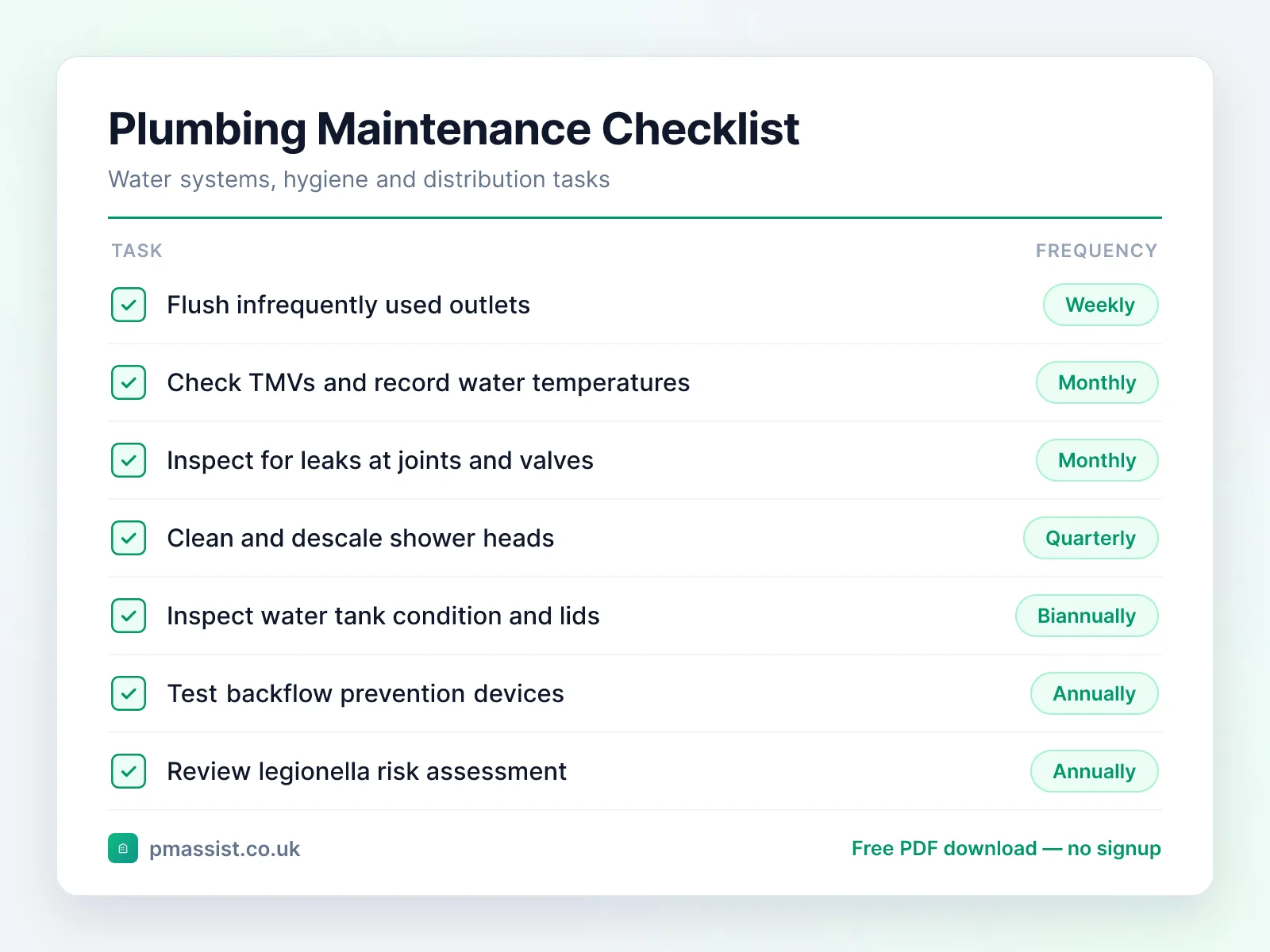
Water system maintenance combines mechanical checks (pumps, valves, pressurisation) with water hygiene and legionella control under ACoP L8 — temperature monitoring, tank inspections, TMV servicing, and flushing. Choose the checklist for your specific asset below.
Water Systems
Degasser (Deaerator) Maintenance Checklist
9 tasks · Free PDF
Chemical Dosing Pot Maintenance Checklist
8 tasks · Free PDF
Water Softener Maintenance Checklist
10 tasks · Free PDF
Water Treatment Unit Maintenance Checklist
10 tasks · Free PDF
Strainer (Y-type / Basket) Maintenance Checklist
8 tasks · Free PDF
Pressure Reducing Valve (PRV) Maintenance Checklist
9 tasks · Free PDF
Non-Return Valve (Check Valve) Maintenance Checklist
8 tasks · Free PDF
Riser Isolation Valve Maintenance Checklist
9 tasks · Free PDF
Cold Water Storage Tank Maintenance Checklist
10 tasks · Free PDF
Thermostatic Mixing Valve (TMV) Maintenance Checklist
10 tasks · Free PDF
Backflow Prevention Device (RPZ Valve) Maintenance Checklist
10 tasks · Free PDF
Unvented Hot Water Cylinder Maintenance Checklist
10 tasks · Free PDF
Point-of-Use Water Heater Maintenance Checklist
10 tasks · Free PDF
Grease Trap / Grease Management System Maintenance Checklist
10 tasks · Free PDF
Instantaneous Water Heater Maintenance Checklist
10 tasks · Free PDF
Emergency Shower & Eyewash Station Maintenance Checklist
8 tasks · Free PDF
Petrol & Oil Interceptor Maintenance Checklist
7 tasks · Free PDF
Pumps & Pressurisation
Pump Maintenance Checklist
12 tasks · Free PDF
Pressurisation Unit Maintenance Checklist
15 tasks · Free PDF
Expansion Vessel Maintenance Checklist
9 tasks · Free PDF
Pressurisation Set (Packaged) Maintenance Checklist
10 tasks · Free PDF
Booster Pump Set Maintenance Checklist
11 tasks · Free PDF
Sump Pump Maintenance Checklist
11 tasks · Free PDF
Sewage Pump Maintenance Checklist
11 tasks · Free PDF
Circulating Pump Maintenance Checklist
10 tasks · Free PDF
Jockey Pump Maintenance Checklist
10 tasks · Free PDF
Submersible Pump Maintenance Checklist
10 tasks · Free PDF
Other maintenance checklist categories
The L8 rhythm: what gets checked and when
UK water hygiene practice under ACoP L8 and HSG274 Part 2 settles into a predictable rhythm: monthly temperature monitoring at sentinel outlets (hot above 50°C, cold below 20°C), weekly flushing of little-used outlets, quarterly cleaning and descaling of shower heads, six-monthly checks of cold water storage temperatures, and an annual internal inspection of tanks and calorifiers. TMVs get an annual service and fail-safe test; RPZ backflow prevention valves are tested annually by an approved tester.
The schedule itself should come from your legionella risk assessment — buildings with healthcare uses, dead legs, or complex storage need more; a small simple system may justify less. What never changes is the record-keeping: temperature logs and inspection records are the compliance evidence, and gaps in the log read as gaps in control.
Mechanical reliability underpins hygiene
The mechanical side of the checklist — pump seals and bearings, duty/standby changeover, booster set pressures, expansion vessel pre-charge — is what keeps the hygiene regime workable. A failed duty pump that leaves a standby running unnoticed, or a booster set cycling on a waterlogged vessel, shortens equipment life and can destabilise the temperatures the L8 regime depends on. Exercising valves and rotating duty/standby pairs regularly prevents the classic failure mode of standby plant that has seized by the time it's needed.
Where tanks, softeners, or water heaters are due for replacement, the maintenance history is the business case: logged failures, water quality results, and inspection photos make the capital conversation straightforward.
Compliance & CAFM
Schedule plumbing & water systems maintenance automatically
Every checklist here is also a planned maintenance programme in PM Assist. Add the asset to a building and its tasks go into the planner at the right frequency.
- Statutory tests are tracked on the compliance register with the date last done, the date next due and the certificate.
- Inspection forms run on your phone, and failed items become remedial actions.
- Included in every paid plan.
Frequently asked questions
What does a water system maintenance checklist cover?
How does legionella control fit into plumbing maintenance?
Are these water maintenance checklists free?
Find the detail behind every checklist
PM Assist makes your O&M manuals, settings, and records instantly searchable — so engineers get the specifications and procedures behind each task in seconds.