Facilities Management for Schools & Universities
Education estates run on scarce windows and stretched teams: maintenance squeezed into holidays, buildings from every era since the Victorians, and a compliance load — asbestos, legionella, fire — that doesn't shrink because the site team is small. This guide covers the sector's FM challenges, the standards that apply, and how to get the document side under control.
£11.4 billion
Repairing every defective element of England's school estate would cost £11.4 billion.
234
234 schools and colleges in England have confirmed RAAC in their buildings.
More sourced figures in our UK facilities management statistics hub.
The FM challenge across education estates
Schools and universities maintain some of the most varied building stock in the country — Victorian blocks, 1960s system-built classrooms, PFI-era additions, and modern labs, often on the same site. The condition consequences are now well documented: the Department for Education's own survey put the repair bill for England's schools at £11.4 billion, and the RAAC crisis showed how quickly a latent building issue can close classrooms.
Unlike commercial buildings, the maintenance calendar is brutal: major work compresses into holiday windows, and term-time failures — heating in January, kitchen extract at lunchtime — have immediate operational impact. Site teams are small, budgets are tight, and responsibility structures (local authority, academy trust, university estates department) add their own complexity when buildings and their records change hands.
- Maintenance compressed into school-holiday windows
- Mixed-age stock with legacy issues: RAAC, asbestos, ageing heating plant
- Small site teams carrying statutory duties usually spread across whole departments
- Academisation and mergers move buildings — and their documents — between organisations
The document burden in education
Every school and university carries a statutory paper trail: asbestos registers and management plans, legionella risk assessments and flushing records, fire risk assessments, electrical and gas certificates, plus the O&M manuals from every project since the building opened. DfE's Good Estate Management for Schools guidance expects responsible bodies to know their buildings — which is hard when the knowledge lives in filing cabinets and departed caretakers' memories.
When a school converts to an academy or joins a trust, that documentation transfers too — or fails to. Estates teams routinely inherit buildings with incomplete records and spend years reconstructing what should have been handed over.
How PM Assist helps school and university estates teams
PM Assist turns the documents you have into answers you can use. Upload O&M manuals, certificates, surveys, and drawings for each site, then ask in plain English — "when is the boiler service due at the junior site?", "where is the gas isolation for the science block?", "what did the last legionella risk assessment flag?". Answers come with source citations, so they work for governors' reports and compliance audits alike.
For multi-site trusts and university campuses, that means one searchable knowledge base instead of a different filing system per building — and a soft landing whenever buildings or staff change hands.
Key standards and regulations
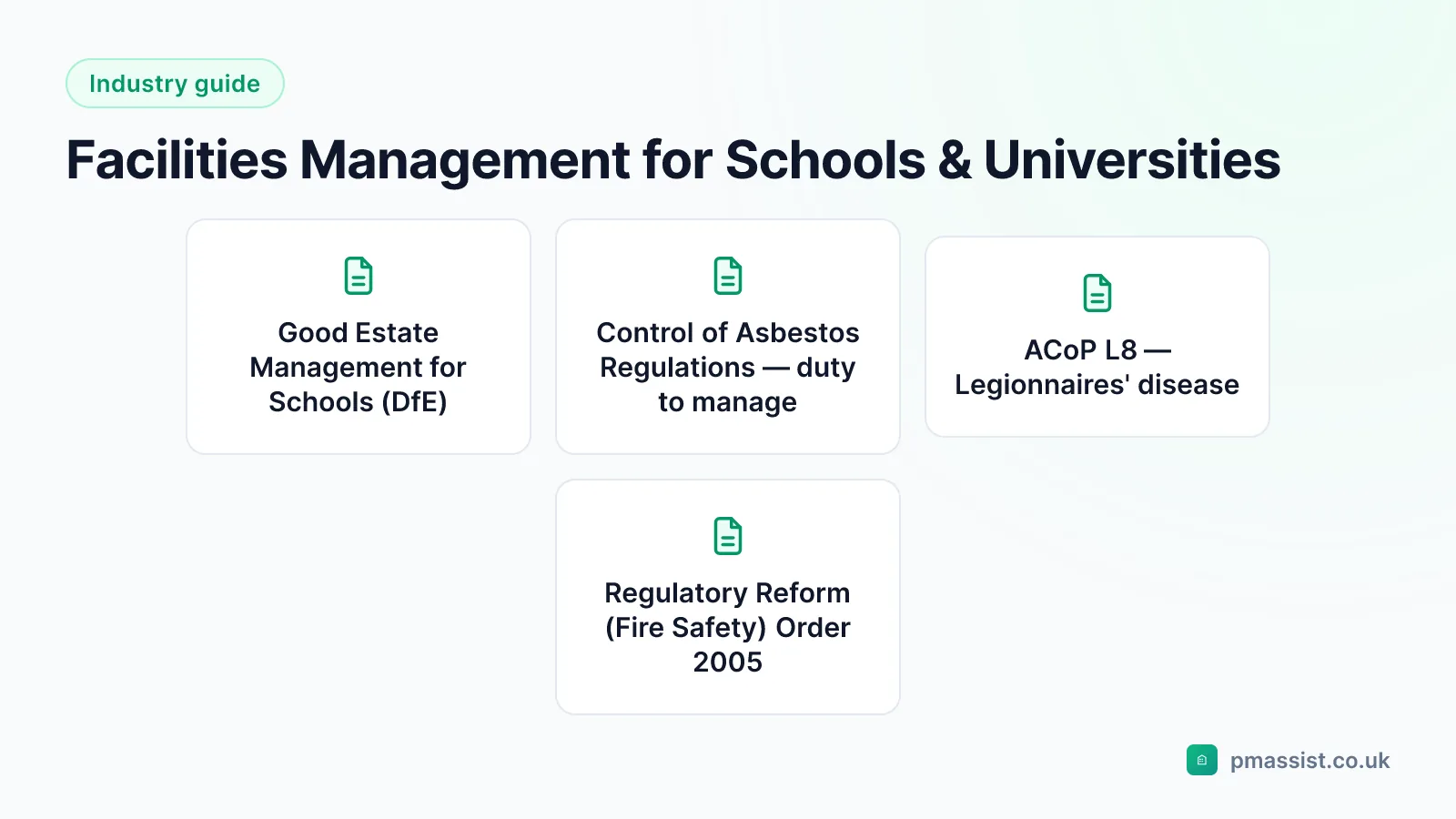
Good Estate Management for Schools (DfE)
The Department for Education's guidance for schools, trusts, and local authorities on managing school land, buildings, and compliance.
Official guidanceControl of Asbestos Regulations — duty to manage
Most schools built before 2000 contain asbestos; the duty to manage requires an up-to-date register, management plan, and information for anyone who might disturb it.
Official guidanceACoP L8 — Legionnaires' disease
Legionella control applies fully to education — and holiday shutdowns create exactly the stagnation risk that flushing regimes and monitoring exist to manage.
Official guidanceRegulatory Reform (Fire Safety) Order 2005
The fire safety framework for education premises: risk assessments, precautions, and maintained escape routes, alarms, and emergency lighting.
Official guidanceFree maintenance checklists for this sector
Compliance topics for this sector
Guides for schools & universities teams
Inspection checklists for this sector
Compliance & CAFM
Compliance software for schools & universities
PM Assist sets up the compliance register for each building from its property type, so the duties that apply to your estate are listed from day one.
- Each duty sits on the compliance register, showing when it was last done, when it is next due and the certificate behind it.
- Duties with no record held are listed as gaps, so nothing is missed just because nobody logged it.
- AI reads your certificates and proposes the dates and remedial actions; a person checks them against the source document before they count.
Frequently asked questions
What compliance duties do school estates teams have?
How much would it cost to repair England's school buildings?
Why does legionella matter especially in schools?
How does AI document search help a small site team?
One searchable knowledge base for every site
Upload each building's O&M manuals, certificates, and surveys, and let your team ask questions in plain English — free to start, no credit card required.
- Upload and organise building documentation
- AI-powered search across all your manuals
- Source-cited answers for every query
- Team collaboration and access control
- No credit card required to start