Facilities Management for Commercial Property
Commercial property FM lives at the junction of landlord, tenant, and managing agent — where every mobilisation inherits someone else's filing system and every compliance question lands on the service charge. This guide covers the sector's operating challenges, the regulations that bite hardest, and how to stop the O&M handover pack being the weakest link.
13,134
Fire services attended 13,134 fires in non-dwelling buildings in England in a single year.
Golden thread
Fragmented building information is why the law now demands a “golden thread”.
Independent Review of Building Regulations and Fire Safety · More context
More sourced figures in our UK facilities management statistics hub.
The FM challenge in commercial and managed property
Managed commercial buildings — offices, mixed-use, retail, industrial — change hands constantly: tenants fit out and vacate, managing agents win and lose instructions, and contractors rotate through procurement cycles. Each transition is a documentation event. The incoming team inherits O&M manuals, statutory certificates, and drawings in whatever state the outgoing team left them, and mobilisation quality often determines the next five years of operational pain.
Meanwhile the compliance bar keeps rising. Fire safety duties tightened after Grenfell, minimum energy standards now block lettings of the worst-performing stock, and the Building Safety Act's golden thread has made accessible, accurate building information a legal expectation rather than good practice.
- Multi-tenant sites with split landlord/tenant demise and shared plant
- Frequent mobilisations between managing agents and FM providers
- Service-charge scrutiny — every maintenance decision must be justifiable
- Rising information duties: fire safety, MEES, golden thread
The document burden in commercial property
A single managed building carries fire risk assessments and fire-safety maintenance records, electrical and gas certificates, water hygiene monitoring, lift examination reports, F-Gas records, TM44 air conditioning inspection reports, EPCs — plus the O&M manuals and record drawings for the base build and every tenant fit-out since. Multiply by a portfolio and the volume defeats folder structures.
The cost shows up at the worst moments: during due diligence on a sale, during an insurance claim, during a fire officer's visit, or in the first months of a mobilisation when the new team simply doesn't know what it has.
How PM Assist helps property and FM teams
PM Assist gives building managers and engineers a single, searchable home for every building's documentation. Ask in plain English — "what's the refrigerant in the roof plant?", "when does the five-yearly EICR fall due?", "which fire dampers serve level 3?" — and get answers cited to the exact document and page, whether it arrived in last month's handover or a 2009 fit-out pack.
For portfolio teams, that turns mobilisation from an archaeology project into an upload job, keeps service-charge decisions evidenced, and puts the golden thread principle — findable, reliable building information — into practice on ordinary commercial stock.
Key standards and regulations
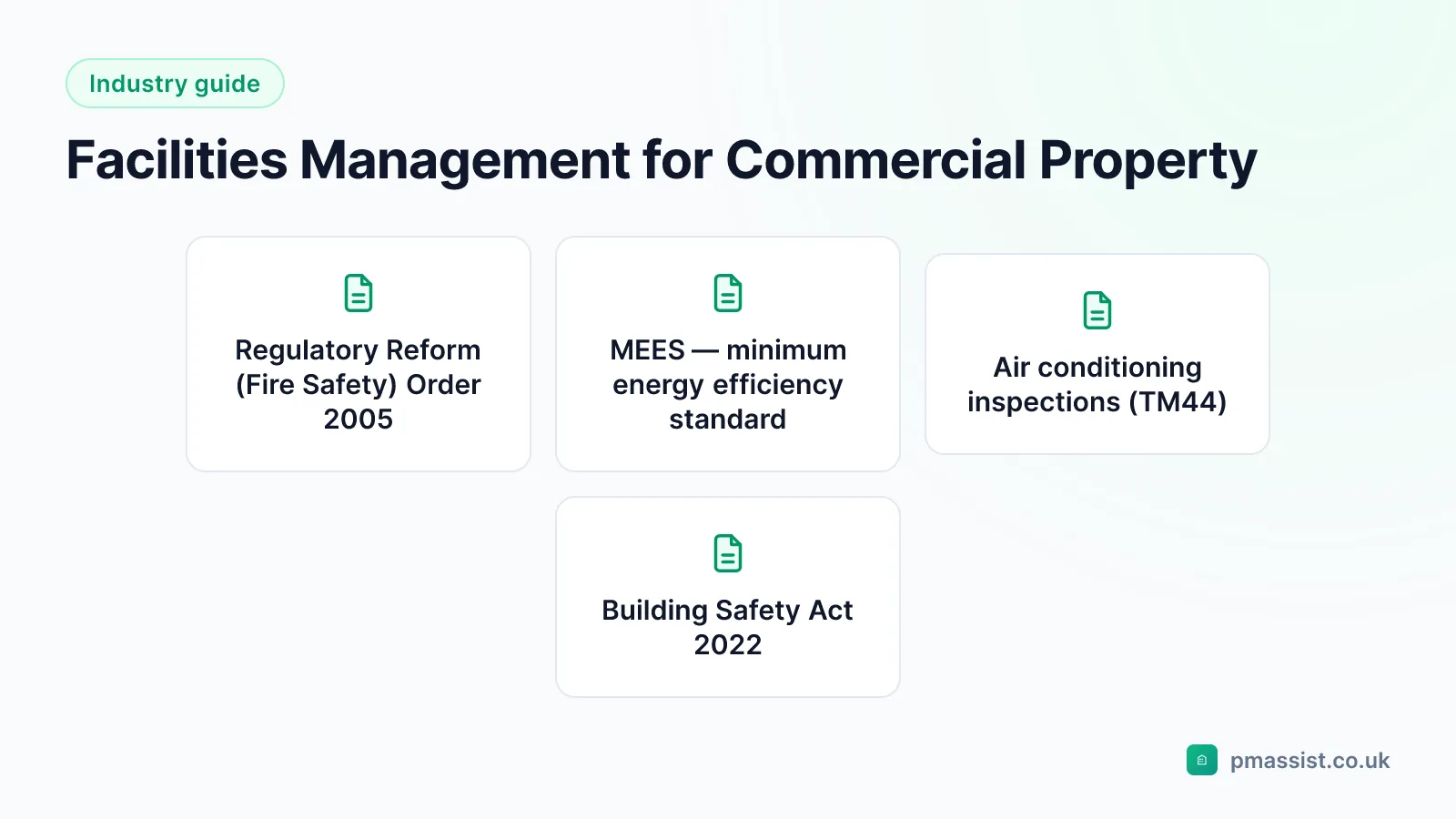
Regulatory Reform (Fire Safety) Order 2005
The fire safety framework for all non-domestic premises: risk assessment, precautions, and maintained fire systems, with duties on the responsible person.
Official guidanceMEES — minimum energy efficiency standard
Since 1 April 2023, landlords must not continue to let non-domestic property rated below EPC E unless a valid exemption is registered.
Official guidanceAir conditioning inspections (TM44)
Systems over 12kW effective rated output must be inspected by an accredited energy assessor at least every five years.
Official guidanceBuilding Safety Act 2022
Establishes the golden thread of building information — a statutory duty for higher-risk buildings and the direction of travel for everything else.
Official guidanceFree maintenance checklists for this sector
Compliance topics for this sector
Guides for commercial & managed property teams
Inspection checklists for this sector
Compliance & CAFM
Compliance software for commercial & managed property
PM Assist sets up the compliance register for each building from its property type, so the duties that apply to your estate are listed from day one.
- Each duty sits on the compliance register, showing when it was last done, when it is next due and the certificate behind it.
- Duties with no record held are listed as gaps, so nothing is missed just because nobody logged it.
- AI reads your certificates and proposes the dates and remedial actions; a person checks them against the source document before they count.
Frequently asked questions
What compliance documents should a commercial building hold?
What is MEES and how does it affect landlords?
Does the golden thread apply to ordinary commercial buildings?
How does AI search help during a mobilisation?
Make every handover pack searchable
Upload O&M manuals, certificates, and drawings for every building you manage, and give your team source-cited answers in seconds — free to start.
- Upload and organise building documentation
- AI-powered search across all your manuals
- Source-cited answers for every query
- Team collaboration and access control
- No credit card required to start