Facilities Management for Healthcare & NHS Estates
Healthcare estates are the hardest buildings in the UK to run. Plant serves clinical spaces around the clock, every system carries its own Health Technical Memorandum, and the evidence trail matters as much as the work itself. Here's what healthcare FM teams are up against — and how to keep the documentation side under control.
£15.9 billion
Clearing the NHS estate's backlog maintenance would cost £15.9 billion.
5,400
Property and infrastructure failures cause around 5,400 NHS clinical service incidents every year.
More sourced figures in our UK facilities management statistics hub.
The FM challenge in healthcare estates
No other sector combines criticality, complexity, and age quite like healthcare. Theatres, wards, and diagnostic suites depend on specialised ventilation, medical gas, water, and electrical systems that cannot simply be switched off for maintenance — planned work has to be negotiated around clinical activity, and a failure is a patient-safety event, not an inconvenience.
The estate itself makes that harder. Many trusts operate a patchwork of buildings spanning a century of construction, each refurbishment adding another layer of plant and another set of documentation. Estates teams carry the institutional knowledge that holds this together, and every retirement or agency handover puts some of it at risk.
- 24/7 clinical operation — maintenance windows are scarce and hard-won
- Specialised plant: theatre ventilation, medical gas, isolation rooms, standby generation
- Ageing, mixed-era buildings with decades of accumulated documentation
- High regulatory and audit exposure: water safety groups, fire authorities, CQC visits
The document burden healthcare carries
HTM compliance is evidence-based: it is not enough to maintain a ventilation system to HTM 03-01 or a water system to HTM 04-01 — you must be able to produce the validation reports, flushing records, risk assessments, and service sheets that prove it. A single acute site can hold thousands of such documents across O&M manuals, commissioning packs, and contractor reports.
When a water safety group meeting, fire officer visit, or incident investigation asks a question, the answer usually exists — in a scanned PDF somewhere in a shared drive. The time estates teams spend hunting for it is time not spent on the backlog.
How PM Assist helps healthcare estates teams
PM Assist makes the documentation you already hold searchable in plain English. Upload O&M manuals, commissioning data, drawings, and certificates, and ask questions the way you'd ask a colleague — "what is the design air-change rate for theatre 3?", "when was the calorifier last inspected?", "where are the isolation valves for ward 7?". Every answer cites its source document, so it stands up in an audit.
That means faster fault-finding on critical plant, compliance evidence produced in seconds rather than afternoons, and a defence against knowledge loss when experienced engineers move on.
Key standards and regulations
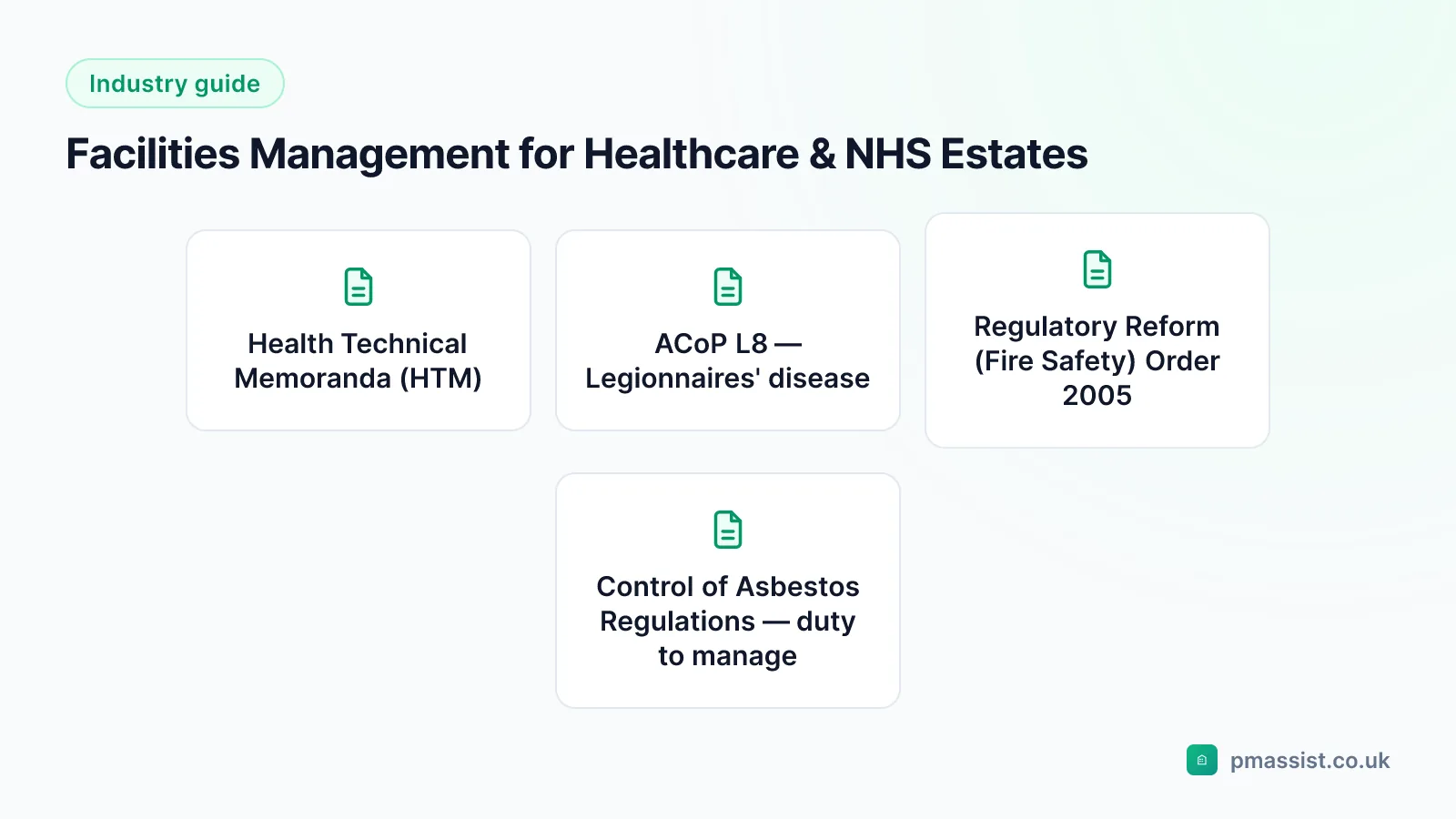
Health Technical Memoranda (HTM)
NHS England's suite of standards for healthcare building engineering — ventilation, water, electrical, medical gas, and fire safety in healthcare premises.
Official guidanceACoP L8 — Legionnaires' disease
HSE's Approved Code of Practice for controlling legionella in water systems — the foundation of every hospital water safety plan.
Official guidanceRegulatory Reform (Fire Safety) Order 2005
The fire safety law for non-domestic premises in England and Wales, applied to healthcare alongside HTM 05 Firecode guidance.
Official guidanceControl of Asbestos Regulations — duty to manage
The statutory duty to identify, record, and manage asbestos-containing materials — a live issue across older hospital estates.
Official guidanceFree maintenance checklists for this sector
Compliance topics for this sector
Guides for healthcare & nhs estates teams
Inspection checklists for this sector
Compliance & CAFM
Compliance software for healthcare & NHS estates
PM Assist sets up the compliance register for each building from its property type, so the duties that apply to your estate are listed from day one.
- Each duty sits on the compliance register, showing when it was last done, when it is next due and the certificate behind it.
- Duties with no record held are listed as gaps, so nothing is missed just because nobody logged it.
- AI reads your certificates and proposes the dates and remedial actions; a person checks them against the source document before they count.
Frequently asked questions
What standards govern facilities management in NHS estates?
How big is the NHS maintenance backlog?
Why is documentation such a problem for healthcare estates?
How does AI document search help with HTM compliance?
Give your estates team instant answers
Upload your O&M manuals, commissioning packs, and certificates, and get source-cited answers to any question about your buildings — free to start.
- Upload and organise building documentation
- AI-powered search across all your manuals
- Source-cited answers for every query
- Team collaboration and access control
- No credit card required to start