Digital Transformation in Facilities Management
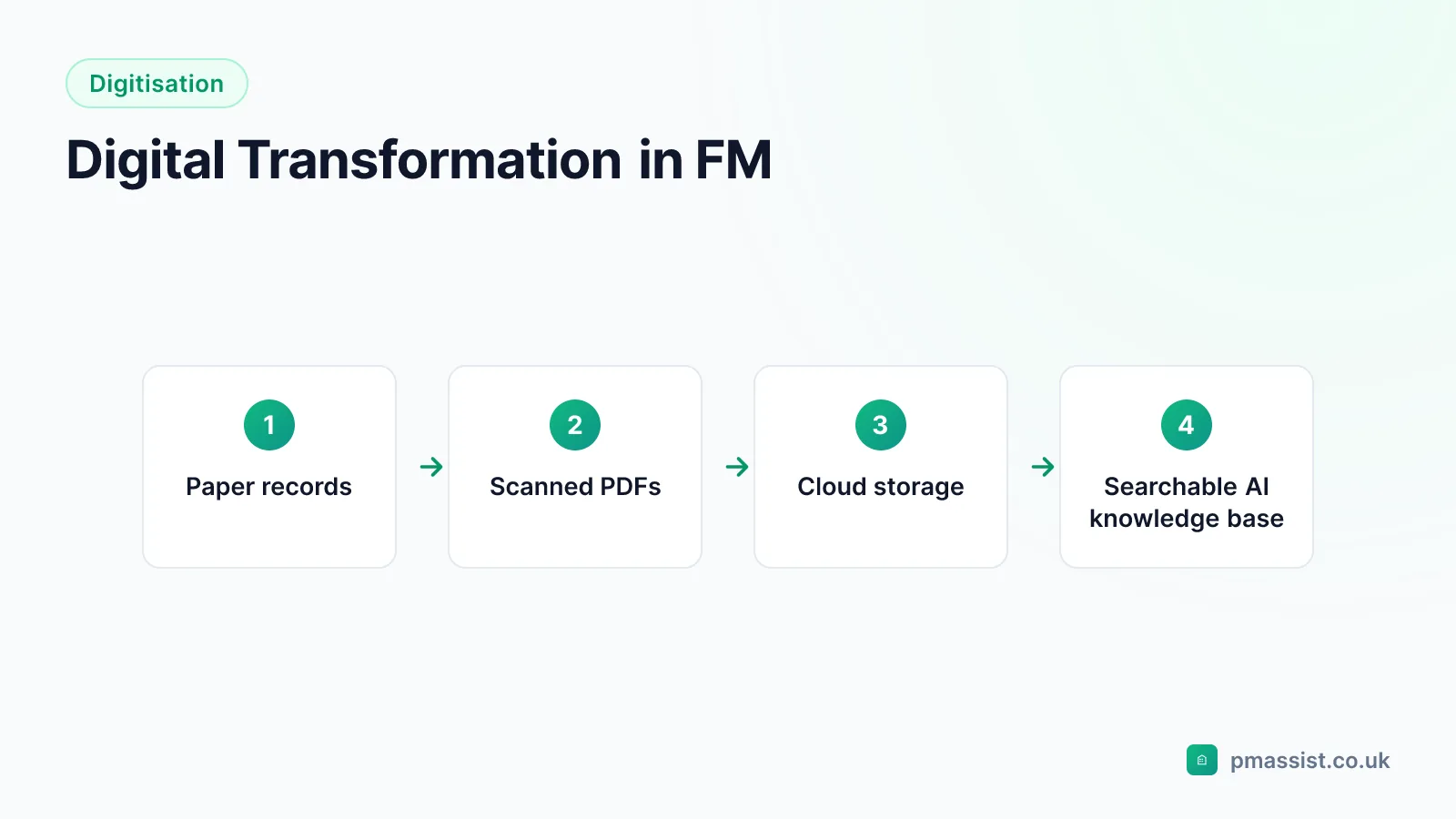
Facilities management is undergoing a digital transformation that is fundamentally changing how buildings are operated and maintained. From paper-based O&M packs and manual inspection processes to AI-powered search, IoT-connected sensors, and predictive analytics, the tools available to FM teams are evolving rapidly.
This transformation is not happening uniformly across the industry. While some organisations are already using advanced AI and IoT solutions, many FM teams are still working with paper-based processes and basic digital tools. Understanding the digital transformation journey — and identifying practical starting points — is essential for FM teams looking to modernise their operations.
The Evolution of FM Technology
Phase 1: Paper-Based Operations
For decades, facilities management ran on paper. O&M manuals arrived as printed binders, maintenance was tracked on log sheets, and building information lived in filing cabinets. Work orders were written on paper, signed off by hand, and filed physically. This approach worked, but it was slow, error-prone, and entirely dependent on physical access to the right documents.
Some FM teams still operate primarily with paper-based systems, particularly for older buildings that were handed over before digital documentation became standard. The challenge with paper-based operations is not just efficiency — it is the risk of information loss. Paper documents deteriorate, get misplaced, and are difficult to share across teams.
Phase 2: Basic Digitisation
The first wave of digital transformation in FM involved scanning paper documents to create PDF copies, adopting email for communication, and using spreadsheets for maintenance tracking and asset registers. This phase made information more portable and shareable, but did not fundamentally change how FM teams worked.
PDF documents are an improvement over paper in terms of storage and distribution, but they retain many of the same accessibility problems. Finding specific information still requires opening individual files and using basic keyword search, which has significant limitations for technical documentation.
Phase 3: CAFM and Integrated Systems
Computer-Aided Facility Management (CAFM) systems represented a significant step forward, providing integrated platforms for work order management, asset tracking, space management, and maintenance scheduling. These systems brought structure and accountability to FM operations that paper-based processes could not provide.
CAFM systems are now widely adopted across the industry, though the level of utilisation varies significantly. Some organisations use their CAFM as a comprehensive operational platform, while others use only basic features like work order management.
Phase 4: IoT and Connected Buildings
The Internet of Things (IoT) introduced the concept of connected buildings, where sensors monitor equipment performance, environmental conditions, and energy consumption in real time. Building Management Systems (BMS) became more sophisticated, integrating data from across building systems to provide centralised monitoring and control.
IoT technology enables condition-based monitoring and predictive maintenance — significant advances over time-based preventative maintenance schedules. However, the implementation complexity and cost of IoT solutions means adoption is concentrated in newer or higher-value buildings.
Phase 5: AI and Intelligent Buildings
The current frontier of digital transformation in FM is artificial intelligence. AI is being applied across multiple dimensions of facilities management: document search, predictive maintenance, energy optimisation, space utilisation analysis, and automated reporting. Unlike previous technology waves, AI has the potential to improve operations for FM teams of all sizes, not just those managing large, modern building portfolios.
Practical Digital Transformation for FM Teams
One of the challenges with digital transformation is that it can feel overwhelming. The gap between where many FM teams are today and the vision of a fully intelligent building is enormous. The key is to focus on practical, incremental improvements that deliver measurable value.
Start with Document Accessibility
Every FM team has building documentation — O&M manuals, drawings, maintenance schedules, and procedures. Making this documentation searchable and accessible is one of the highest-impact, lowest-barrier starting points for digital transformation.
AI-powered document search tools like PM Assist can transform how your team accesses building information. Upload your existing PDF documentation, and your team can immediately start finding answers to questions in seconds rather than minutes. No integration work, no infrastructure changes, and no training required.
Optimise Existing Systems
Before investing in new technology, ensure you are getting full value from existing systems. Many FM teams use only a fraction of their CAFM system's capabilities. Investing time in configuration, training, and process optimisation for existing tools often delivers better returns than purchasing new ones.
Build a Data Foundation
AI and advanced analytics are only as good as the data they work with. Focus on improving data quality and consistency in your existing systems. Ensure asset registers are up to date, maintenance history is recorded consistently, and building documentation is organised and accessible.
Prioritise Based on Pain Points
Rather than pursuing technology for its own sake, identify the specific operational pain points that technology could address. If your team spends significant time searching for information in O&M manuals, AI document search will have an immediate impact. If energy costs are a major concern, energy monitoring and optimisation tools may be the priority.
The Building Safety Act and Digital Documentation
In the UK, the Building Safety Act has significant implications for how building information is managed. The concept of the golden thread of information — a digital record of building design, construction, and maintenance information that must be maintained throughout the building's lifecycle — is driving a regulatory requirement for better documentation management.
For higher-risk buildings, maintaining accurate and accessible building information is now a legal requirement. This regulatory pressure is accelerating digital transformation in FM, as organisations need to demonstrate that building information is maintained, accessible, and up to date.
AI-powered document search supports compliance with these requirements by making building documentation genuinely accessible and searchable, with audit trails showing how information is accessed and used.
Overcoming Barriers to Digital Transformation
Common barriers to digital transformation in FM include budget constraints, resistance to change, skills gaps, and the perceived complexity of technology implementation. Addressing these barriers requires a practical approach:
Start small and demonstrate value: Begin with low-cost, high-impact tools that deliver measurable benefits quickly. Document search AI is an ideal starting point — it is affordable, requires no integration, and delivers immediate time savings.
Focus on user experience: Choose tools that are intuitive and require minimal training. The best technology is the technology your team actually uses. Natural language search, for example, requires no training because it works the way people naturally communicate.
Build incrementally: Digital transformation is a journey, not a destination. Each improvement builds a foundation for the next. Start with document accessibility, then build toward more advanced capabilities as your team's digital maturity grows.
Looking Ahead
The pace of AI development suggests that the tools available to FM teams will continue to improve rapidly. Future possibilities include AI that can proactively identify maintenance requirements from documentation, automated compliance checking against regulatory requirements, and integration between document knowledge bases and building management systems.
For FM teams starting their digital transformation journey today, the most important step is the first one. Try PM Assist free and experience how AI document search can improve your team's access to building information.
Get the FM AI digest
One short email a month with the most useful new guides, tools and changes from PM Assist. Unsubscribe anytime.
We use your email only to send the digest. No spam, unsubscribe anytime. See our privacy policy.
Compliance & CAFM
Put this into practice with PM Assist
PM Assist's building compliance software tracks every statutory duty across your buildings, plans the maintenance behind them and keeps the evidence searchable.
- A compliance register for each building, with the date each duty was last done and when it is next due.
- Planned maintenance and inspection forms generated from your asset register.
- AI reads your certificates and proposes the dates and remedial actions; a person checks them against the source document before they count.
Related articles
Start your digital transformation
AI document search is the easiest first step. Try free today.
Start free