How to Prepare for a Building Compliance Audit
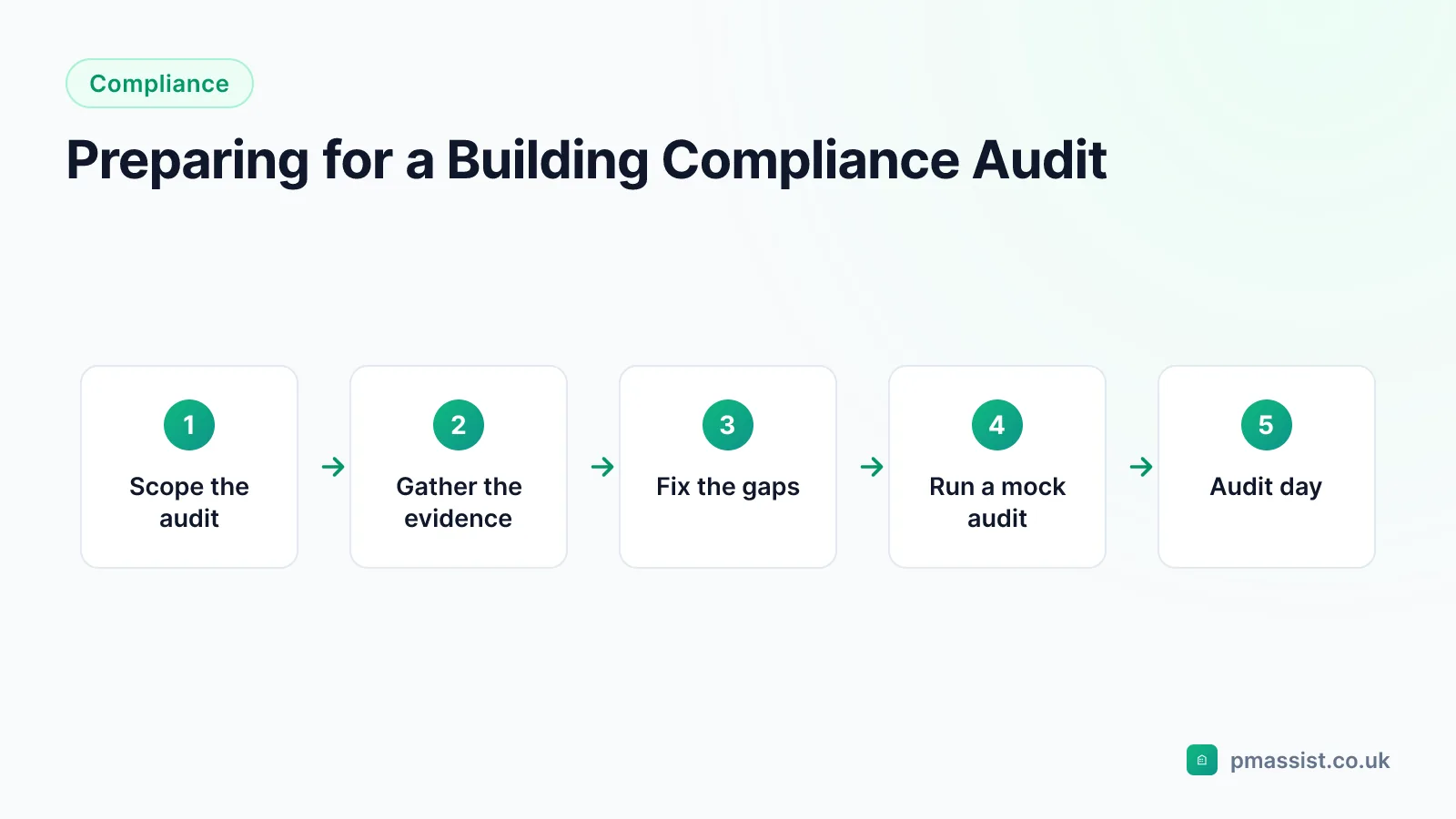
A compliance audit is not really a test of whether your building is safe — it is a test of whether you can prove it is. Plenty of well-maintained buildings score poorly because the evidence is disorganised, while the inverse rarely happens: nobody passes an audit on the strength of work they cannot document. Preparation, then, is mostly about getting your evidence in order.
Whether the audit is from an insurer, an enforcing authority, a client, or an internal assurance team, the same principles apply. Here is how to prepare.
Understand what the audit covers
Start by confirming the scope. A fire safety audit, an insurer's survey, and an ISO assurance audit ask different questions. Get the scope and any pre-audit checklist in advance, and map it to your building's statutory compliance obligations. Knowing exactly what will be examined lets you focus your preparation rather than panic-checking everything.
Build an evidence index
For each obligation in scope, you need to be able to answer two questions instantly: was the work done? and where is the proof? Build a simple index that maps each compliance area to its current evidence — the fire risk assessment, the latest EICR, the legionella monitoring records, the lift examination reports, and so on. This index is what turns an audit from a document hunt into a guided tour.
The biggest time sink here is locating documents that exist but are buried. If your evidence is scattered across shared drives, contractor portals, and email, assembling the index is where most preparation time goes — and where it most often falls down.
Check for the common findings
Auditors see the same gaps again and again. Pre-empt them:
- Unaddressed actions. A fire risk assessment or EICR with open actions is a classic finding. Confirm remedial work was completed and that you can show it.
- Gaps in routine records. A missing month of fire alarm tests or legionella temperatures stands out immediately. Review the logs for continuity.
- Expired certificates. Check renewal dates on EICRs, gas safety certificates, lift examinations, and F-Gas checks before the auditor does.
- Out-of-date assessments. Confirm risk assessments reflect the building's current use and layout.
- Inaccessible documents. If you cannot find it, the auditor will record it as not provided — regardless of whether it exists.
Verify the physical reality matches the paperwork
Auditors will often spot-check the building against the records — confirming a fire door is not propped open, an extinguisher is in its designated place, or a damper schedule matches what is installed. Walk the building with your records in hand and reconcile the two. Discrepancies between documentation and reality are among the most damaging findings because they undermine confidence in everything else.
Make your evidence searchable, not just stored
The single biggest improvement you can make to audit readiness is moving from stored evidence to searchable evidence. When every certificate, assessment, and log is in one place and can be retrieved with a plain-English question, audit preparation collapses from days to hours, and the audit itself becomes a calm demonstration rather than a scramble.
This is where a tool like PM Assist earns its place. By indexing your compliance documentation and making it instantly searchable, it lets you answer any auditor question on the spot — and, just as valuably, lets you find the gaps yourself before the auditor does. Pair it with disciplined planned preventive maintenance and the routine records take care of themselves.
On the day
Have a single point of contact who knows the building and can retrieve evidence quickly. Be open about any known gaps and what you are doing to close them — auditors respond far better to a managed plan than to a defensive cover-up. And keep notes of every finding so the post-audit action plan writes itself.
Conclusion
Compliance audits reward organisation as much as good maintenance. The buildings that sail through are not necessarily better maintained — they are better evidenced. Invest in making your compliance documentation centralised and searchable, keep your routine records continuous, and reconcile the paperwork with the building, and you will turn audits from a recurring source of stress into a straightforward demonstration of control.
Try PM Assist free and walk into your next audit with every document one question away.
Get the FM AI digest
One short email a month with the most useful new guides, tools and changes from PM Assist. Unsubscribe anytime.
We use your email only to send the digest. No spam, unsubscribe anytime. See our privacy policy.
Compliance & CAFM
Put this into practice with PM Assist
PM Assist's building compliance software tracks every statutory duty across your buildings, plans the maintenance behind them and keeps the evidence searchable.
- A compliance register for each building, with the date each duty was last done and when it is next due.
- Planned maintenance and inspection forms generated from your asset register.
- AI reads your certificates and proposes the dates and remedial actions; a person checks them against the source document before they count.