10 Building Compliance Documents Every FM Needs
Ask any facilities manager what keeps them up at night and compliance will be near the top of the list. The legal duties are demanding enough; the harder problem is often simply proving they have been met. When an auditor, insurer, or enforcing authority asks "show me the records", the evidence needs to be produced quickly and confidently — not after an afternoon of digging through folders, contractor portals, and email attachments.
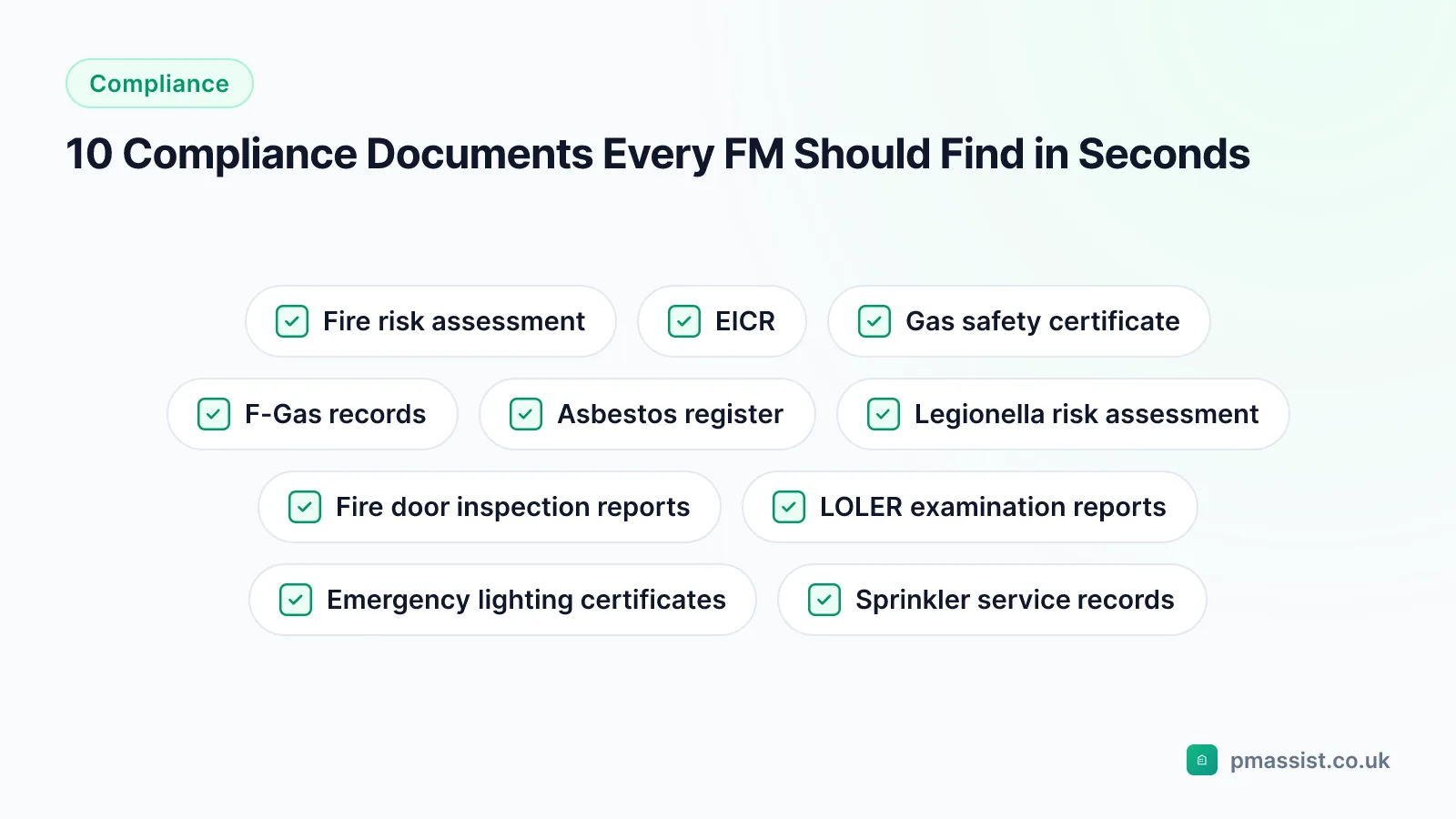
Here are the ten compliance documents every FM should be able to locate in seconds, why each matters, and what good looks like.
1. Fire risk assessment (FRA)
The fire risk assessment is the cornerstone of fire safety compliance under the Regulatory Reform (Fire Safety) Order 2005. It identifies hazards, the people at risk, and the precautions required. Crucially, it carries an action plan — and the most common finding in fire audits is an FRA with unaddressed actions. You should be able to pull up the current FRA and confirm the status of its actions immediately.
2. Fire alarm and emergency lighting test records
Weekly fire alarm tests and monthly emergency lighting checks, plus the annual emergency lighting duration test, generate a steady stream of records to BS 5839 and BS 5266. These logs are routine but essential — a gap of even one month is both a control failure and an evidence gap. Keep them retrievable by building and system.
3. Fire damper drop test certificates
Fire dampers must be drop-tested at least annually under BS 9999 to confirm they will close and maintain compartmentation. Because dampers are hidden in ductwork, their records — and the access details to reach them — are easy to lose. A damper schedule that ties each damper to its location and last test is invaluable.
4. Electrical Installation Condition Report (EICR)
The EICR is the formal assessment of a building's fixed wiring, typically renewed every five years. An unsatisfactory report (containing C1, C2, or FI items) demands remedial work — so you need both the report and evidence the actions were closed out. Being able to retrieve the latest EICR and its remedial history quickly is a frequent audit requirement.
5. Legionella risk assessment and monitoring records
Legionella control under ACoP L8 rests on a written scheme, monthly temperature logs, tank inspections, and TMV servicing. The volume of monitoring data is significant, and the risk assessment must be current. Quick access to the assessment and the monitoring evidence is the difference between a smooth audit and a scramble.
6. Gas safety records
Gas appliances and plant must be maintained and certified by Gas Safe registered engineers. The resulting certificates and service records form part of the building's safety evidence and accumulate fast across a portfolio. Make sure the current certificate for any building or appliance is a quick search away.
7. Lift LOLER thorough examination reports
Passenger lifts require a thorough examination under LOLER, typically every six months, separate from routine servicing. The examination reports — and any defects they raise — must be tracked. Across a portfolio with many lifts, losing sight of examination dates and remedial actions is a real risk.
8. Asbestos register and management plan
Under the Control of Asbestos Regulations 2012, the duty to manage requires an accurate register that must be consulted before any work that could disturb the fabric. This document cannot take half an hour to find — it needs to be checkable in seconds before a permit is issued or a drill goes into a wall.
9. Pressure system written scheme and examination
Pressure systems — calorifiers, expansion vessels, air receivers — fall under the Pressure Systems Safety Regulations, requiring a written scheme of examination and periodic inspection by a competent person. The written scheme and the latest examination reports should be readily accessible for each relevant asset.
10. F-Gas records
Air conditioning and refrigeration equipment containing fluorinated refrigerants require leak checks and record-keeping under the F-Gas Regulations, at frequencies based on the CO₂-equivalent charge. Operators must keep records of refrigerant type, quantity, checks, and any work — and produce them on request.
The common thread: access, not just existence
Notice what unites this list. In almost every case, the building probably has the document. The problem is rarely existence — it is access. Compliance evidence ends up scattered across shared drives, contractor portals, email inboxes, and filing cabinets, organised (if at all) in ways that made sense to whoever filed it, not to the person who needs it under pressure.
That access gap has real consequences. It turns a routine audit into a stressful hunt, delays contractors waiting for information, and — at worst — means a critical check (like the asbestos register) gets skipped because finding it took too long. The fix is to centralise this documentation and make it genuinely searchable, so that "show me the records" is answered with a question, not an excavation.
This is exactly the gap PM Assist is built to close. By indexing your compliance documentation and letting your team ask plain-English questions, it turns a scattered archive into a reliable, instantly searchable source of evidence. You can explore the statutory compliance essentials and our equipment maintenance checklists to see how the pieces fit together.
Conclusion
Compliance is judged on evidence, and evidence is only useful if you can find it. Audit your own access to these ten documents: if you cannot produce each one in under a minute, the issue is not your maintenance regime — it is how your documentation is stored and searched. Fixing that is one of the highest-leverage improvements an FM team can make.
Try PM Assist free and make your compliance documents searchable in seconds.
Get the FM AI digest
One short email a month with the most useful new guides, tools and changes from PM Assist. Unsubscribe anytime.
We use your email only to send the digest. No spam, unsubscribe anytime. See our privacy policy.
Compliance & CAFM
Put this into practice with PM Assist
PM Assist's building compliance software tracks every statutory duty across your buildings, plans the maintenance behind them and keeps the evidence searchable.
- A compliance register for each building, with the date each duty was last done and when it is next due.
- Planned maintenance and inspection forms generated from your asset register.
- AI reads your certificates and proposes the dates and remedial actions; a person checks them against the source document before they count.