Fire Door Inspection Checklist
A free fire door inspection checklist for the Fire Safety (England) Regulations 2022 — check gaps, seals, closers, hinges, and glazing against each door reference.
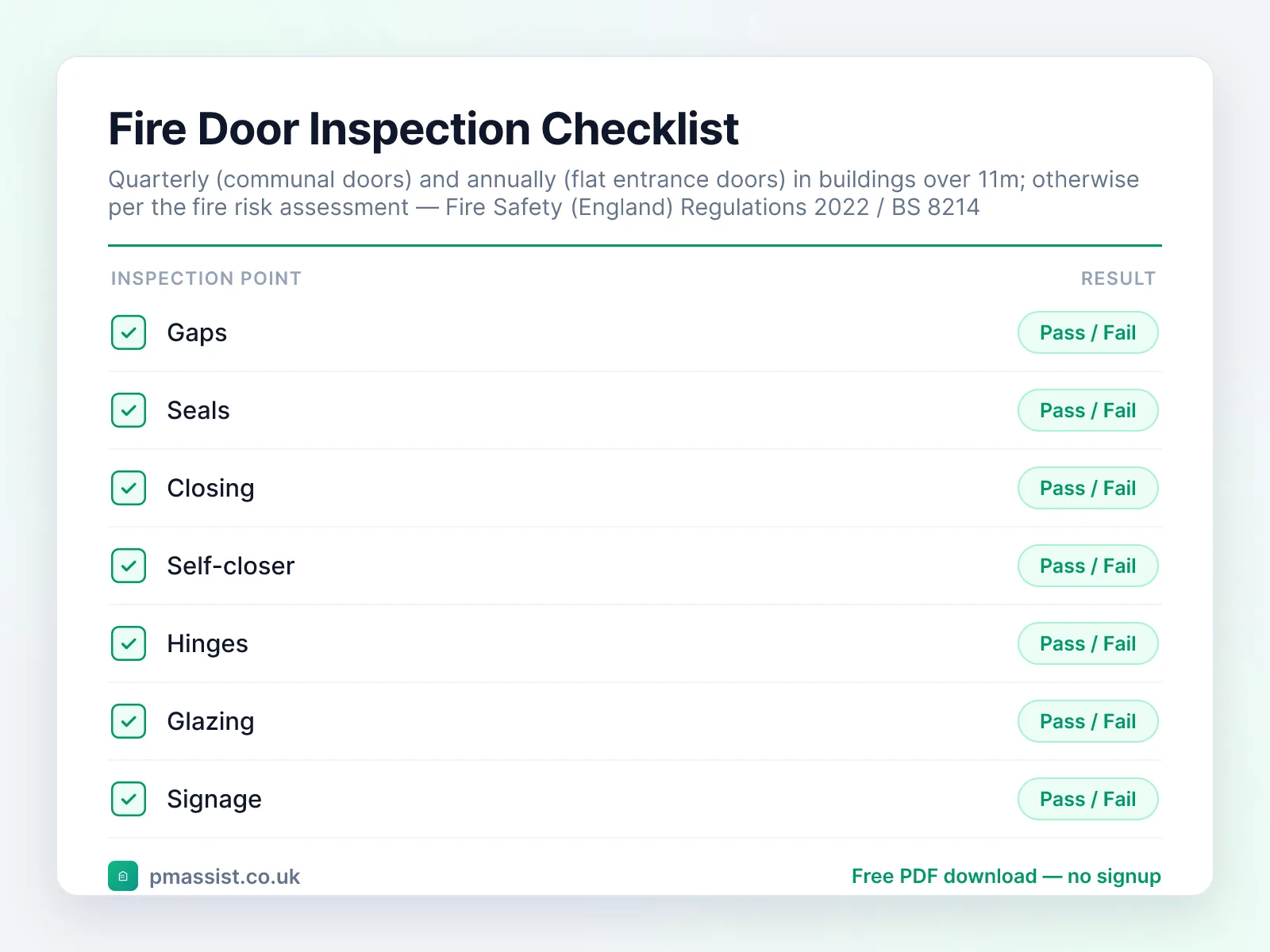
Quarterly (communal doors) and annually (flat entrance doors) in buildings over 11m; otherwise per the fire risk assessment
A competent person — the responsible person, FM team, or a specialist fire door inspector
Fire Safety (England) Regulations 2022 / BS 8214
A fire door inspection confirms that a fire door assembly will resist fire and smoke — checking the gaps, seals, closer, hinges, glazing, and signage as a working whole. Under the Fire Safety (England) Regulations 2022, responsible persons in buildings over 11m must check communal fire doors quarterly and flat entrance doors annually. This checklist covers the routine visual and functional inspection recorded against each door.
Fire Door Inspection Checklist: what to check
Gaps
Even gap around the leaf, within tolerance (typically ~3mm)
Seals
Intumescent and smoke seals intact, continuous, and undamaged
Closing
Door closes fully onto the latch from any open position
Self-closer
Operates correctly and is not disconnected or too weak to latch
Hinges
Secure with all fixings present (typically 3 hinges)
Glazing
Vision panels and beading intact and fire-rated
Signage
'Fire door keep shut/locked' signage present as required
Held open
Door not wedged or propped without an approved hold-open device
Leaf & frame
No damage, splitting, or unauthorised alterations
Record
Inspection logged against the individual door reference
Download printable checklist templates from the templates library, or build a custom one with the checklist generator.
What this inspection typically costs
£15–£65 per door for a standard survey; roughly £350–£800 at building level
- What moves the price
- Volume dominates the per-door rate — a 200-door survey costs far less per door than a 20-door one, with bulk rates falling towards £3–£12. Reporting depth is the other variable: a photographic, individually referenced report costs more than a schedule of findings.
- Typical time
- Around 10–20 minutes per door for a competent inspector
Indicative UK market ranges compiled from published price guides, last reviewed August 2026. A planning guide, not a quotation — prices vary by region, building, and contractor.
Managing the records behind this inspection
Common inspection failures
- Doors wedged or propped open, defeating compartmentation
- Gaps too large after settlement or rehanging
- Self-closers disconnected or too weak to latch the door
- Damaged, painted-over, or missing intumescent and smoke seals
- Unauthorised alterations — new locks, letterboxes, or non-rated glazing
- Missing or incorrect signage
Related inspection checklists
What to record, and how long to keep it
Record every door individually against a door reference and location, with the result for each element checked — gaps, seals, closer, hinges, glazing, signage — rather than a single pass or fail for the door. Photograph defects: a written note that a gap was excessive is far weaker evidence than an image with a measurement in it. Log remedial actions with a target date and a completion date, because the gap between those two is what an enforcing authority examines. Keep records for the life of the door set and through any change of responsible person, and make sure the door schedule reconciles to the fire strategy.
Compliance & CAFM
Run this fire door inspection on your phone
This checklist is a ready-made inspection form in PM Assist, included in every paid plan with the compliance register and planned maintenance.
- Complete it on your phone on site, with photos against each item.
- A failed item becomes a remedial action in one tap, with a priority and a deadline.
- The completed inspection can be logged against fire door checks — common parts on the compliance register as the evidence it was done.
Sources
The regulatory positions on this page come from the following primary sources. Where guidance and legislation differ, the legislation governs — always confirm the requirements that apply to your own site and jurisdiction.
- Fire Safety (England) Regulations 2022 — legislation.gov.uk
- Fire Safety (England) Regulations 2022: guidance — GOV.UK
- Regulatory Reform (Fire Safety) Order 2005 — legislation.gov.uk
Frequently asked questions
How often must fire doors be inspected?
What gap should a fire door have?
Who can inspect fire doors?
Keep inspection records searchable
Once inspections are running, the records pile up. PM Assist makes your inspection records, O&M manuals, and certificates instantly searchable — so you can produce evidence on demand.
The inspection is the easy part. Finding last year's record is not.
Ask an O&M manual a question and get the answer back with the page it came from. No signup, and you can drop in your own PDF instead of the sample.
“When was the last F-Gas check?”Runs against a sample chiller manual so you can see the shape of the answer — then try it on one of yours.