Power Factor Correction Unit Maintenance Checklist
Keep power factor correction cutting your reactive power charges — capacitor and contactor checks, controller verification, harmonic and cooling inspection.
Also available as editable Excel and Word — with asset, sign-off and findings columns.
What is a pfc unit maintenance checklist?
A power factor correction unit maintenance checklist is a structured list of the 10 preventive maintenance tasks — covering visual, functional and record-keeping checks — that keep a power factor correction unit running safely and reliably. It groups routine checks by frequency, from daily inspections to annual servicing, so FM teams and building engineers can plan and evidence preventive maintenance.
Core pfc unit checks
- Inspect capacitors for bulging, leakage, and end-of-life signs
- Check the controller and confirm it is correcting to the target power factor
- Confirm the achieved power factor against the supplier's target
What is a power factor correction unit?
A power factor correction (PFC) unit switches banks of capacitors in and out to offset the reactive power drawn by motors, transformers, and other inductive loads, improving the site's power factor. A poor power factor wastes capacity and attracts reactive power (kVArh) charges from the electricity supplier, so PFC equipment directly reduces energy costs. The capacitors, switching contactors, and the controller that decides which steps to switch are the key components, along with cooling and protection against harmonics, which can damage capacitors. Maintenance keeps the correction effective and prevents capacitor failures.
This checklist is one of 17 in our electrical maintenance checklists, covering distribution boards, switchgear, generators, UPS, solar PV and EV charging — inspection, testing and thermographic checks.
Typical PFC Unit maintenance checklist
A practical starting point for planned preventive maintenance. Always refer to the manufacturer's O&M manual and site-specific requirements.
Visual Checks
- Inspect capacitors for bulging, leakage, and end-of-life signs
- Check switching contactors for wear, pitting, and reliable operation
- Inspect connections and busbars for tightness and heat
Functional Checks
- Check the controller and confirm it is correcting to the target power factor
- Measure step currents to confirm each capacitor bank is healthy
- Verify cooling/ventilation and panel temperature are within limits
- Assess harmonic levels and any detuning reactors
- Check protective devices (fuses) for each capacitor step
Record Keeping
- Confirm the achieved power factor against the supplier's target
- Record power factor, step currents, and capacitor condition in the log
Download the free PFC Unit maintenance checklist PDF
Get all 10 tasks as a printable PDF — free, no signup needed. Keep a copy in the plant room, attach it to work orders, or share it with your maintenance contractor.
The PDF is free and needs nothing. The Excel and Word versions add asset details, sign-off and findings columns so you can record the work as you do it — we ask for an email address for those.
Typical maintenance frequency
Suggested intervals for power factor correction unit maintenance. Actual frequencies should follow manufacturer guidance and site-specific risk assessments.
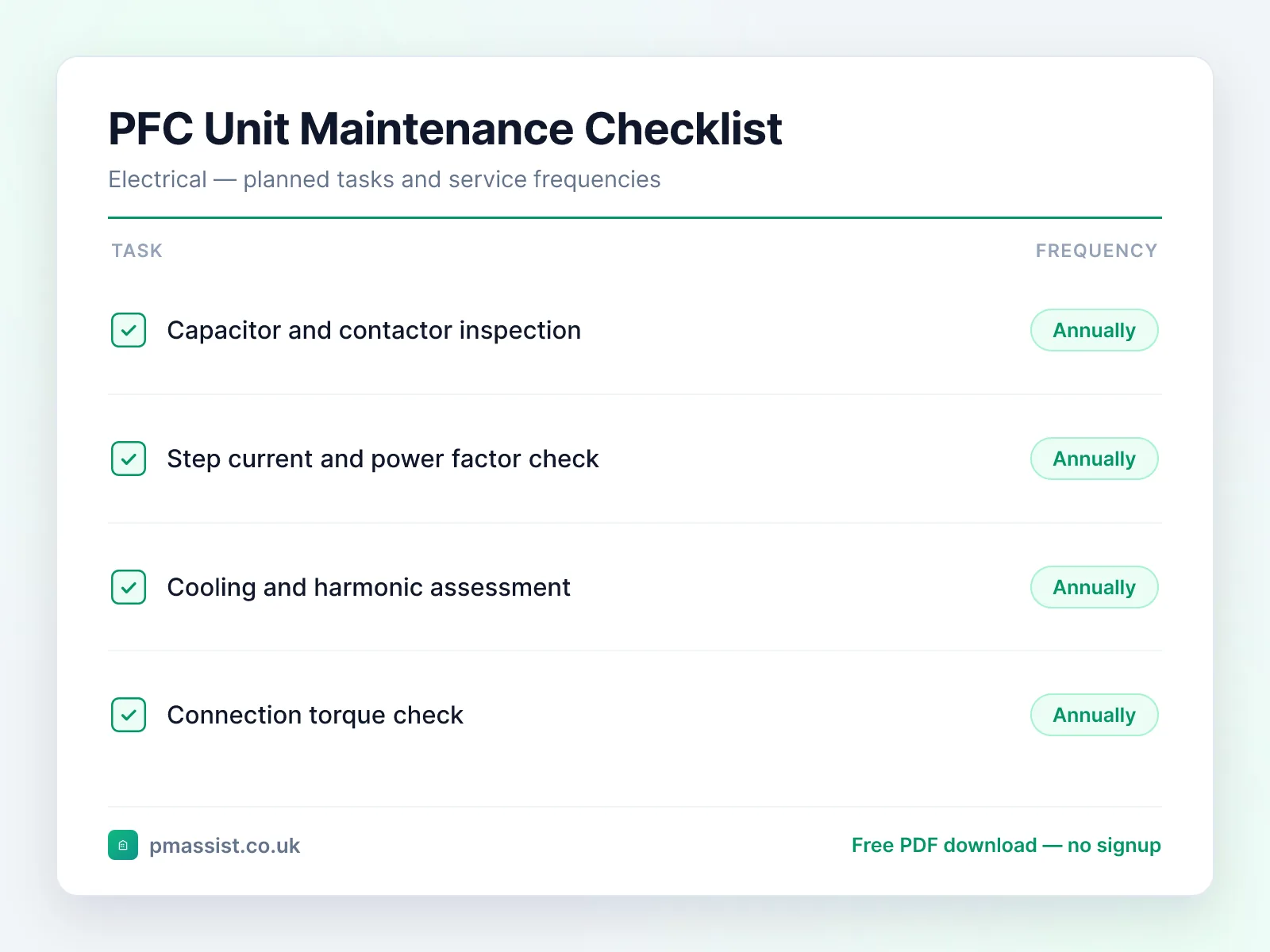
Annually
- •Capacitor and contactor inspection
- •Step current and power factor check
- •Cooling and harmonic assessment
- •Connection torque check
Common faults and issues
Issues to be aware of when maintaining power factor correction unit equipment.
Safety and compliance notes
Key safety considerations for power factor correction unit maintenance. This is general guidance only — always follow OEM instructions, statutory requirements, and your organisation's safe systems of work.
Reference standards and frameworks
- United Kingdom
- BS 7671 (IET Wiring Regulations) and the Electricity at Work Regulations 1989
- North America
- NFPA 70B (electrical equipment maintenance) and ANSI/NETA MTS
Frameworks commonly referenced when planning pfc unit maintenance programmes. Always confirm the requirements that apply to your site and jurisdiction.
Managing PFC Unit documentation with PM Assist
PM Assist helps FM and building operations teams search their O&M manuals and building drawings in seconds. Upload your power factor correction unit documentation and ask questions like “What is the target power factor for this site?” or “How many capacitor steps does the unit have?” — and get source-cited answers instantly.
The checklist tells you what to check. The manual tells you the numbers.
Ask a pfc unit manual a question and get the answer back with the page it came from. No signup, and you can drop in your own PDF instead of the sample.
“What is the target power factor for this site?”Runs against a sample chiller manual so you can see the shape of the answer — then try it on one of yours.
Take this checklist with you
Download the branded PDF, generate a custom version for your asset, or run AI search across all your building documentation.
Related free tools
Related maintenance checklists
Low Voltage Switchgear maintenance checklist
Electrical · 10 tasks
Distribution Board maintenance checklist
Electrical · 9 tasks
Variable Speed Drive (VSD / Inverter) maintenance checklist
Controls & BMS · 10 tasks
Energy Meter maintenance checklist
Metering · 9 tasks
Electricity Sub-Meter maintenance checklist
Metering · 10 tasks
Further reading on pfc unit maintenance
Compliance topics for pfc unit maintenance
Compliance & CAFM
Run power factor correction unit maintenance in PM Assist
This checklist is also a planned maintenance programme in PM Assist, included in every paid plan alongside the compliance register and mobile inspections.
- Add a power factor correction unit to a building's asset register and this maintenance programme is created for you, with each task on its frequency in the planner.
- Electrical Installation Condition Report is tracked on the compliance register, with the date last done, the date next due and the certificate.
- Contractors can be given a login to see their jobs and upload certificates.
Frequently asked questions
Why does power factor correction save money?
Why do PFC capacitors fail?
How do harmonics affect power factor correction?
Manage your building documentation with AI
PM Assist gives FM teams instant access to O&M manuals, drawings, and maintenance knowledge — all searchable with AI.
- Upload and organise building documentation
- AI-powered search across all your manuals
- Source-cited answers for maintenance queries
- Team collaboration and access control
- No credit card required to start