Search Building Compliance Documents with AI
A commercial building runs at least seven statutory compliance regimes in parallel — electrical, gas, fire, water, asbestos, lifts and pressure systems — and each produces its own trail of certificates, logs and examination reports. PM Assist indexes all of them together, so any certificate, test result or inspection record is one plain-English question away.
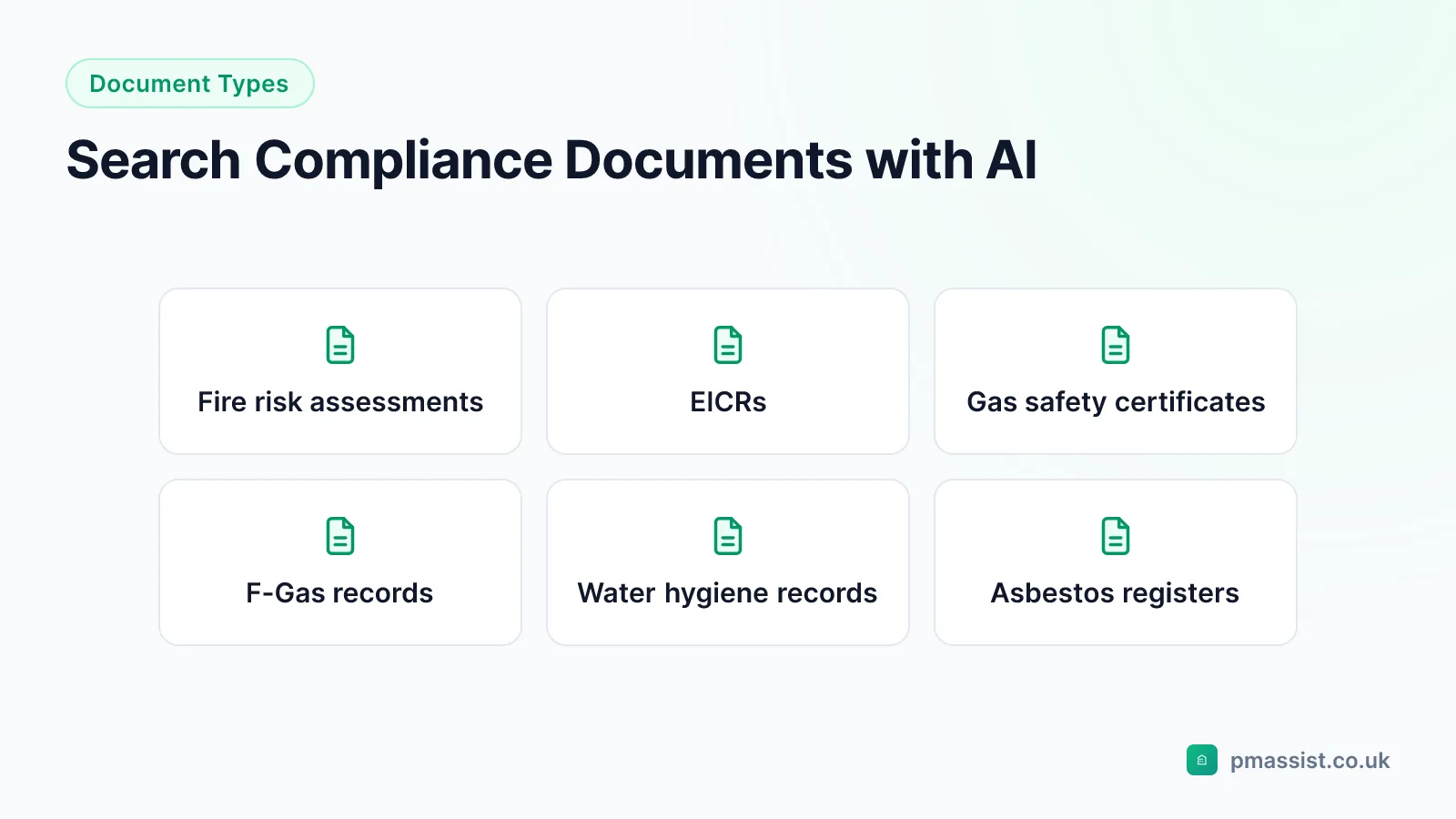
Seven evidence trails, one search box
Every compliance regime has its own contractors, its own certificate formats, and its own renewal cycle. An EICR arrives from the electrical contractor every five years; gas safety certificates arrive annually; legionella temperature logs arrive monthly; fire door checks arrive quarterly. Filed by contractor or by date, this evidence is only findable by the person who filed it — and when an auditor, insurer or enforcing authority asks for a specific record, that person may not be the one looking.
The operational risk is real. Delayed access to compliance evidence turns routine audits into scrambles, complicates insurance renewals and claims, and in the worst cases exposes the responsible person to enforcement action for records that exist but cannot be produced. The documentation is rarely missing — retrieval is the bottleneck.
PM Assist removes that bottleneck by indexing every page of every uploaded record, including scanned PDFs, and answering natural-language questions with source citations. Because the search is semantic rather than keyword-based, asking for an "electrical safety certificate" surfaces the EICR even though the document never uses that phrase.
Electrical: EICRs, certificates and remedial tracking
The Electricity at Work Regulations 1989 and BS 7671 require the fixed installation to be maintained in a safe condition, with the Electrical Installation Condition Report as the primary evidence. EICRs classify observations as C1, C2, C3 or FI, and acting on those classifications — then evidencing that you acted — is where most electrical compliance effort goes.
With the EICRs indexed, you can ask "what C2 observations are outstanding for the main switchroom?" or "when was the last EICR for the ground floor?" and get cited answers, making it practical to review findings across many distribution boards and prioritise remedial works. Emergency lighting test certificates, minor works certificates and periodic inspection records sit in the same searchable pool.
Gas: safety certificates and appliance records
Gas appliances and installations must be maintained and checked by Gas Safe registered engineers, producing safety certificates, service records and inspection reports that form part of the building's safety evidence. Across a portfolio with many appliances on annual renewal cycles, these certificates accumulate quickly, and confirming a specific appliance's status — for a transaction, an audit, or a defect investigation — means finding the right record fast.
PM Assist retrieves gas records by building, appliance, location or engineer, and a question like "when does the gas safety certificate for the boiler plant expire?" is answered from the certificate itself, with the source shown.
Fire: from the risk assessment to quarterly door checks
Fire safety generates the widest documentation set of any regime. Under the Regulatory Reform (Fire Safety) Order 2005, the responsible person must maintain the fire risk assessment and evidence that fire safety measures are maintained: fire alarm system certificates, emergency lighting test records, sprinkler and dry riser tests, fire damper drop-test records, and the fire strategy document itself.
The Fire Safety (England) Regulations 2022 added per-door record-keeping — quarterly checks on communal fire doors and annual checks on flat entrance doors in buildings over 11 metres — so a single building can carry inspection histories for hundreds of individual doors. The Building Safety Act 2022 raises the bar further for higher-risk buildings, where the safety case depends on being able to produce this golden thread of information on demand.
With all of it indexed, "when was the fire risk assessment last reviewed?", "show me the inspection history for door FD-L3-012" and "which dampers failed their last drop test?" are questions answered in seconds, not folder-trawling sessions.
Water: legionella control records under ACoP L8
Legionella control under ACoP L8 and HSG274 produces a large, repeating record set — the risk assessment, the written scheme of control, monthly temperature logs across potentially hundreds of outlets, tank inspection and disinfection records, and TMV servicing evidence. These records are the proof that the written scheme is actually being followed, and being unable to retrieve them quickly undermines an otherwise sound water safety regime.
PM Assist makes the whole set searchable: "show me the temperature records for the east wing", "when was the cold water storage tank last disinfected?", or "what did the legionella risk assessment say about the calorifiers?" all return cited answers from your own records.
Asbestos: the register you check before every job
Under the Control of Asbestos Regulations 2012, the dutyholder must maintain an asbestos register and management plan — and, crucially, ensure anyone who might disturb the building fabric checks it first. Drilling or cutting without checking the register can release fibres, so the register cannot be a document that takes half an hour to locate. It has to be consultable in the seconds between planning a task and starting it.
Searchable asbestos documentation means a contractor or engineer can check for recorded ACMs in a specific room, floor or area before work begins, and retrieve survey findings, material assessments and re-inspection records without hunting for the latest survey PDF. That accessibility is what turns a compliant document into an effective control.
Lifts: LOLER thorough examination reports
Passenger lifts require a thorough examination by a competent person under the Lifting Operations and Lifting Equipment Regulations 1998, typically every six months — separate from routine maintenance, and resulting in a report on the lift's condition and any defects. Across a portfolio, examination dates and remedial actions are easy to lose track of, and lift compliance is a recurring source of audit findings for exactly that reason.
With LOLER reports, service records and lift O&M documentation indexed together, the latest examination, its date, and any outstanding defects for a specific lift are one query away.
Answering an audit in real time
The test of compliance record-keeping is an auditor, insurer or fire officer asking for evidence at short notice. Teams that rely on folder structures typically spend days assembling evidence packs; teams with searchable records answer queries as they are asked, which itself demonstrates the standard of document control auditors look for.
Searching systematically for each required deliverable also exposes the gaps: if a certificate cannot be found, that is an early warning that a test was missed or a record never filed — found on your schedule, not the auditor's.
- Retrieve any certificate by system, location, date or contractor
- Review EICR observations and remedial status across all boards
- Produce per-door fire inspection histories on demand
- Evidence the legionella written scheme with monitoring records
- Check the asbestos register before any intrusive work
- Confirm LOLER examination dates and outstanding defects
Related guides
Inspection checklists for this
Free tools for this
Compliance & CAFM
Compliance, maintenance and documents in one place
PM Assist is building compliance software with the O&M manuals built in: every paid plan includes the compliance register, planned maintenance and mobile inspections.
- The compliance register is set up from each building's property type, with gaps shown for duties that have no record.
- Planned maintenance is generated from the asset register, with the tasks and frequencies already written.
- AI reads your certificates and proposes the dates and remedial actions; a person checks them against the source document before they count.
Sources
The regulatory positions on this page come from the following primary sources. Where guidance and legislation differ, the legislation governs — always confirm the requirements that apply to your own site and jurisdiction.
- Regulatory Reform (Fire Safety) Order 2005 — legislation.gov.uk
- Electrical safety at work — Health and Safety Executive
Frequently asked questions
Which compliance documents can PM Assist search?
Can PM Assist search scanned certificates?
Can one query cover several compliance regimes at once?
Can I find certificate expiry and renewal dates?
Does PM Assist replace our compliance management system?
Is compliance documentation kept secure?
Find Any Compliance Record in Seconds
Upload your certificates, registers and logs — and answer any audit, insurer or fire authority request with a source-cited search.
- Upload and organise building documentation
- AI-powered search across all your manuals
- Source-cited answers for every query
- Team collaboration and access control
- No credit card required to start