Battery Energy Storage System (BESS) Maintenance Checklist
Keep battery storage safe and performing — module and BMS checks, cooling and ventilation, fire-safety verification, connection inspection, and inverter monitoring.
Also available as editable Excel and Word — with asset, sign-off and findings columns.
What is a battery storage maintenance checklist?
A battery energy storage system (bess) maintenance checklist is a structured list of the 10 preventive maintenance tasks — covering visual, functional, safety and record-keeping checks — that keep a battery energy storage system (bess) running safely and reliably. It groups routine checks by frequency, from daily inspections to annual servicing, so FM teams and building engineers can plan and evidence preventive maintenance.
Core battery storage checks
- Inspect DC and AC connections and busbars for tightness and heat
- Review the BMS for cell/module voltages, temperatures, and balancing
- Verify ventilation and confirm no abnormal heat or swelling of modules
- Record cell data, temperatures, faults, and safety-system tests in the log
What is a battery energy storage system (bess)?
A battery energy storage system (BESS) stores electrical energy — from the grid, solar PV, or other sources — for later use, supporting load shifting, peak shaving, backup, and grid services. Typically lithium-ion, a BESS combines battery modules, a battery management system (BMS), power conversion (inverter), thermal management, and dedicated fire detection and suppression. The principal concern is safety: lithium battery thermal runaway is a serious fire risk, so cooling, ventilation, the BMS, and fire systems are central to maintenance, alongside performance and connection integrity. As on-site storage grows with solar and EV, BESS is an increasing FM responsibility.
This checklist is one of 17 in our electrical maintenance checklists, covering distribution boards, switchgear, generators, UPS, solar PV and EV charging — inspection, testing and thermographic checks.
Typical Battery Storage maintenance checklist
A practical starting point for planned preventive maintenance. Always refer to the manufacturer's O&M manual and site-specific requirements.
Visual Checks
- Inspect DC and AC connections and busbars for tightness and heat
- Inspect enclosure, signage, and access/egress arrangements
Functional Checks
- Review the BMS for cell/module voltages, temperatures, and balancing
- Check the thermal management / cooling system operates correctly
- Check the inverter/PCS operation, error logs, and cooling
- Confirm state of charge/health and performance via monitoring
Safety Checks
- Verify ventilation and confirm no abnormal heat or swelling of modules
- Test the dedicated fire detection and suppression/alarm systems
- Verify isolation, emergency stop, and shutdown arrangements
Record Keeping
- Record cell data, temperatures, faults, and safety-system tests in the log
Download the free Battery Storage maintenance checklist PDF
Get all 10 tasks as a printable PDF — free, no signup needed. Keep a copy in the plant room, attach it to work orders, or share it with your maintenance contractor.
The PDF is free and needs nothing. The Excel and Word versions add asset details, sign-off and findings columns so you can record the work as you do it — we ask for an email address for those.
Typical maintenance frequency
Suggested intervals for battery energy storage system (bess) maintenance. Actual frequencies should follow manufacturer guidance and site-specific risk assessments.
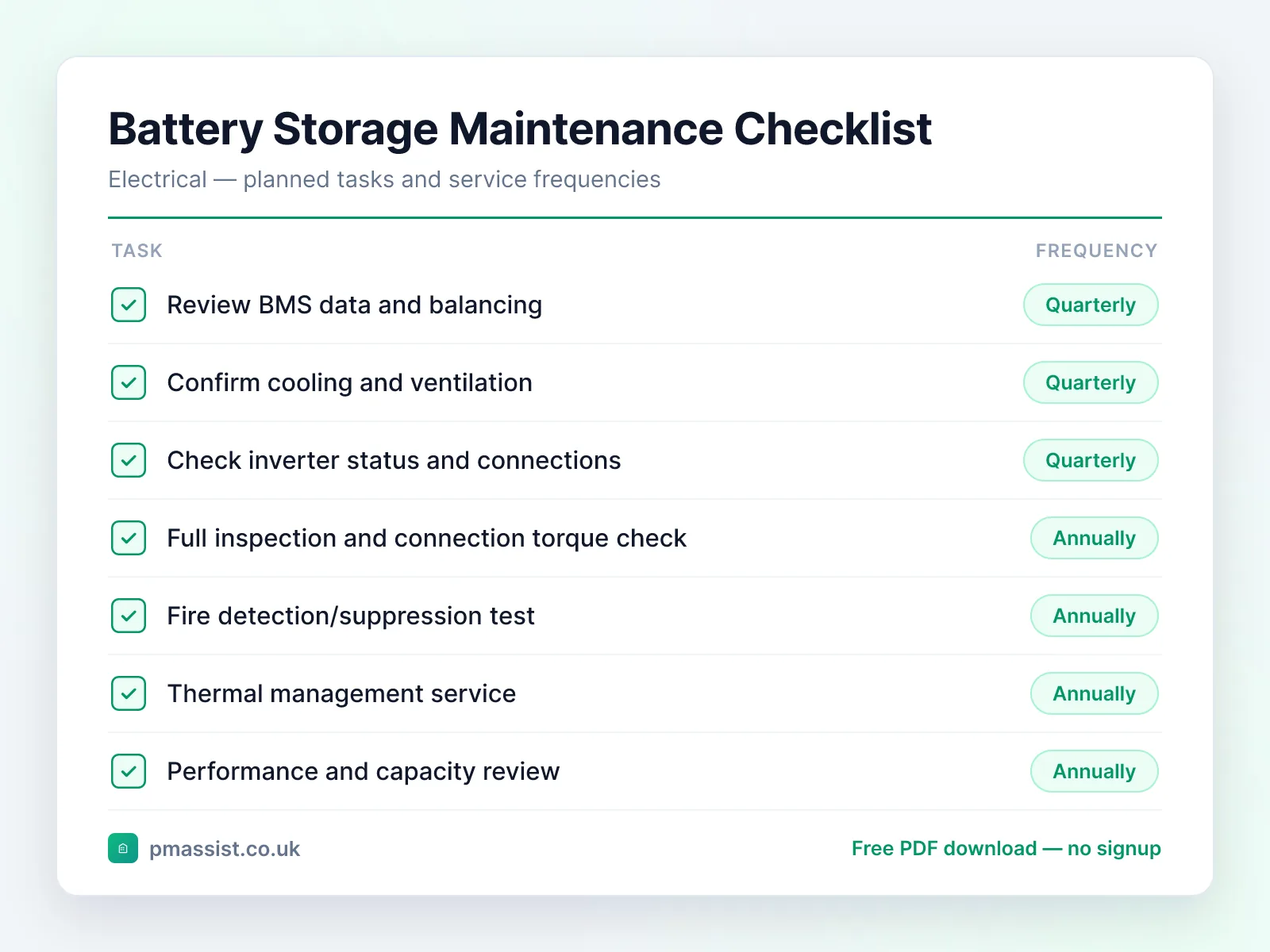
Quarterly
- •Review BMS data and balancing
- •Confirm cooling and ventilation
- •Check inverter status and connections
Annually
- •Full inspection and connection torque check
- •Fire detection/suppression test
- •Thermal management service
- •Performance and capacity review
Common faults and issues
Issues to be aware of when maintaining battery energy storage system (bess) equipment.
Safety and compliance notes
Key safety considerations for battery energy storage system (bess) maintenance. This is general guidance only — always follow OEM instructions, statutory requirements, and your organisation's safe systems of work.
Reference standards and frameworks
- United Kingdom
- BS 7671 (IET Wiring Regulations) and the Electricity at Work Regulations 1989
- North America
- NFPA 70B (electrical equipment maintenance) and ANSI/NETA MTS
Frameworks commonly referenced when planning battery storage maintenance programmes. Always confirm the requirements that apply to your site and jurisdiction.
Managing Battery Storage documentation with PM Assist
PM Assist helps FM and building operations teams search their O&M manuals and building drawings in seconds. Upload your battery energy storage system (bess) documentation and ask questions like “What is the BESS capacity and chemistry?” or “Where is the emergency stop located?” — and get source-cited answers instantly.
The checklist tells you what to check. The manual tells you the numbers.
Ask a battery storage manual a question and get the answer back with the page it came from. No signup, and you can drop in your own PDF instead of the sample.
“What is the BESS capacity and chemistry?”Runs against a sample chiller manual so you can see the shape of the answer — then try it on one of yours.
Take this checklist with you
Download the branded PDF, generate a custom version for your asset, or run AI search across all your building documentation.
Related free tools
Related maintenance checklists
Solar PV System maintenance checklist
Electrical · 10 tasks
EV Charging Point maintenance checklist
Electrical · 10 tasks
Uninterruptible Power Supply (UPS) maintenance checklist
Electrical · 12 tasks
Standby Generator maintenance checklist
Electrical · 12 tasks
Low Voltage Switchgear maintenance checklist
Electrical · 10 tasks
Further reading on battery storage maintenance
Compliance topics for battery storage maintenance
Compliance & CAFM
Run battery energy storage system maintenance in PM Assist
This checklist is also a planned maintenance programme in PM Assist, included in every paid plan alongside the compliance register and mobile inspections.
- Add a battery energy storage system to a building's asset register and this maintenance programme is created for you, with each task on its frequency in the planner.
- UPS Service & Battery Test is tracked on the compliance register, with the date last done, the date next due and the certificate.
- Contractors can be given a login to see their jobs and upload certificates.
Frequently asked questions
What are the main safety risks of battery storage?
How is battery storage performance maintained?
Who can maintain a BESS?
Manage your building documentation with AI
PM Assist gives FM teams instant access to O&M manuals, drawings, and maintenance knowledge — all searchable with AI.
- Upload and organise building documentation
- AI-powered search across all your manuals
- Source-cited answers for maintenance queries
- Team collaboration and access control
- No credit card required to start