What is an O&M Manual?
An O&M (operation and maintenance) manual is the handover documentation that tells building teams how to operate and maintain a building's systems. This guide explains what it contains, why it matters, and how to keep it usable.
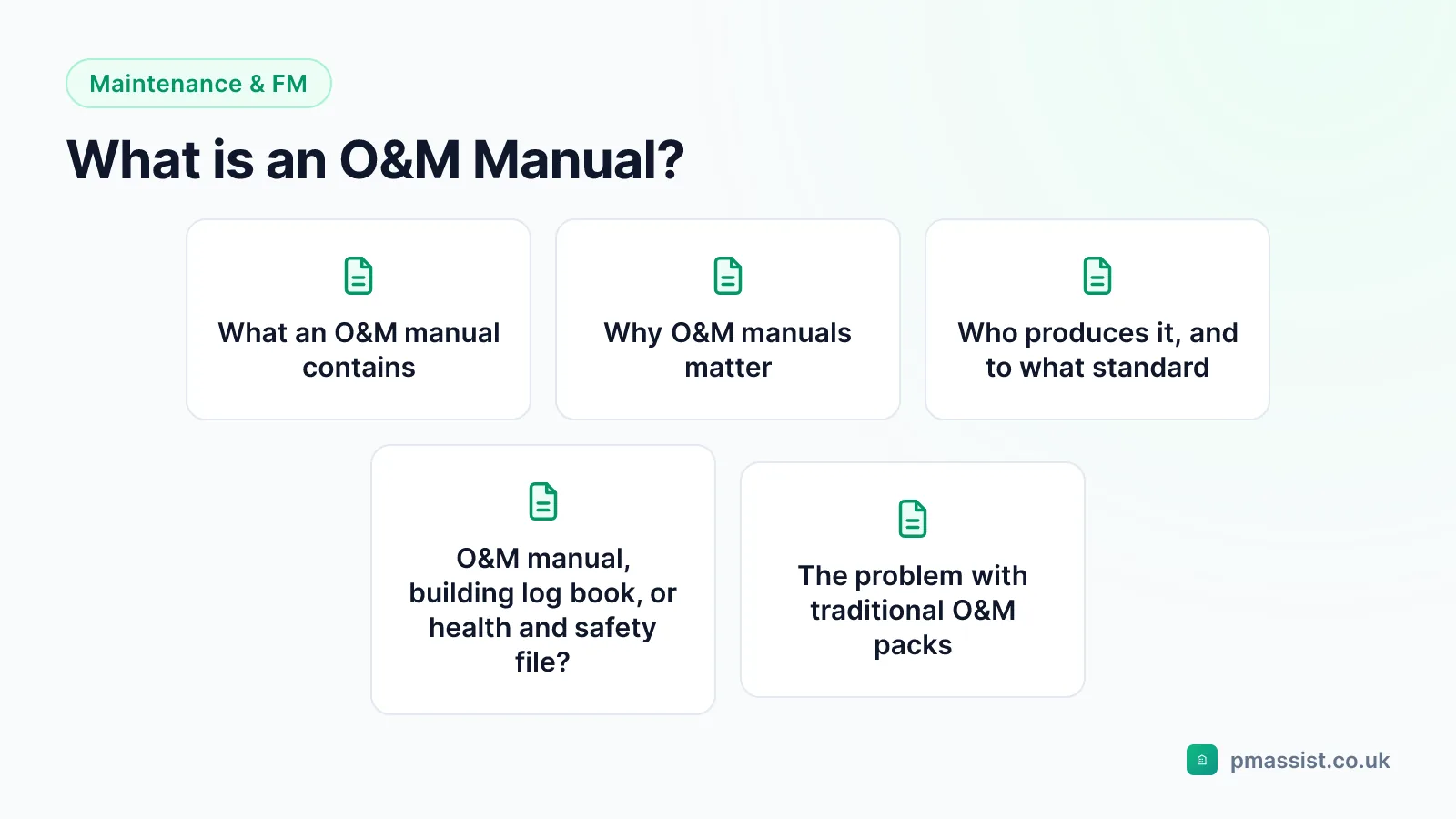
In short
An O&M manual (operation and maintenance manual) is the compiled set of information handed over at the completion of a building or project, describing how to operate, maintain, and service its systems and equipment. It includes manufacturer data, drawings, certificates, maintenance requirements, and asset details.
What an O&M manual contains
An O&M manual brings together everything a building team needs to run and maintain the installed systems. On a large project it can run to thousands of pages across dozens of volumes, compiled from contractors and manufacturers. The breadth is exactly what makes it valuable — and what makes finding a specific answer in it so difficult.
- System descriptions and how each installation operates
- Manufacturer technical data, manuals, and spare parts lists
- As-installed drawings and schematics
- Maintenance requirements and recommended frequencies
- Commissioning records and test certificates
- Statutory and warranty documentation
- Asset registers and equipment schedules
Why O&M manuals matter
The O&M manual is the knowledge that lets a building be operated safely and efficiently after the people who built it have gone. When a fault occurs, an engineer needs the right settings, the isolation points, the manufacturer's instructions. When a system needs servicing, the maintenance regime comes from here. When a building is sold or re-let, the O&M information is part of its value and its compliance evidence. A poor or inaccessible O&M pack costs time on every single fault and maintenance task for the life of the building.
Who produces it, and to what standard
The O&M manual is normally compiled by the main contractor, often through a specialist technical author, pulling together information from subcontractors and equipment manufacturers. It is delivered at practical completion, which is precisely the moment when everyone involved is under most pressure to finish — and it shows in the quality.
That is why the specification matters more than the deliverable. Where a client sets requirements up front — structure, file naming, searchable rather than scanned PDFs, asset data in a defined schema, and a review before acceptance — the pack that arrives is usable. Where the contract simply requires 'O&M manuals', what arrives is whatever discharges that obligation. CIBSE TM31 covers the building log book, BS 8587 addresses facility information management, and BS 8536 covers design and construction for operability; specifying against them is how a client converts a vague obligation into something checkable.
- Usually compiled by the main contractor or a specialist technical author
- Delivered at practical completion, when project pressure is highest
- Quality is set by what the client specified, not by convention
- TM31, BS 8587, and BS 8536 give something concrete to specify against
O&M manual, building log book, or health and safety file?
Three handover documents get conflated, and they answer different questions. The O&M manual is the detailed technical record: how each system works, how to maintain it, and the manufacturer data behind it. The building log book, covered by CIBSE TM31, is a deliberately concise summary of how the building is meant to operate and perform, aimed at whoever runs it day to day rather than at an engineer stripping down a pump. The health and safety file, required under the CDM Regulations, holds the information needed to carry out future work safely — residual risks and hazards, not operating instructions.
They draw on overlapping source material and are usually handed over together, which is how the confusion starts. But asking a log book to serve as an O&M manual gives you a document with no maintenance detail, and asking an O&M manual to serve as a health and safety file gives you thousands of pages in which the residual asbestos risk is on page 1,400. Each needs to exist, and each needs to be findable on its own terms.
The problem with traditional O&M packs
Traditional O&M manuals are delivered as enormous PDF packs or boxes of folders. The information is all there, but it is practically unsearchable: an engineer needing one valve's specification might face scrolling through hundreds of pages across multiple files. As a result, O&M packs are often left unopened and teams rely on memory or guesswork instead. The modern answer is to make the O&M library searchable in plain language, so any team member can ask a question and get a sourced answer in seconds — turning a dead archive into a live knowledge base.
Related maintenance checklists
Sources
The regulatory positions on this page come from the following primary sources. Where guidance and legislation differ, the legislation governs — always confirm the requirements that apply to your own site and jurisdiction.
- TM31: Building log book toolkit — CIBSE
- Soft Landings framework — BSRIA
Frequently asked questions
What is the difference between an O&M manual and a health and safety file?
Who produces the O&M manual?
How do you make an O&M manual usable?
Turn your O&M manuals into instant answers
PM Assist indexes your entire O&M library and answers plain-language questions with page-level citations — so your team finds what they need in seconds, not hours.
- Upload and organise building documentation
- AI-powered search across all your manuals
- Source-cited answers for every query
- Team collaboration and access control
- No credit card required to start
Knowing the standard is one thing. Finding it in the paperwork is another.
Ask an O&M manual a question and get the answer back with the page it came from. No signup, and you can drop in your own PDF instead of the sample.
“When was the last F-Gas check?”Runs against a sample chiller manual so you can see the shape of the answer — then try it on one of yours.