Dry Riser Maintenance Checklist
Keep your dry riser ready for the fire service — six-monthly visual inspections, the annual wet pressure test, and inlet, outlet, and cabinet condition checks to BS 9990.
Also available as editable Excel and Word — with asset, sign-off and findings columns.
What is a dry riser maintenance checklist?
A dry riser maintenance checklist is a structured list of the 10 preventive maintenance tasks — covering visual, functional and record-keeping checks — that keep a dry riser running safely and reliably. It groups routine checks by frequency, from daily inspections to annual servicing, so FM teams and building engineers can plan and evidence preventive maintenance.
Core dry riser checks
- Inspect the inlet breeching, cap, washers, and instantaneous couplings for damage
- Check landing valves on each floor open and close and have caps and washers fitted
- Record inspections, test pressures, and defects in the dry riser log
What is a dry riser?
A dry riser is a normally empty vertical pipe that lets firefighters pump water from a fire appliance, via a ground-level inlet, up to landing valves on each floor of a building. It is required in buildings where firefighting access above about 18 m would otherwise be difficult. Dry risers are maintained to BS 9990: a six-monthly visual inspection of inlets, outlets, valves, and cabinets, and an annual wet pressure test of the installation. They are a passive asset — the test regime is the only thing that proves they will work on the day.
This checklist is one of 19 in our fire safety maintenance checklists, covering fire dampers, alarms, emergency lighting, sprinklers, risers and fire doors — the statutory checks and their records.
Typical Dry Riser maintenance checklist
A practical starting point for planned preventive maintenance. Always refer to the manufacturer's O&M manual and site-specific requirements.
Visual Checks
- Inspect the inlet breeching, cap, washers, and instantaneous couplings for damage
- Confirm riser cabinets are signed, glazed/secured, and unobstructed
- Check for leaks at joints, valves, and couplings during the wet test
- Inspect pipework brackets and supports for corrosion and security
- Confirm identification signage and floor markings are correct and legible
Functional Checks
- Check landing valves on each floor open and close and have caps and washers fitted
- Verify the air valve and drain valve are present and operable
- Carry out the annual wet pressure test to the required pressure and hold
- Drain down fully after wet testing and confirm the riser is left empty
Record Keeping
- Record inspections, test pressures, and defects in the dry riser log
Download the free Dry Riser maintenance checklist PDF
Get all 10 tasks as a printable PDF — free, no signup needed. Keep a copy in the plant room, attach it to work orders, or share it with your maintenance contractor.
The PDF is free and needs nothing. The Excel and Word versions add asset details, sign-off and findings columns so you can record the work as you do it — we ask for an email address for those.
Typical maintenance frequency
Suggested intervals for dry riser maintenance. Actual frequencies should follow manufacturer guidance and site-specific risk assessments.
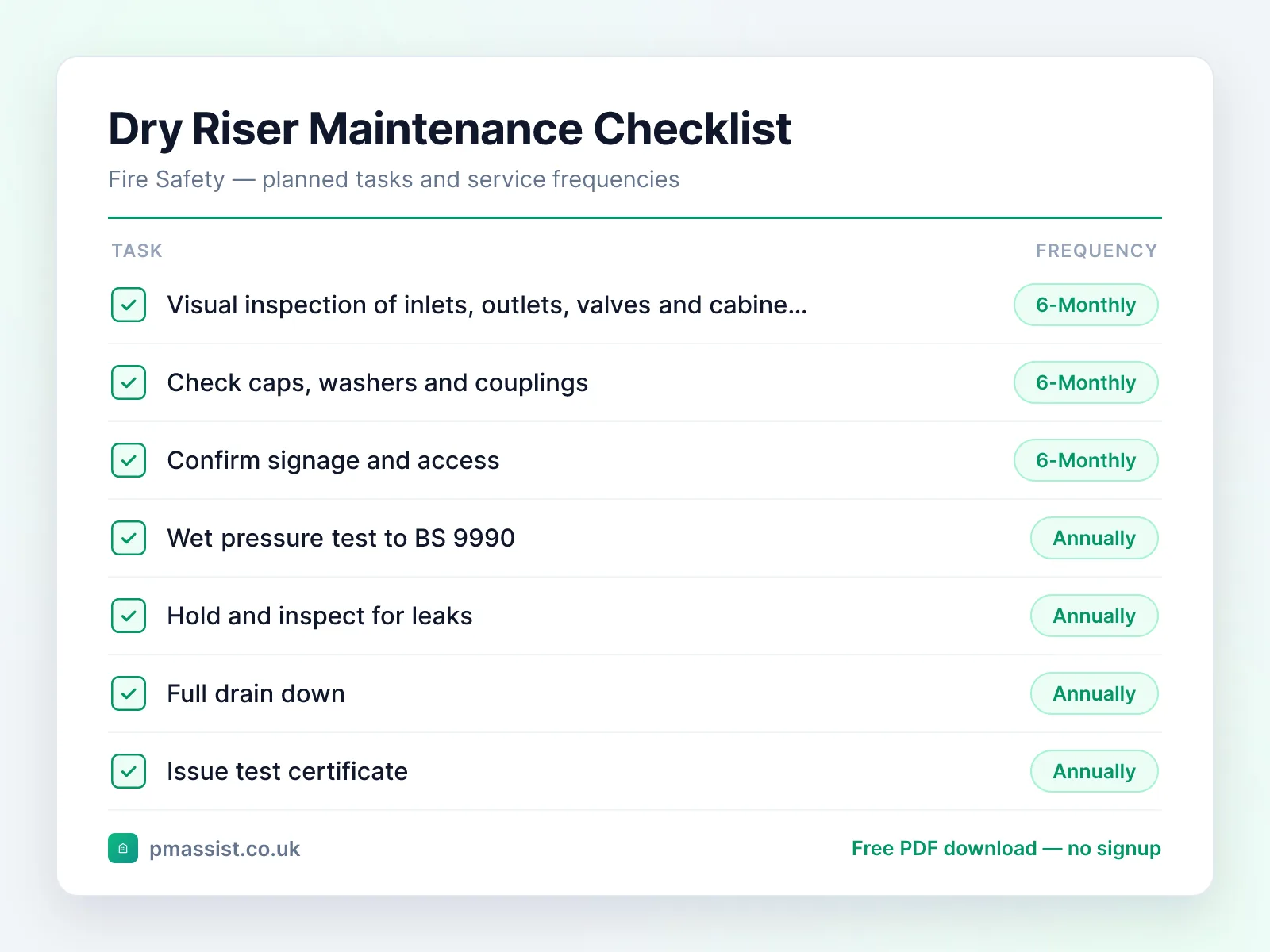
Every 6 Months
- •Visual inspection of inlets, outlets, valves and cabinets
- •Check caps, washers and couplings
- •Confirm signage and access
Annually
- •Wet pressure test to BS 9990
- •Hold and inspect for leaks
- •Full drain down
- •Issue test certificate
Common faults and issues
Issues to be aware of when maintaining dry riser equipment.
Safety and compliance notes
Key safety considerations for dry riser maintenance. This is general guidance only — always follow OEM instructions, statutory requirements, and your organisation's safe systems of work.
Reference standards and frameworks
- United Kingdom
- The Regulatory Reform (Fire Safety) Order 2005 and the relevant BS 5306 / BS 9999 parts
- North America
- The applicable NFPA standards (e.g. NFPA 10, 25, 72, 80)
Frameworks commonly referenced when planning dry riser maintenance programmes. Always confirm the requirements that apply to your site and jurisdiction.
Managing Dry Riser documentation with PM Assist
PM Assist helps FM and building operations teams search their O&M manuals and building drawings in seconds. Upload your dry riser documentation and ask questions like “When was the last wet pressure test?” or “Where is the dry riser inlet located?” — and get source-cited answers instantly.
The checklist tells you what to check. The manual tells you the numbers.
Ask a dry riser manual a question and get the answer back with the page it came from. No signup, and you can drop in your own PDF instead of the sample.
“When was the last wet pressure test?”Runs against a sample chiller manual so you can see the shape of the answer — then try it on one of yours.
Take this checklist with you
Download the branded PDF, generate a custom version for your asset, or run AI search across all your building documentation.
Related free tools
Related maintenance checklists
Wet Riser maintenance checklist
Fire Safety · 10 tasks
Sprinkler System maintenance checklist
Fire Safety · 10 tasks
Fire Hose Reel maintenance checklist
Fire Safety · 10 tasks
Fire Alarm Control Panel maintenance checklist
Fire Safety · 10 tasks
Portable Fire Extinguisher maintenance checklist
Fire Safety · 10 tasks
Inspection checklists for this asset
Maintenance keeps the asset working; a statutory inspection records whether it currently passes. Both usually apply.
Further reading on dry riser maintenance
Compliance topics for dry riser maintenance
Compliance & CAFM
Run dry riser maintenance in PM Assist
This checklist is also a planned maintenance programme in PM Assist, included in every paid plan alongside the compliance register and mobile inspections.
- Add a dry riser to a building's asset register and this maintenance programme is created for you, with each task on its frequency in the planner.
- Dry Riser Test is tracked on the compliance register, with the date last done, the date next due and the certificate.
- Contractors can be given a login to see their jobs and upload certificates.
Frequently asked questions
How often must a dry riser be tested?
What is the difference between a dry riser and a wet riser?
Who is responsible for dry riser maintenance?
Manage your building documentation with AI
PM Assist gives FM teams instant access to O&M manuals, drawings, and maintenance knowledge — all searchable with AI.
- Upload and organise building documentation
- AI-powered search across all your manuals
- Source-cited answers for maintenance queries
- Team collaboration and access control
- No credit card required to start