Emergency Lighting Inspection Checklist
A free emergency lighting inspection checklist to BS 5266 — the monthly function test and annual 3-hour duration test, with what to check and record.
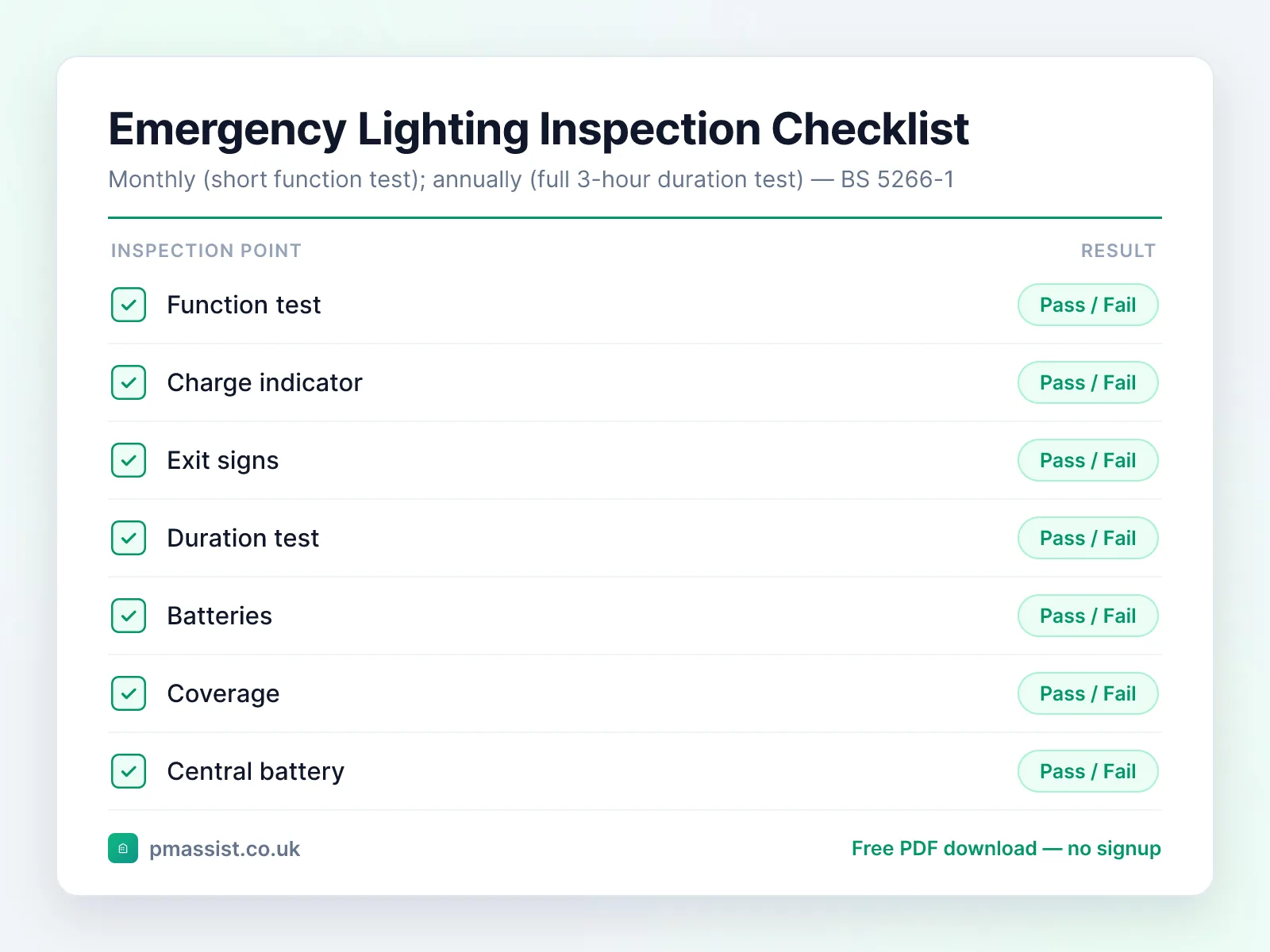
Monthly (short function test); annually (full 3-hour duration test)
The responsible person or FM team (monthly); a competent person for the annual duration test
BS 5266-1
An emergency lighting inspection confirms that escape routes and safety equipment will be illuminated if the power fails. Under BS 5266, this means a brief monthly function test of every luminaire and exit sign, and a full-rated-duration test (typically three hours) annually. This checklist covers both, plus the condition checks that keep the system reliable and the records that evidence it.
Emergency Lighting Inspection Checklist: what to check
Function test
Every luminaire and exit sign illuminates when tested on battery
Charge indicator
Healthy charge LED lit on each luminaire
Exit signs
Correctly positioned, illuminated, and unobstructed
Duration test
Luminaires stay lit for the full rated duration (annually)
Batteries
No swelling, leakage, or end-of-life indicators
Coverage
Escape routes still covered after any layout changes
Central battery
Charger, alarms, and standby capacity healthy (if fitted)
Cleanliness
Diffusers and exit sign legends clean and clear
Record
Monthly and annual tests logged in the emergency lighting log book
Download printable checklist templates from the templates library, or build a custom one with the checklist generator.
Managing the records behind this inspection
Further reading
Common inspection failures
- Batteries failing to hold the full three-hour duration as they age
- Luminaires removed or relocated during fit-out, leaving gaps in coverage
- Exit signs obscured by signage, stock, or new partitions
- Monthly test not carried out or not logged
- Charge LED not checked, so a failed luminaire goes unnoticed
Related inspection checklists
What to record, and how long to keep it
Record the monthly function test and the annual full-duration test separately, with the date, the duration achieved, and the identity of every luminaire that failed. A result of 'pass' with no luminaire-level detail is not evidence — the point of the annual test is to find the individual fittings whose batteries no longer hold. Log remedial work and the retest that confirmed it. Keep the system's design documentation and rated duration alongside the log, because without them nobody can judge whether a three-hour result was the right target.
Compliance & CAFM
Run this emergency lighting inspection on your phone
This checklist is a ready-made inspection form in PM Assist, included in every paid plan with the compliance register and planned maintenance.
- Complete it on your phone on site, with photos against each item.
- A failed item becomes a remedial action in one tap, with a priority and a deadline.
- The completed inspection can be logged against emergency lighting test on the compliance register as the evidence it was done.
Sources
The regulatory positions on this page come from the following primary sources. Where guidance and legislation differ, the legislation governs — always confirm the requirements that apply to your own site and jurisdiction.
- Regulatory Reform (Fire Safety) Order 2005 — legislation.gov.uk
- Electrical safety at work — Health and Safety Executive
Frequently asked questions
How often should emergency lighting be inspected?
Why is the annual test three hours?
What happens if emergency lighting fails the test?
Keep inspection records searchable
Once inspections are running, the records pile up. PM Assist makes your inspection records, O&M manuals, and certificates instantly searchable — so you can produce evidence on demand.
The inspection is the easy part. Finding last year's record is not.
Ask an O&M manual a question and get the answer back with the page it came from. No signup, and you can drop in your own PDF instead of the sample.
“When was the last F-Gas check?”Runs against a sample chiller manual so you can see the shape of the answer — then try it on one of yours.