Firefighting Equipment Monthly Check Checklist (High-Rise Residential)
The monthly checks high-rise residential buildings need — firefighting and evacuation lifts, dry and wet risers, smoke control and other key firefighting equipment.
Monthly
The responsible person or their competent contractor
Fire Safety (England) Regulations 2022
The Fire Safety (England) Regulations 2022 require the responsible person for a high-rise residential building (18 metres or seven storeys and above) to carry out monthly routine checks of lifts for use by firefighters and evacuation lifts, and of other key firefighting equipment, and to report any fault that cannot be fixed within 24 hours to the local fire and rescue service. This checklist covers that monthly routine; it sits alongside, not instead of, the contractors' servicing.
Firefighting Equipment Monthly Check Checklist (High-Rise Residential): what to check
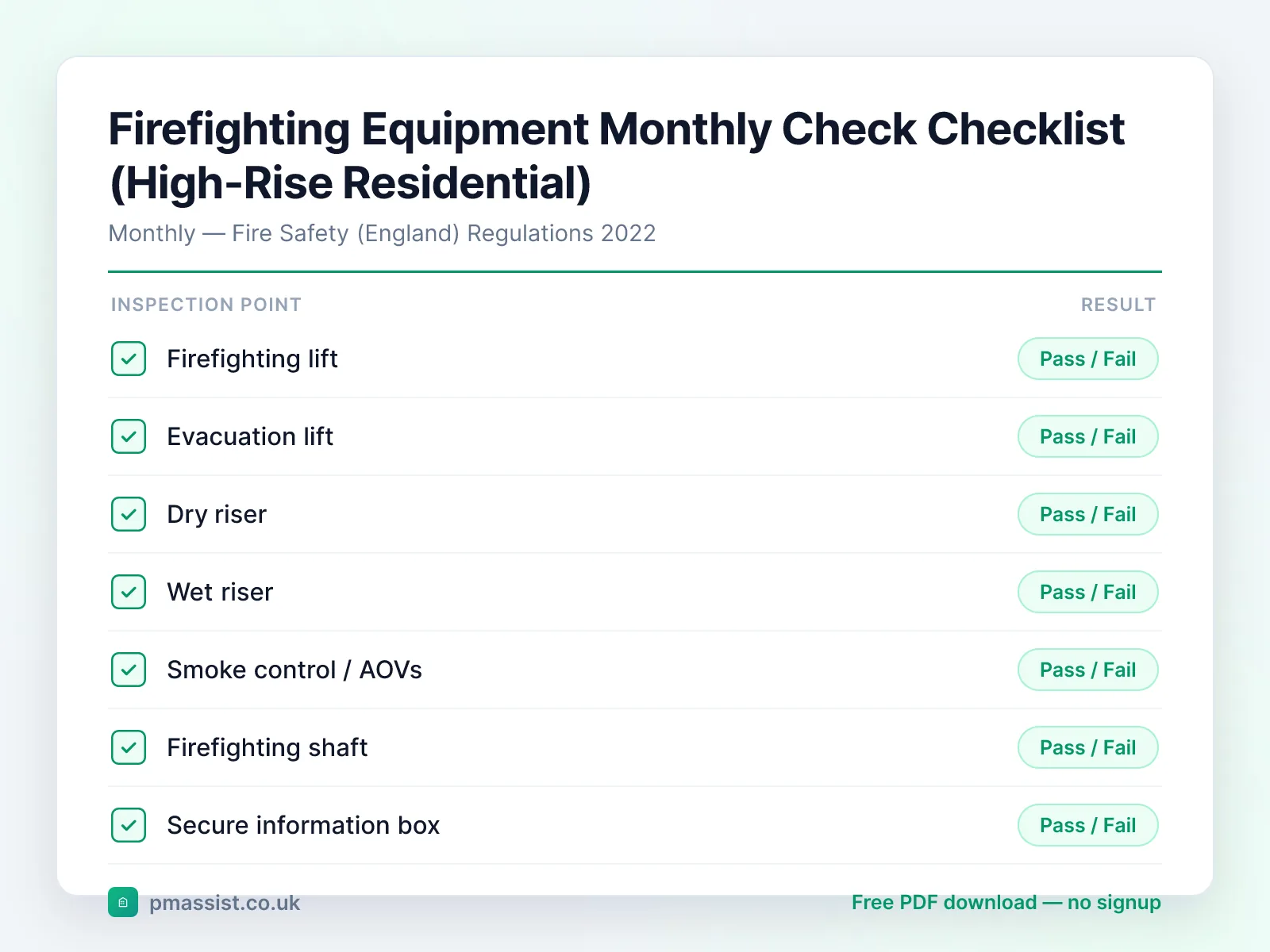
Firefighting lift
Firefighter switch recalls the lift and it operates under firefighter control
Evacuation lift
Evacuation mode operates correctly
Dry riser
Inlet and landing valves undamaged, caps and straps in place, box doors secure
Wet riser
Pumps and tank ready; landing valves undamaged
Smoke control / AOVs
Vents and controls operate; panel shows normal
Firefighting shaft
Lobbies and stairs clear; doors self-close
Secure information box
Accessible, secure and plans present
Faults
Any fault not fixed within 24 hours reported to the fire and rescue service
Download printable checklist templates from the templates library, or build a custom one with the checklist generator.
Common inspection failures
- Firefighter switch not tested because the lift contractor visits quarterly
- Dry riser inlet vandalised or caps missing
- AOV panel in fault
- Faults left for more than 24 hours without telling the fire service
- No record of the monthly check
Related inspection checklists
What to record, and how long to keep it
Record each monthly check: the date, who did it, each lift and item of equipment checked, the result, faults found, the repair and — where a fault could not be fixed within 24 hours — when and how the fire and rescue service was told. Keep the records available for the fire and rescue service.
Compliance & CAFM
Run this firefighting equipment monthly check on your phone
This checklist is a ready-made inspection form in PM Assist, included in every paid plan with the compliance register and planned maintenance.
- Complete it on your phone on site, with photos against each item.
- A failed item becomes a remedial action in one tap, with a priority and a deadline.
- The completed inspection can be logged against firefighting lifts & equipment monthly check on the compliance register as the evidence it was done.
Frequently asked questions
Which buildings need monthly firefighting equipment checks?
What must be reported to the fire service?
Does the lift contractor's visit count as the monthly check?
Keep inspection records searchable
Once inspections are running, the records pile up. PM Assist makes your inspection records, O&M manuals, and certificates instantly searchable — so you can produce evidence on demand.
The inspection is the easy part. Finding last year's record is not.
Ask an O&M manual a question and get the answer back with the page it came from. No signup, and you can drop in your own PDF instead of the sample.
“When was the last F-Gas check?”Runs against a sample chiller manual so you can see the shape of the answer — then try it on one of yours.