Fire Escape Route Inspection Checklist
A free weekly fire escape route checklist — clear corridors and stairs, final exit doors that open, signage, emergency lighting and the route to the assembly point.
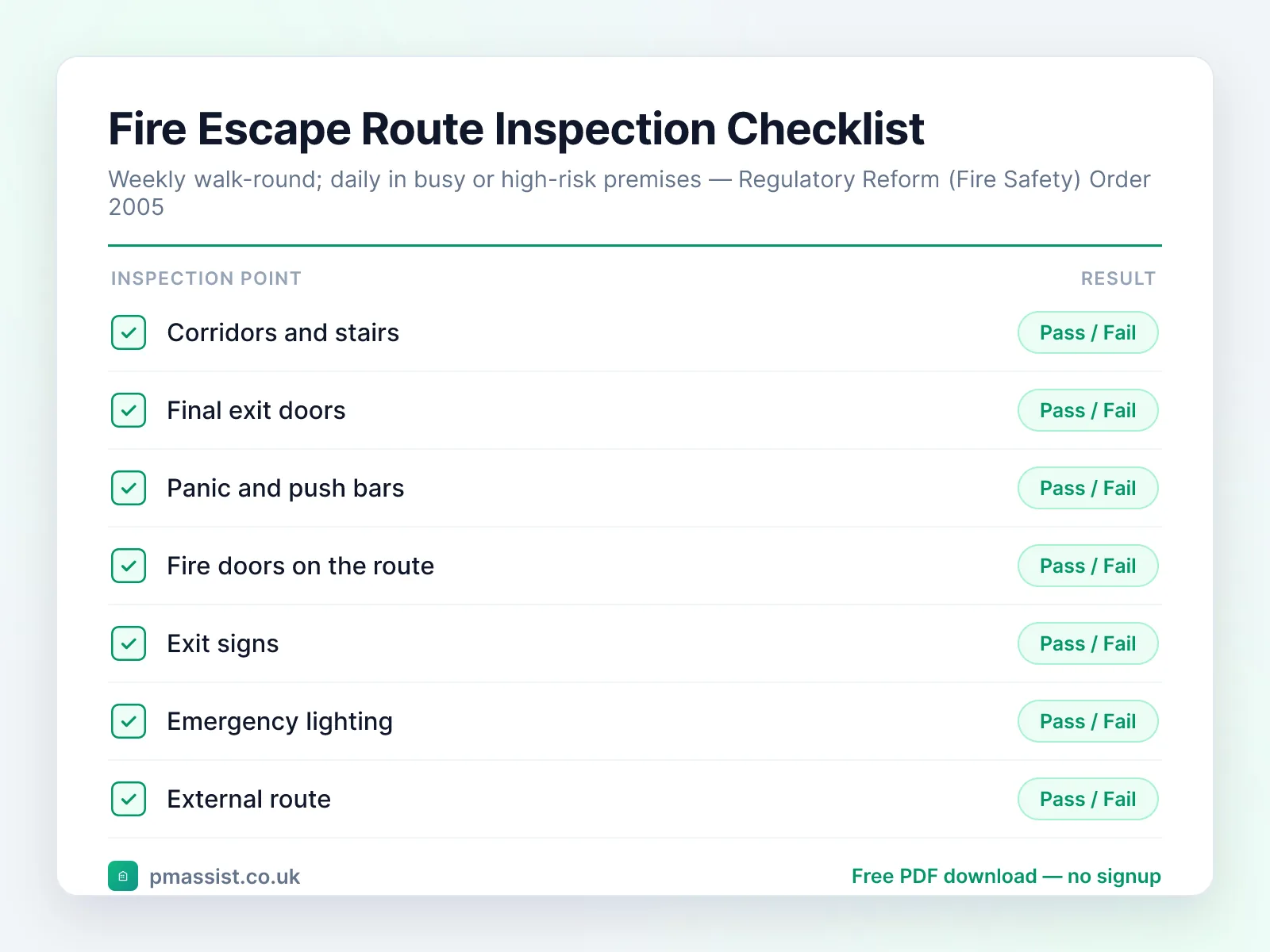
Weekly walk-round; daily in busy or high-risk premises
The responsible person, a fire warden or the site team
Regulatory Reform (Fire Safety) Order 2005
A fire escape route inspection confirms that everyone can get out: corridors and stairs are clear, fire exit doors open easily from the inside without a key, exit signs are visible and the route to the assembly point is unobstructed. The Regulatory Reform (Fire Safety) Order 2005 requires escape routes and exits to be kept clear and usable at all times, and the fire risk assessment will usually set a weekly walk-round. It is the most common fire safety failure found on inspection because routes get blocked day to day.
Fire Escape Route Inspection Checklist: what to check
Corridors and stairs
Clear of storage, rubbish and trip hazards along the full route
Final exit doors
Open easily from inside without a key, and are not locked or chained
Panic and push bars
Operate freely and release the door
Fire doors on the route
Close fully onto their frames and are not wedged open
Exit signs
Present, visible and illuminated where required
Emergency lighting
Luminaires on the route show healthy charge indicators
External route
Path from the final exit to the assembly point is clear and lit
Assembly point
Signed and not obstructed by parked vehicles or works
Refuges
Clear and the communication outstation is accessible
Download printable checklist templates from the templates library, or build a custom one with the checklist generator.
Common inspection failures
- Deliveries or bins stored in corridors and stairs
- Final exit doors locked for security
- Fire doors wedged open
- Exit signs obscured by new signage or stock
- External routes blocked by parked cars or skips
Related inspection checklists
What to record, and how long to keep it
Record each walk-round in the fire log book: the date, who did it, the routes and exits checked, anything found blocked or defective and what was done about it. Blocked-route findings that repeat point to a management problem, not a one-off, and the fire risk assessment should be told.
Compliance & CAFM
Run this fire escape route inspection on your phone
This checklist is a ready-made inspection form in PM Assist, included in every paid plan with the compliance register and planned maintenance.
- Complete it on your phone on site, with photos against each item.
- A failed item becomes a remedial action in one tap, with a priority and a deadline.
- Completed inspections stay on the building's record, ready for an auditor or insurer.
Frequently asked questions
How often should fire escape routes be checked?
Can fire exit doors be locked?
Who is responsible for keeping escape routes clear?
Keep inspection records searchable
Once inspections are running, the records pile up. PM Assist makes your inspection records, O&M manuals, and certificates instantly searchable — so you can produce evidence on demand.
The inspection is the easy part. Finding last year's record is not.
Ask an O&M manual a question and get the answer back with the page it came from. No signup, and you can drop in your own PDF instead of the sample.
“When was the last F-Gas check?”Runs against a sample chiller manual so you can see the shape of the answer — then try it on one of yours.