The Future of Facilities Management Technology
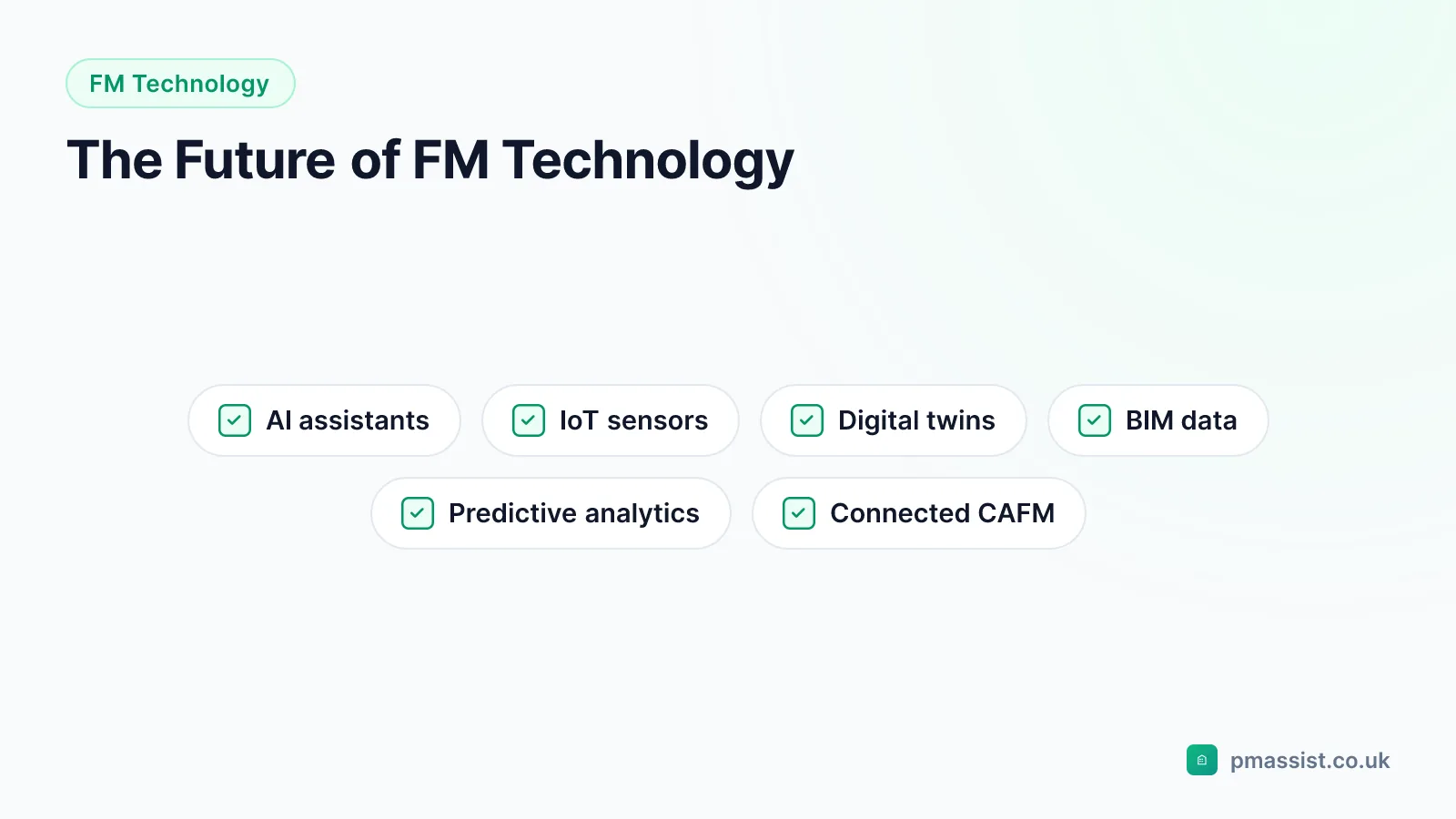
Facilities management is undergoing a technological transformation that will fundamentally change how buildings are operated, maintained, and experienced. While the core mission of FM remains the same — keeping buildings safe, comfortable, and efficient — the tools and techniques available to FM professionals are evolving rapidly. Technologies that seemed futuristic just five years ago are now being deployed in commercial buildings across the United Kingdom and beyond.
This article examines the key technologies that are shaping the future of facilities management: artificial intelligence, the Internet of Things, digital twins, smart building platforms, and sustainable building technology. For each, we explore what the technology does, how it applies to FM, and what practical steps FM teams can take to prepare for adoption.
Artificial Intelligence in Facilities Management
Artificial intelligence is arguably the most significant technology trend in facilities management today. AI encompasses a range of capabilities — natural language processing, machine learning, computer vision, and predictive analytics — each of which has practical applications in building operations.
AI-Powered Document Intelligence
One of the most immediately practical applications of AI in FM is document intelligence. Buildings generate enormous volumes of documentation — O&M manuals, drawings, specifications, test certificates, maintenance records, and compliance documents. Historically, this documentation has been difficult to search, poorly organised, and underutilised. AI changes this by enabling semantic search across building documentation.
Platforms like PM Assist use AI to make O&M manuals searchable using natural language questions. Instead of navigating folder structures and scanning through PDF pages, engineers ask questions in plain English and receive source-cited answers in seconds. This capability transforms how FM teams interact with their documentation and is explored in detail in our guide on how to search O&M manuals with AI.
Predictive Maintenance and Fault Detection
AI-driven predictive maintenance uses machine learning algorithms to analyse data from building management systems and IoT sensors, identifying patterns that indicate developing equipment faults. Rather than waiting for equipment to fail (reactive maintenance) or servicing on fixed schedules regardless of condition (preventive maintenance), predictive maintenance targets interventions precisely when they are needed.
The practical impact is significant. Predictive maintenance can reduce unplanned equipment downtime by 30 to 50 per cent and extend asset lifespan by 20 to 40 per cent. For FM teams, this means fewer emergency call-outs, better-planned maintenance activities, and more predictable operational costs. As we discussed in our article on how AI transforms facilities management, predictive maintenance is one of the most compelling AI use cases in the industry.
AI-Optimised Energy Management
Energy consumption represents one of the largest operating costs for commercial buildings, and AI-driven energy optimisation is delivering measurable savings. AI energy systems analyse data from occupancy sensors, weather forecasts, energy tariffs, and BMS trend logs to make real-time adjustments to HVAC, lighting, and other building systems. These systems typically achieve energy reductions of 15 to 25 per cent compared to traditional static control strategies.
The sophistication of AI energy management is increasing rapidly. Modern systems can learn building thermal characteristics, predict occupancy patterns, and pre-condition spaces to optimise both comfort and energy efficiency. They can also identify equipment that is consuming more energy than expected, which often indicates a developing fault or suboptimal control settings.
The Internet of Things (IoT)
The Internet of Things refers to the network of physical devices embedded with sensors, software, and connectivity that enables them to collect and exchange data. In facilities management, IoT is creating an unprecedented level of visibility into building performance and occupant behaviour.
Sensor Networks
Modern buildings can be equipped with sensors that monitor virtually every aspect of their operation. Temperature and humidity sensors track environmental conditions in each zone. Occupancy sensors detect how many people are in each space. Air quality sensors measure CO2, particulate matter, and volatile organic compounds. Water flow sensors detect leaks and monitor consumption. Vibration sensors on rotating equipment detect developing mechanical faults.
The cost of sensors has fallen dramatically in recent years, making it practical to deploy dense sensor networks even in existing buildings. Wireless sensors with battery lives of five to ten years can be installed without cabling, reducing installation costs and disruption. Many sensors communicate using low-power wide-area network (LPWAN) technologies like LoRaWAN, which provide building-wide coverage without requiring Wi-Fi infrastructure.
Edge Computing
As IoT sensor networks grow, the volume of data they generate becomes too large to process entirely in the cloud. Edge computing addresses this by processing data locally — at the building level — and sending only meaningful insights to cloud platforms. This reduces bandwidth requirements, improves response times, and enhances data privacy.
For FM teams, edge computing means that IoT-driven alerts and actions can happen in real time. A water leak sensor can trigger a local shutdown valve in milliseconds, rather than waiting for data to travel to the cloud and back. A temperature spike in a server room can activate emergency cooling immediately. The combination of local processing speed and cloud-based analytics provides both immediacy and intelligence.
IoT Platform Integration
One of the biggest challenges with IoT in facilities management is integration. A typical building might have IoT sensors from multiple manufacturers, a BMS from a different vendor, access control from another, and CCTV from yet another. Each system generates valuable data, but they operate in silos.
IoT integration platforms are emerging to solve this problem. These platforms provide a single interface for data from multiple sources, enabling FM teams to see the whole picture rather than checking individual systems. They also enable cross-system automation — for example, when the access control system shows that the last person has left a floor, the IoT platform can automatically reduce HVAC and lighting to unoccupied settings.
Digital Twins
A digital twin is a virtual replica of a physical building that is continuously updated with real-time data from sensors and building systems. It provides a dynamic, data-rich model of the building that FM teams can use for monitoring, analysis, simulation, and decision-making.
How Digital Twins Work
A digital twin starts with a 3D model of the building — typically derived from the BIM model created during design and construction. This geometric model is then enriched with operational data: real-time sensor readings, BMS data, maintenance records, and space utilisation information. The result is a living model that reflects the current state of the building, not just its as-designed condition.
FM teams can navigate the digital twin visually, clicking on a piece of equipment to see its current operational status, maintenance history, and associated documentation. They can view environmental conditions zone by zone, track energy consumption in real time, and identify areas where performance deviates from expectations.
Simulation and Scenario Planning
One of the most powerful capabilities of digital twins is simulation. FM teams can model the impact of changes before implementing them in the physical building. What would happen to comfort levels if the heating setpoint were reduced by one degree? How would a proposed office layout change affect ventilation requirements? What is the optimal maintenance schedule for a piece of equipment given its actual operating conditions?
These simulations help FM teams make better decisions, reduce risk, and optimise building performance. They also provide valuable evidence for business cases — when proposing a capital investment in new equipment or a building modification, the digital twin can model the expected operational impact and return on investment.
Current Limitations
Digital twins are powerful but not yet mainstream in FM. The primary barriers are cost (creating and maintaining a digital twin requires significant investment), data quality (the twin is only as good as the data feeding it), and skills (FM teams need training to use digital twin platforms effectively). However, costs are falling, data availability is improving thanks to IoT, and platform usability is getting better with each generation.
Smart Building Platforms
Smart building platforms represent the convergence of BMS, IoT, AI, and cloud computing into unified systems that provide intelligent building management. Unlike traditional BMS, which primarily control HVAC and lighting based on fixed schedules and setpoints, smart building platforms use data and AI to continuously optimise building performance.
Integrated Building Operating Systems
The concept of a building operating system — a single software layer that manages all building systems — is becoming reality. These platforms integrate data from HVAC, lighting, access control, fire systems, lifts, and IoT sensors, providing a unified view of building operations. They use AI to identify optimisation opportunities, detect anomalies, and automate routine decisions.
For FM teams, smart building platforms reduce the complexity of managing multiple disparate systems. Instead of monitoring separate dashboards for BMS, access control, CCTV, and energy management, they have a single interface that shows the information they need, highlights issues that require attention, and automates responses where appropriate.
Occupant Experience Apps
Smart buildings increasingly include mobile applications that allow occupants to interact with building systems. These apps enable desk and meeting room booking, temperature and lighting preferences, fault reporting, and wayfinding. The data generated by these interactions provides valuable insights for FM teams — which spaces are most popular, what comfort preferences people have, where recurring issues are concentrated.
Occupant experience apps also improve the relationship between FM teams and building users. When an occupant can report a fault through an app and track its resolution, they feel more engaged and the FM team gets structured data about issues rather than informal complaints. This data can be analysed to identify trends and prioritise improvements.
Sustainable Building Technology
Sustainability is no longer optional in facilities management. Legislation such as MEES (Minimum Energy Efficiency Standards), the requirement for Energy Performance Certificates, and the UK's net zero commitments are driving FM teams to reduce the environmental impact of their buildings. Technology is a critical enabler of these sustainability goals.
Carbon Monitoring and Reporting
AI-powered carbon monitoring platforms automatically calculate and report building carbon emissions using data from smart meters, utility bills, and BMS systems. These platforms can track Scope 1, 2, and 3 emissions, identify the largest sources of carbon in a building or portfolio, and model the impact of proposed interventions. Automated reporting reduces the administrative burden of ESG compliance and ensures accuracy.
Renewable Energy Integration
As more buildings install solar panels, battery storage, and heat pumps, managing the interaction between these systems and the grid becomes increasingly complex. AI-driven energy management systems optimise the use of on-site generation, determining when to use solar power directly, when to store it, and when to export to the grid based on real-time tariff information and consumption forecasts.
Circular Economy and Asset Tracking
Technology is also enabling circular economy approaches in FM. Digital material passports track the components and materials in a building, supporting end-of-life recovery and recycling. Asset tracking systems monitor equipment age, condition, and specifications, enabling informed decisions about repair versus replacement and supporting the procurement of refurbished components.
Preparing Your FM Team for the Future
The pace of technological change in facilities management can feel overwhelming, but FM teams do not need to adopt every technology simultaneously. A pragmatic approach is to start with technologies that address your most pressing operational challenges and build from there.
Start with Document Intelligence
For most FM teams, the most accessible and immediately valuable technology is AI-powered document search. It requires no hardware installation, no complex integration, and no specialist training. You upload your O&M manuals and your team can start finding information faster immediately. This is why we built PM Assist — to give FM teams a practical, immediate entry point into AI technology. You can learn the basics of getting started with our guide on how to digitise O&M manuals.
Build Data Foundations
Most advanced FM technologies — digital twins, predictive maintenance, AI energy optimisation — depend on good data. Start building your data foundations now by ensuring your BMS trend data is being logged and retained, your maintenance records are being captured digitally, and your asset registers are accurate and up to date. These data foundations will make future technology adoption much smoother.
Invest in Skills
The FM professionals who will thrive in the coming decade are those who combine traditional building services knowledge with data literacy and technology confidence. Encourage your team to develop skills in data analysis, BMS programming, and AI tool usage. The technology itself is becoming easier to use, but understanding what it can do and how to apply it requires investment in people.
Conclusion
The future of facilities management technology is not a single breakthrough but a convergence of capabilities — AI, IoT, digital twins, smart building platforms, and sustainability tools — that together transform how buildings are managed. These technologies are not replacing FM professionals; they are giving them superpowers. Better information, faster analysis, and automated routine decisions free FM teams to focus on what they do best: keeping buildings running safely, comfortably, and efficiently.
The FM teams and organisations that begin adopting these technologies now will have a significant competitive advantage. They will operate more efficiently, attract better talent, deliver superior outcomes for building owners and occupants, and be better positioned to meet the sustainability challenges of the coming decades.
Try PM Assist free and take the first step into the future of facilities management technology.
Get the FM AI digest
One short email a month with the most useful new guides, tools and changes from PM Assist. Unsubscribe anytime.
We use your email only to send the digest. No spam, unsubscribe anytime. See our privacy policy.
Compliance & CAFM
Put this into practice with PM Assist
PM Assist's building compliance software tracks every statutory duty across your buildings, plans the maintenance behind them and keeps the evidence searchable.
- A compliance register for each building, with the date each duty was last done and when it is next due.
- Planned maintenance and inspection forms generated from your asset register.
- AI reads your certificates and proposes the dates and remedial actions; a person checks them against the source document before they count.