Best AI Tools for Facilities Management (2026)
Last reviewed: May 2026. This piece is updated each spring to reflect what FM teams are actually using on the ground — not just what vendors are pitching.
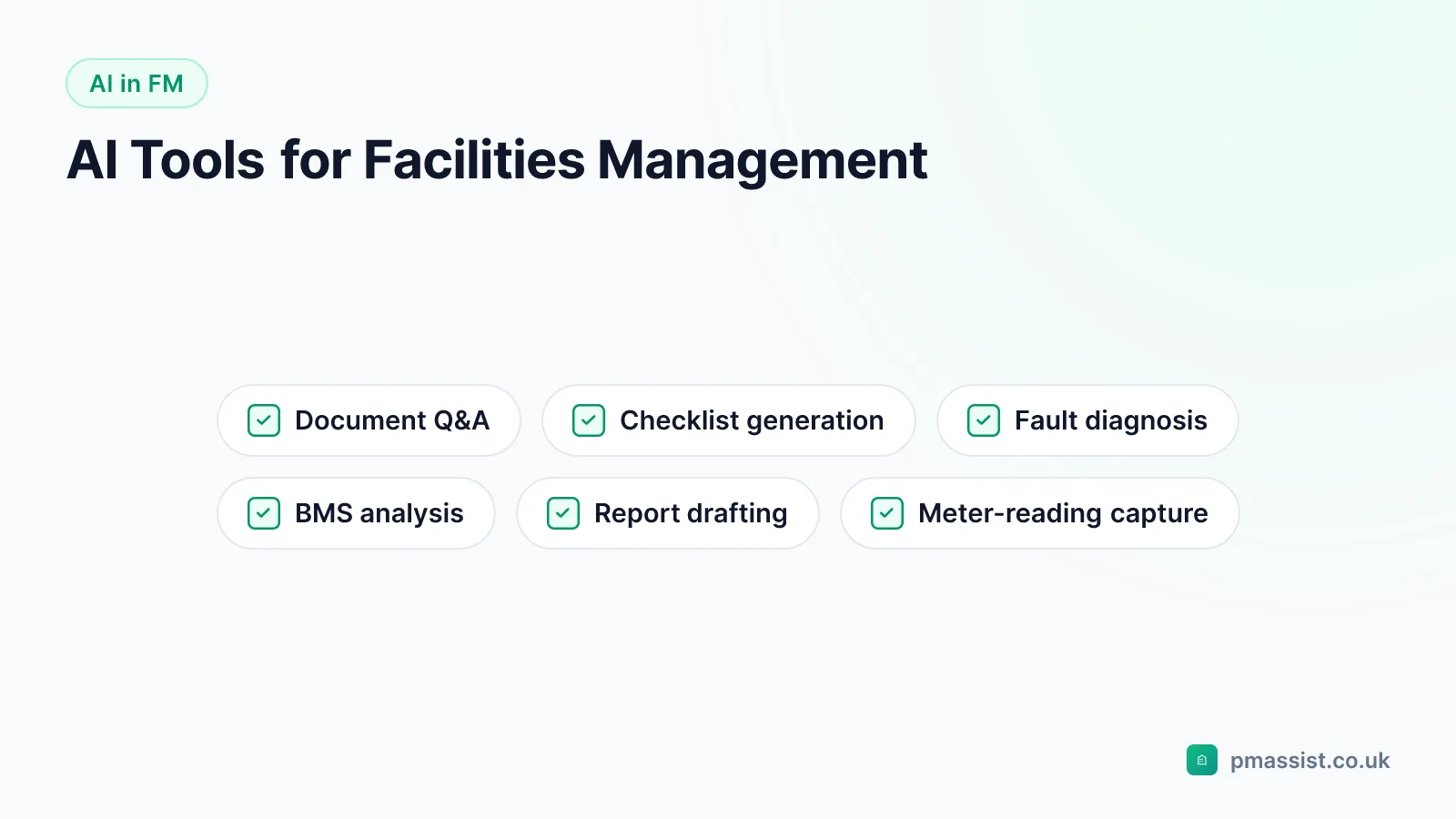
Artificial intelligence has moved from pitch deck to plant room in the last two years. The combination of large language models, computer vision, and cheap retrieval-augmented search means a UK facilities team in 2026 can deploy useful AI on its existing document library in an afternoon — no IT project, no sensor retrofit, no committee. This article covers the AI tool categories that have earned their place in a real FM stack, with notes on what works, what is still hype, and where to start if you only have time for one thing.
The short version
- Start here: AI document search — fastest payback, no infrastructure. Upload your O&M library and you are searching the same afternoon.
- Worth it if your data is ready: predictive maintenance and energy optimisation — real savings, but they need BMS or sensor data piped somewhere useful.
- Point-of-work helpers: diagnostic tools like a chiller diagnostic or HVAC fault lookup give engineers decision support without a full data project.
- Still maturing for most buildings: computer vision and fully autonomous control — promising, but rarely the first thing a commercial FM team should buy.
What changed in 2026
Three shifts have made AI tooling genuinely practical for FM this year. First, retrieval-augmented generation (RAG) on private documents is now commodity — the same approach that powers AI document search no longer requires a custom model, and runs at low cost on a single building's O&M library. Second, Google's AI Overviews and AI Mode now ground answers in the same web pages that traditional search ranks, so well-maintained FM knowledge bases get cited directly. And third, interactive engineering tools — calculators, diagnostic walk-throughs — are emerging that combine reliable physics with AI explanation, like our chiller diagnostic and refrigerant calculator for superheat, subcool and the seven generic chiller fault categories engineers actually see on site.
AI tools for facilities management at a glance
Before the detail, here is how the main categories compare on the two things that actually decide whether a tool earns its place: what it is best at, and how much groundwork you need before it pays back.
| AI tool category | Best for | Setup effort | Start here? |
|---|---|---|---|
| Document search | Finding answers in O&M manuals, drawings and procedures | Low — upload and go | Yes |
| Predictive maintenance | Catching equipment failures before they happen | High — needs sensor/BMS data | Critical plant only |
| Energy optimisation | Cutting HVAC and lighting energy spend | Medium–high — BMS integration | If metering is good |
| Diagnostic tools | Point-of-work fault lookup for engineers | None — free, in-browser | Yes, alongside search |
| Helpdesk & ticketing | Triaging routine occupant requests | Medium — workflow setup | For high-volume sites |
| Computer vision | Space utilisation and visual inspection | High — cameras and models | Rarely first |
AI-Powered Document Search
One of the most immediately impactful applications of AI in facilities management is document search. FM teams manage extensive libraries of O&M manuals, drawings, maintenance schedules, and procedures. Traditionally, finding specific information in these documents has been a manual, time-consuming process.
AI document search tools use semantic understanding to make these document libraries searchable in natural language. Instead of relying on keyword matching, these tools understand the meaning behind questions and can find relevant information even when different terminology is used.
PM Assist is purpose-built for this use case in facilities management. It allows teams to upload their O&M manuals, drawings, and procedures, then search across all documents using plain English questions. Every answer includes source citations referencing the original document, page, and section — essential for verification in safety-critical environments.
Key benefits: Reduces information retrieval time from minutes to seconds. Eliminates knowledge dependency on individual team members. Works across documents from multiple manufacturers and disciplines.
Predictive Maintenance AI
Predictive maintenance uses AI to analyse equipment data and predict when maintenance will be needed before a failure occurs. By monitoring sensors, operating patterns, and historical maintenance data, AI systems can identify early warning signs of equipment degradation — from a chiller operating outside normal pressure ranges to an AHU drawing higher fan current than expected.
For facilities management teams, predictive maintenance offers the potential to shift from reactive (fix it when it breaks) and preventative (service it on a schedule) to predictive (service it when data indicates it needs attention). This optimisation can reduce both unnecessary maintenance visits and unexpected equipment failures.
The maturity gap in 2026 is wide: large data-centre operators and supermarket portfolios run real predictive models, while most commercial offices still don't pipe their BMS into anywhere useful. A pragmatic interim is to use AI-assisted diagnostic tools at the point of work — for example, our chiller diagnostic tool for refrigerant pressure and fault category lookup, or our HVAC fault diagnosis tool for general symptom-to-cause walk-throughs. These give engineers structured decision support without requiring full predictive infrastructure.
Key benefits: Reduces unexpected equipment failures. Optimises maintenance scheduling. Extends equipment lifespan by addressing issues before they become critical.
Considerations: Requires sensor data and connectivity infrastructure. Implementation complexity varies significantly depending on building age and existing BMS capabilities. Most effective for critical or expensive equipment where the cost of failure justifies the investment in monitoring.
Energy Optimisation AI
Energy management is a significant cost centre for building operations. AI-powered energy optimisation tools analyse building energy consumption patterns, occupancy data, weather forecasts, and energy tariffs to recommend or automatically implement energy-saving measures.
These tools can optimise HVAC schedules, adjust lighting levels based on occupancy and daylight, and identify equipment that is consuming more energy than expected. Some advanced systems can learn building behaviour patterns and continuously adjust settings to minimise energy use while maintaining occupant comfort.
Key benefits: Reduces energy costs (typically 10-30% savings). Supports sustainability reporting and carbon reduction targets. Identifies equipment operating inefficiently.
Considerations: Requires integration with BMS and metering systems. Effectiveness depends on the quality and granularity of available data. May require initial commissioning period to learn building patterns.
Computer Vision for Building Management
Computer vision AI can analyse images and video to provide insights for building management. Applications include monitoring space utilisation through camera analysis, detecting maintenance issues (water leaks, damage) through regular visual inspections, and automating security monitoring.
In the context of facilities management, computer vision is particularly useful for space planning and optimisation. By understanding how spaces are actually used versus how they are designed to be used, FM teams can make informed decisions about layout changes, furniture provision, and cleaning schedules.
Key benefits: Provides objective data on space utilisation. Can identify maintenance issues before they are reported. Supports evidence-based space planning decisions.
AI-Powered Helpdesk and Ticketing
AI chatbots and automated ticketing systems are increasingly being used to handle first-line FM requests from building occupants. These systems can answer common questions (WiFi passwords, room booking, reporting issues), categorise and prioritise maintenance requests, and route issues to the correct team.
By handling routine enquiries automatically, these tools free up FM team time for more complex tasks. They also provide a better experience for building occupants, who get immediate responses to common questions rather than waiting for a human response.
Key benefits: Reduces response time for routine requests. Frees FM team time for complex issues. Provides consistent information to all building users.
Asset Management AI
AI is enhancing traditional Computer-Aided Facility Management (CAFM) systems with smarter asset management capabilities. AI-powered asset management can predict equipment replacement timelines, optimise lifecycle costing decisions, and identify patterns in maintenance data that suggest systemic issues.
For FM teams managing large portfolios, AI can help prioritise capital expenditure by analysing the condition, age, and maintenance history of assets across multiple buildings. This supports more informed budgeting and lifecycle planning.
Key benefits: Better lifecycle costing and replacement planning. Identifies patterns across portfolio-level data. Supports capital expenditure prioritisation.
Choosing the Right AI Tools for Your FM Team
When evaluating AI tools for facilities management, consider the following practical factors:
Start with high-impact, low-complexity: Document search tools like PM Assist deliver immediate value with minimal implementation effort — upload your documents and start searching. This contrasts with predictive maintenance or energy optimisation, which require sensor infrastructure and integration work. You can also use our free PPM maintenance checklists to build a structured starting point for your planned maintenance regime.
Consider your data readiness: AI tools are only as good as the data they work with. If your building documentation is well-maintained, document search AI will be immediately effective. If your BMS data is comprehensive and well-structured, predictive maintenance tools will deliver better results. Our guides on replacing paper O&M manuals and planned preventive maintenance documentation cover how to get your data in order first.
Security and data isolation: FM documentation often contains sensitive building information. Ensure any AI tool you adopt provides appropriate data isolation, encryption, and access controls. For multi-tenant or multi-building operations, per-building data separation is essential.
Integration requirements: Some AI tools require significant integration with existing systems (BMS, CAFM, sensors). Others operate standalone. Factor integration complexity and cost into your evaluation.
The Practical Starting Point
For most FM teams, the highest-impact starting point for AI adoption is document search. The reason is simple: every FM team has documents, and every FM team spends significant time searching through them. AI document search delivers immediate, measurable time savings with minimal setup.
Try PM Assist free and experience how AI-powered document search can transform your FM team's efficiency. Upload your O&M manuals, ask a question, and see the difference.
AI in facilities management: frequently asked questions
What is AI in facilities management?
AI in facilities management means using machine-learning and language-model tools to do work that previously needed a person to read, watch or calculate: finding the right page in an O&M manual, spotting a chiller drifting out of its normal operating band, forecasting when a pump will fail, optimising an HVAC schedule against weather and occupancy, or triaging helpdesk requests. It does not replace the engineer; it removes the searching, sifting and monitoring around the engineering.
How is AI actually used in facilities management today?
The uses with real adoption in UK FM in 2026 are, in rough order: AI document search over O&M manuals, drawings and certificates; BMS analytics and fault detection that flag drift and short-cycling; predictive maintenance on critical plant with sensor data; energy optimisation of HVAC schedules; AI helpdesk triage; and generation of maintenance checklists and method statements from a description of the asset. Computer vision for space utilisation and condition surveys is growing but still mostly in larger estates.
Which AI tools do facilities managers use most?
Document-search assistants (such as PM Assist), BMS analytics platforms, predictive-maintenance modules inside CAFM systems, energy-management platforms with machine-learning optimisation, and general-purpose assistants for drafting reports and specifications. The pattern across teams we work with is one specialist tool for the documentation problem, one for the building data problem, and a general assistant for writing — not a single platform that does everything.
What is the best first AI tool for an FM team without IT support?
AI document search. It needs no sensors, no BMS integration and no data project — you upload the PDFs you already have and start asking questions — so it is the one category a small team can adopt in an afternoon and see a return on the same week. Predictive maintenance and energy optimisation deliver more per building but need infrastructure and a commissioning period, which makes them second and third steps rather than first.
Will AI replace facilities managers or building engineers?
No. The physical work — inspecting, testing, repairing, commissioning — and the judgement about risk and priority stay with people. What changes is the ratio of engineering time to searching and admin time. Teams that adopt AI tools report the same engineers covering more assets with better records, not fewer engineers; the roles most affected are the ones spent mostly on finding information and filling in forms.
Is AI in facilities management safe for sensitive building documents?
It depends on the tool. Look for per-building data isolation, encryption in transit and at rest, a clear statement that your documents are not used to train the provider's models, UK or EU data residency, role-based access, and audit logs. A tool that cannot answer those questions in writing is not ready for O&M packs that contain security drawings and access details.
Written and last reviewed by the PM Assist engineering team — building services engineers and former FM managers who work directly with the tools described here. We update this piece each spring; if a section feels dated, please let us know at support@pmassist.co.uk.
Get the FM AI digest
One short email a month with the most useful new guides, tools and changes from PM Assist. Unsubscribe anytime.
We use your email only to send the digest. No spam, unsubscribe anytime. See our privacy policy.
Compliance & CAFM
Put this into practice with PM Assist
PM Assist's building compliance software tracks every statutory duty across your buildings, plans the maintenance behind them and keeps the evidence searchable.
- A compliance register for each building, with the date each duty was last done and when it is next due.
- Planned maintenance and inspection forms generated from your asset register.
- AI reads your certificates and proposes the dates and remedial actions; a person checks them against the source document before they count.