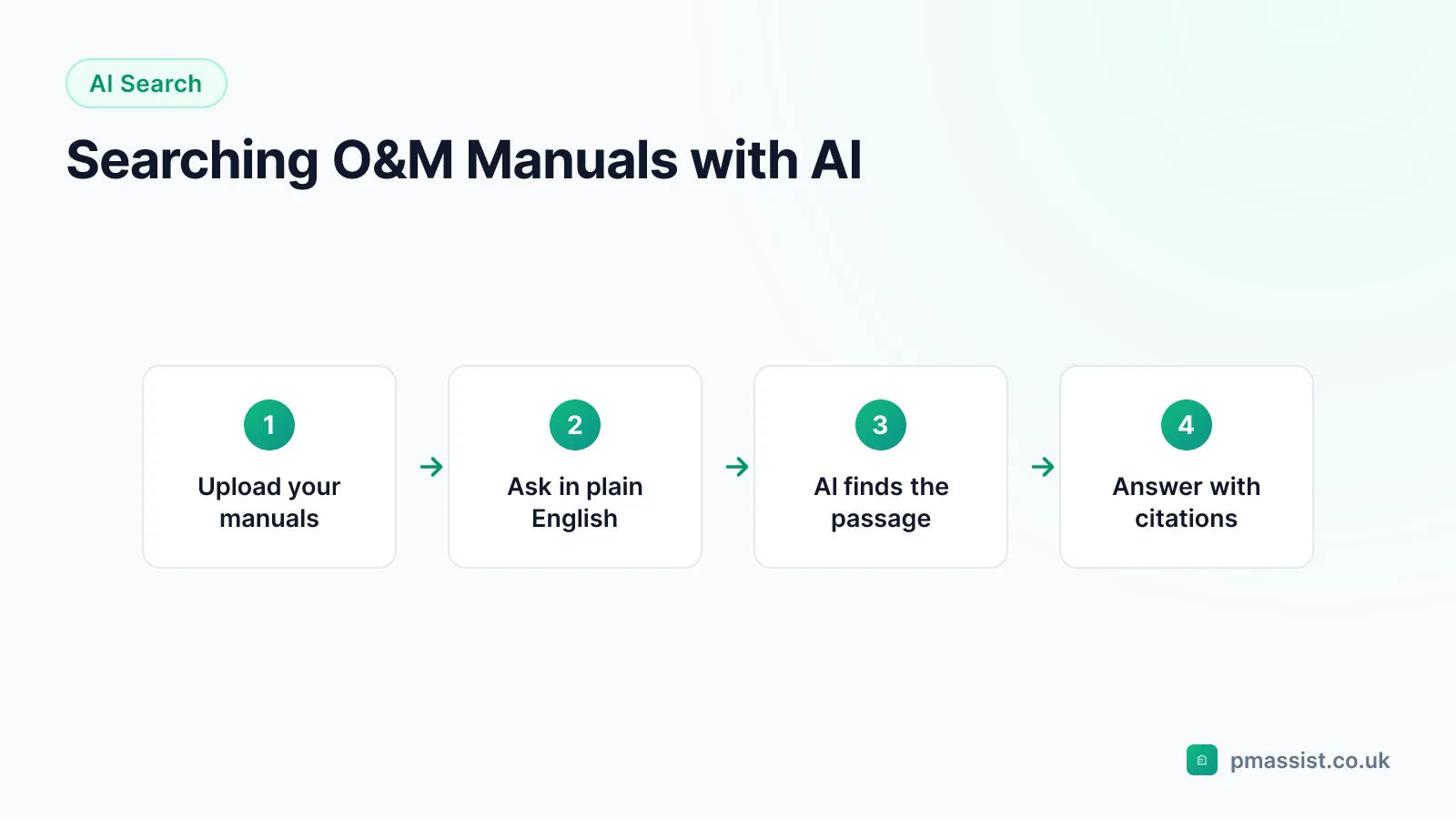
Operations and maintenance manuals are the backbone of building management. They contain everything a facilities management team needs to operate, maintain, and troubleshoot building systems — from HVAC equipment specifications to emergency procedures and warranty information. Yet despite their importance, finding specific information within O&M manuals remains one of the most time-consuming tasks for FM professionals.
Artificial intelligence is changing this. AI-powered document search tools like PM Assist can index your entire O&M documentation library and make it searchable using natural language questions. Instead of scrolling through hundreds of PDF pages, you can ask a question in plain English and receive a source-cited answer in seconds.
Why Traditional O&M Manual Search Fails
Before exploring how AI search works, it is worth understanding why traditional approaches fall short. Most O&M manuals are delivered as PDF files — sometimes dozens of them for a single building. These PDFs vary in quality: some have embedded text that is searchable with Ctrl+F, while others are scanned images where keyword search is impossible without OCR processing.
Even when keyword search works, it has fundamental limitations. If you search for "AHU maintenance schedule" but the document uses "air handling unit service intervals", you will get no results. This vocabulary mismatch is a common problem in technical documentation where different manufacturers use different terminology for the same concepts.
The structural challenge is equally problematic. O&M packs often contain documents from dozens of different subcontractors and manufacturers, each with their own formatting and organisation. There is rarely a unified index or table of contents that spans the entire documentation set. Finding information requires knowing which document to look in first — knowledge that typically resides in the heads of experienced team members.
How AI-Powered O&M Manual Search Works
AI document search uses a fundamentally different approach to finding information. Rather than matching keywords, AI systems understand the meaning of your question and match it against the meaning of content in your documents. This is called semantic search, and it solves many of the problems that make traditional keyword search ineffective for O&M documentation.
Step 1: Document Ingestion and Processing
The first step is uploading your O&M manuals to the AI search platform. When you upload a PDF, the system processes every page, extracting text content and creating a structured index. For scanned documents, OCR technology converts images of text into actual searchable text.
During processing, the AI breaks down your documents into meaningful chunks — paragraphs, sections, and pages that represent discrete pieces of information. Each chunk is then converted into a mathematical representation called a vector embedding, which captures the semantic meaning of the content.
Step 2: Understanding Your Question
When you ask a question, the same AI model converts your question into a vector embedding. This allows the system to compare the meaning of your question against the meaning of every indexed chunk in your document library. Crucially, this works even when you use different words than the documents — "What's the filter replacement schedule for the Level 3 AHU?" will match content about "air handling unit filter maintenance intervals on the third floor".
Step 3: Retrieval and Answer Generation
The system identifies the most relevant document sections and uses them to generate a comprehensive answer. Importantly, every piece of information in the answer is traced back to its source document, page, and section. This source citation is critical for FM teams who need to verify information against the original manufacturer documentation.
Practical Examples of AI O&M Manual Search
To illustrate how this works in practice, here are some common scenarios where AI search outperforms traditional methods:
Equipment Fault-Finding
A site engineer encounters a fault code on a BMS panel. With traditional search, they would need to identify the correct O&M manual for that equipment, locate the fault code table, and cross-reference any related procedures. With AI search, they can ask "What does fault code E17 mean on the Trend BMS panel?" and receive an immediate answer with the document reference.
Maintenance Planning
When planning quarterly maintenance, an FM manager needs to compile maintenance requirements across all building systems. Instead of opening each manufacturer's manual individually, they can ask "What quarterly maintenance tasks are required for the cooling system?" and get a consolidated answer drawing from multiple documents.
Emergency Procedures
During an emergency, speed matters. AI search allows any team member to instantly find relevant procedures: "What is the emergency shutdown procedure for the gas boiler?" returns the answer with source reference in seconds, rather than the minutes it might take to locate the correct manual and page.
Getting Started with AI O&M Manual Search
If you are considering implementing AI-powered O&M manual search for your buildings, here is a practical guide to getting started:
1. Gather Your O&M Documentation
Collect all your O&M manuals, drawings, specifications, and procedures in PDF format. If you have paper-only documents, scan them — the AI can process scanned documents using OCR.
2. Choose a Platform Designed for FM
Not all AI search tools are suitable for facilities management documentation. Look for platforms that understand the context of building documentation, provide source citations for verification, and offer per-building data isolation. PM Assist is purpose-built for this use case.
3. Upload and Start Searching
Upload your documents to the platform. Most AI search tools process documents automatically — you do not need to tag, categorise, or restructure your files. Once processing is complete, start asking questions and evaluate the quality of answers.
4. Introduce to Your Team
One of the benefits of AI search is that it requires no training. Your team members can start using it immediately by typing questions in plain English. Encourage them to verify answers using the source citations until they are confident in the system.
Security Considerations
O&M manuals contain sensitive building information, so security is important when choosing an AI search platform. Key features to look for include per-building data separation (your documents are not visible to other users or organisations), encryption in transit and at rest, role-based access control, and confirmation that your documents are not used to train third-party AI models.
Learn more about how PM Assist handles security.
The Future of O&M Documentation
AI-powered search is just the beginning of how technology will transform O&M documentation management. As AI capabilities advance, we can expect to see more intelligent document analysis, automated maintenance scheduling based on manufacturer recommendations, and integration with building management systems.
For now, the practical benefit is clear: AI search makes O&M manuals usable. Instead of being static archives that gather dust (physical or digital), O&M documentation becomes an active, accessible knowledge base that supports better building operations every day.
Conclusion
AI-powered O&M manual search represents a significant improvement in how facilities management teams access building documentation. By using semantic search instead of keyword matching, AI tools overcome the vocabulary mismatches, structural inconsistencies, and format variations that make traditional search ineffective.
The practical result is that any team member can find the information they need in seconds, with source citations for verification. This reduces equipment downtime, improves maintenance planning, and ensures that critical building information is accessible when it matters most.
Try PM Assist free and see how AI search can transform your team's access to O&M documentation.
Get the FM AI digest
One short email a month with the most useful new guides, tools and changes from PM Assist. Unsubscribe anytime.
We use your email only to send the digest. No spam, unsubscribe anytime. See our privacy policy.