AI for Building Operations: A Practical Guide
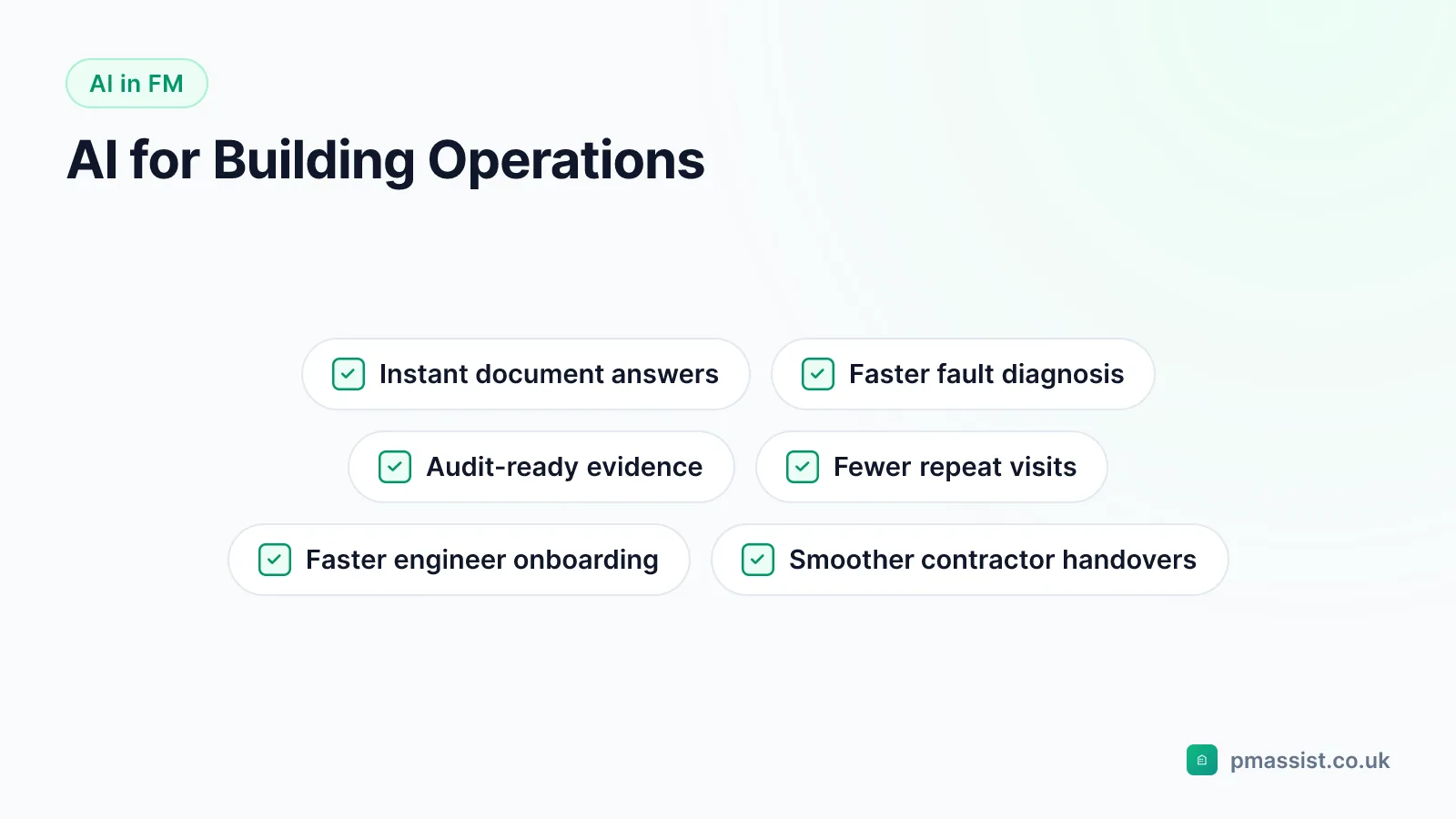
Building operations is the ongoing work of keeping commercial, residential, and institutional buildings functioning safely, efficiently, and comfortably. It encompasses maintenance management, equipment monitoring, energy management, compliance, and tenant services — all requiring access to accurate building information and effective decision-making tools.
Artificial intelligence is beginning to have a practical impact on building operations, moving beyond theoretical applications into tools that FM teams can use today. This guide explores the practical ways AI can improve building operations, with a focus on applications that are accessible to teams of all sizes and budgets.
Understanding AI in the Context of Building Operations
Before diving into specific applications, it is worth clarifying what AI means in practical terms for building operations. AI is not a single technology but a broad category that includes natural language processing (understanding and generating human language), machine learning (systems that improve through experience), computer vision (analysing images and video), and large language models (AI systems trained on vast amounts of text data).
For building operations teams, the most immediately useful AI capabilities are natural language processing (for document search and chatbots), machine learning (for predictive maintenance and energy optimisation), and large language models (for generating insights from building data and documentation).
AI for Building Documentation and Knowledge Management
The most accessible and impactful application of AI for building operations is document search and knowledge management. Every building has extensive documentation — O&M manuals, drawings, maintenance procedures, equipment specifications — and finding the right information when it is needed is a persistent challenge for operations teams.
How AI Document Search Helps Operations Teams
AI-powered document search tools like PM Assist make building documentation searchable using natural language questions. This is fundamentally different from traditional keyword search in several important ways:
Semantic understanding: AI understands the meaning of your question, not just the words. Asking "How do I reset the BMS after a power cut?" will find relevant information even if the documentation describes it as "system recovery procedure following mains power interruption".
Cross-document search: Instead of opening individual PDFs and searching each one, AI searches across your entire documentation library simultaneously. A single question can draw answers from O&M manuals, drawings, specifications, and procedures.
Source citations: Every answer includes references to the original source document, page, and section. This is crucial in building operations where acting on unverified information can have safety implications.
Practical Scenarios
Reactive maintenance: When equipment fails, the operations team needs immediate access to fault-finding procedures, spare part specifications, and contractor contact details. AI search provides these answers in seconds rather than the minutes or hours required for manual searching.
Planned maintenance: When preparing PPM schedules, the team needs to consolidate maintenance requirements across all building systems. AI search can answer questions like "What quarterly maintenance is required for the HVAC system?" drawing from all relevant manufacturer documentation.
Knowledge transfer: When new team members join, they need to quickly build familiarity with the building's systems and documentation. AI search means they can find answers independently from day one, rather than relying on colleagues to point them to the right documents.
AI for Maintenance Optimisation
Beyond document search, AI can help optimise maintenance strategies through analysis of maintenance data, equipment performance trends, and failure patterns.
Moving from Calendar-Based to Condition-Based Maintenance
Traditional planned preventative maintenance (PPM) follows fixed schedules — monthly, quarterly, annual service intervals defined by manufacturers. While this approach is straightforward, it does not account for actual equipment condition. Some equipment may need attention more frequently than the standard schedule, while other equipment may be serviced unnecessarily.
AI can analyse equipment performance data to identify when maintenance is actually needed, rather than when the calendar says it is due. This condition-based approach reduces both unnecessary maintenance visits and unexpected failures, optimising the balance between maintenance cost and equipment reliability.
Identifying Patterns in Maintenance Data
AI excels at finding patterns in large datasets that humans might miss. When applied to maintenance history, AI can identify recurring issues, seasonal patterns, and equipment that is approaching end of life. These insights support better maintenance planning and more informed capital expenditure decisions.
AI for Energy Management in Building Operations
Energy management is a core responsibility of building operations teams, and AI offers significant opportunities for optimisation. AI-powered energy management can analyse consumption patterns, identify waste, optimise equipment schedules, and predict future energy requirements.
Practical applications include optimising HVAC start-up times based on building thermal characteristics and weather forecasts, identifying equipment that is consuming more energy than expected, and automated reporting on energy performance against targets.
Implementing AI in Your Building Operations
For building operations teams looking to implement AI tools, here is a practical approach:
1. Start with Document Search
AI document search delivers the fastest return on investment with the lowest implementation complexity. Upload your existing building documentation to a platform like PM Assist and your team can start benefiting immediately. No infrastructure changes, no integration work, and no training required.
2. Improve Data Collection
More advanced AI applications (predictive maintenance, energy optimisation) require good quality data. If these are future goals, start improving your data collection now. Ensure maintenance activities are recorded consistently in your CAFM system, and invest in submetering where possible.
3. Build Incrementally
Digital transformation does not have to be a big-bang implementation. Start with one tool that addresses your biggest pain point, demonstrate value, and build from there. Each improvement creates a foundation for the next.
4. Prioritise Security
Building documentation contains sensitive information about building systems, security arrangements, and operational procedures. Any AI tool you adopt should provide appropriate data isolation, encryption, and access controls. PM Assist's security approach is designed specifically for the sensitivity of building documentation.
The Future of AI in Building Operations
The pace of AI development suggests that the tools available to building operations teams will continue to improve rapidly. Near-term developments are likely to include deeper integration between document knowledge bases and BMS systems, AI that can proactively recommend maintenance actions based on documentation analysis, and more sophisticated energy optimisation that considers occupancy patterns, weather, and energy markets simultaneously.
For operations teams starting their AI journey today, the key message is that practical, valuable AI tools are available now. You do not need to wait for the technology to mature further or for your building to be equipped with smart sensors. AI document search works with the documentation you already have.
Getting Started
The most impactful first step is the simplest: make your building documentation searchable with AI. Create a free PM Assist account, upload your O&M manuals and drawings, and start asking questions. The time savings are immediate and measurable.
For teams managing multiple buildings, explore our pricing plans to find the right option for your portfolio. Or contact us to discuss enterprise requirements.
Get the FM AI digest
One short email a month with the most useful new guides, tools and changes from PM Assist. Unsubscribe anytime.
We use your email only to send the digest. No spam, unsubscribe anytime. See our privacy policy.
Related articles
Bring AI to your building operations
Start free — upload your documents and start searching today.
Start free