Chiller Maintenance Schedule
What to do daily, weekly, monthly, quarterly and annually on a commercial chiller — organised by frequency rather than by task, with the statutory F-Gas leak check intervals set out against CO₂-equivalent charge.
What is a chiller maintenance schedule?
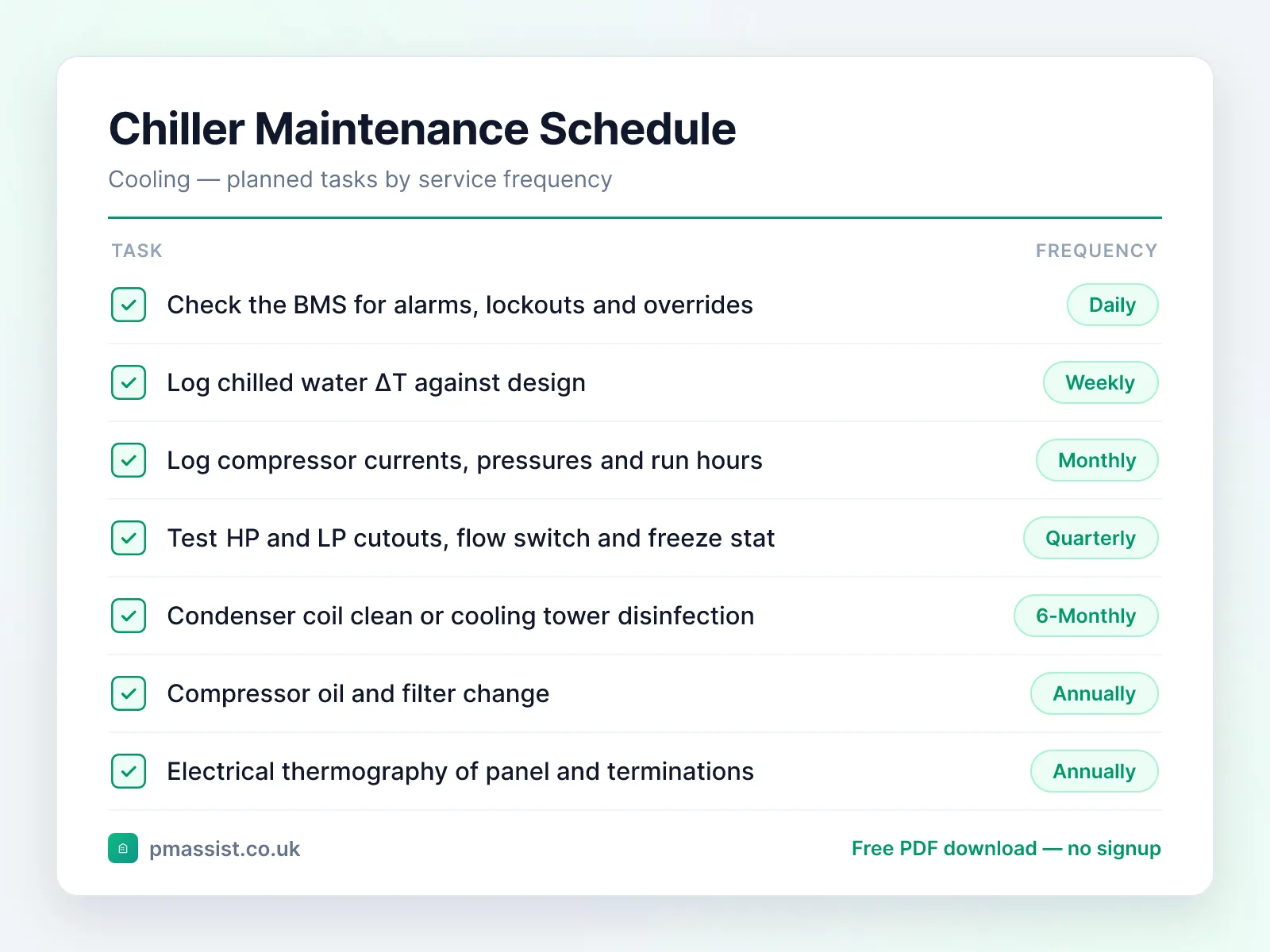
A chiller maintenance schedule sets out planned preventive maintenance by how often each task runs, rather than as a single list of checks. Daily and weekly items are logging and observation by the site team; monthly adds parameter recording and efficiency calculation; quarterly brings in a refrigeration contractor for safety control testing; and the six-monthly and annual visits cover condenser cleaning, oil changes, thermography and the statutory F-Gas leak checks. The intervals below are a practical baseline for UK commercial plant — always confirm the exact tasks and frequencies against the manufacturer's O&M manual for your machine.
The schedule, by frequency
Items marked for a specific chiller type only apply to that type. Everything else applies to any commercial chiller.
Daily
Every operating day · Site team or BMS
- Check the BMS for chiller alarms, lockouts and any manual overrides left in place
- Confirm the chiller is holding chilled water flow and return temperatures at setpoint
- Note any unusual noise, vibration or visible leakage on the plant round
- On process and data centre plant, confirm delivered temperature is inside the process tolerance
Weekly
Once a week · Site team
- Log chilled water flow and return temperatures and calculate ΔT against design
- Check condenser water temperatures on water-cooled plant, or ambient on air-cooled
- Cooling tower checks required by the site's written scheme of control, where fitted
- Visual check for oil staining around service valves, joints and coil headers
- Confirm duty/standby rotation has taken place where the control strategy calls for it
Monthly
Every 4 weeks · Site team or contractor
- Log suction and discharge pressures, compressor currents per phase and run hours
- Record kW input against cooling output and calculate kW/ton or COP for the period
- Air-cooled: visual condenser coil check and clear debris from around the unit
- Water-cooled: condenser water strainer differential check, and treatment chemistry against the control scheme
- Process: glycol concentration check by refractometer
- Review BMS trends for drift in pressures, ΔT, currents and starts per hour
Quarterly
Every 3 months · Refrigeration contractor
- Full operating check under representative load
- Test safety controls — HP and LP cutouts, flow switches, freeze stat and oil safety
- Verify superheat and subcooling against the manufacturer's target range
- Inspect starter panel, contactors and terminations; check star/delta or VSD operation
- Check anti-vibration mounts, pipework supports and refrigerant pipe insulation
- F-Gas leak check on systems of 500 tonnes CO₂e or more (see the table below)
Six-monthly
Twice a year · Refrigeration contractor
- F-Gas leak check on systems of 50 tonnes CO₂e or more but under 500 (see the table below)
- Air-cooled: condenser coil clean before the cooling season, and again after it on dirty sites
- Water-cooled: cooling tower clean and disinfect in line with HSG274 Part 1 and the written control scheme
- Water-cooled: condenser tube end inspection and waterbox condition check
- Oil analysis on large machines, with results trended rather than read in isolation
- Review chilled water quality and inhibitor levels
Annually
Once a year, usually a shutdown · Refrigeration contractor
- Comprehensive service to the manufacturer's schedule
- Compressor oil and filter change
- Air-cooled: full coil clean, fin combing and a documented corrosion survey
- Water-cooled: condenser tube brush clean and eddy current testing of the bundle
- Electrical thermography of panel, starter and motor terminations
- Verify the leak detection system where one is fitted — required at least every 12 months
- F-Gas leak check on systems of 5 tonnes CO₂e or more but under 50 (see the table below)
- Confirm crankcase heaters ahead of any winter shutdown
- Review the asset's F-Gas records, which must be kept for at least five years
F-Gas leak check intervals
Leak check frequency is set by the system's CO₂-equivalent charge, not by its physical size or age. Multiply the refrigerant charge in kilograms by the refrigerant's global warming potential and divide by 1,000 to get tonnes CO₂e. Checks must be carried out by certified personnel.
| Charge | Minimum check frequency | With leakage detection fitted |
|---|---|---|
| Under 5 tonnes CO₂e | No leak check required | — |
| 5 to under 50 tonnes CO₂e | At least every 12 months | At least every 24 months |
| 50 to under 500 tonnes CO₂e | At least every 6 months | At least every 12 months |
| 500 tonnes CO₂e or more | At least every 3 months | At least every 6 months |
- Equipment containing 500 tonnes CO₂e or more must have a leakage detection system fitted, and that system must itself be checked at least every 12 months.
- Hermetically sealed equipment labelled as such is exempt below 10 tonnes CO₂e.
- Records — charge, top-ups, check dates and results, and the engineer's certificate details — must be kept for at least five years.
Great Britain and Northern Ireland now differ
The intervals above are the Great Britain position, based on Regulation (EU) No 517/2014 as retained and amended in UK law. Northern Ireland continues to follow the EU regime under the Windsor Framework, and the EU replaced 517/2014 with Regulation (EU) 2024/573 in 2024. Leak-check thresholds are broadly aligned, but other obligations have diverged — check the current EU regulation for plant in Northern Ireland.
GB reform is in train but not yet law. Defra consulted on changes to the GB regime and has committed to publishing its response and next steps during 2026. That consultation concerned the HFC phase-down schedule; leak checking, training and certification requirements are unchanged. Nothing on this page changes until new legislation is made, but it is worth re-checking once the response is published.
Source: Articles 4, 5 and 6 of Regulation (EU) No 517/2014 on fluorinated greenhouse gases, as assimilated into UK law. This page is a practical summary, not legal advice — confirm your obligations against the regulation and your machine's O&M manual. Last reviewed July 2026.
Task detail by chiller type
This page covers when. For what each task involves on your specific machine, use the checklist for its type.
Chiller maintenance checklist
The generic 18-task checklist covering any commercial chiller.
Air-cooled chiller maintenance checklist
Coil cleaning technique, ambient derating and head pressure control.
Water-cooled chiller maintenance checklist
Condenser approach, tube testing, water treatment and ACoP L8 duties.
Process chiller maintenance checklist
Glycol condition, tolerance verification and N+1 changeover testing.
Chiller maintenance schedule FAQs
What should a chiller maintenance schedule include?
How often does a chiller need an F-Gas leak check?
How do I work out my chiller's CO₂e charge?
Does a chiller need an automatic leak detection system?
Do the same F-Gas rules apply across the whole UK?
How often should chiller condenser coils or tubes be cleaned?
Can chiller maintenance be done without shutting the plant down?
Every interval depends on knowing your plant
Refrigerant type, charge weight, commissioning figures and the manufacturer's schedule all live in the O&M manual. PM Assist makes them searchable in plain English, so the engineer on site can check the number instead of guessing it.