Escalator & Moving Walkway Maintenance Checklist
Keep escalators and moving walkways safe — step, comb, and handrail checks, brake and safety-device testing, emergency-stop verification, and examination compliance.
Also available as editable Excel and Word — with asset, sign-off and findings columns.
What is an escalator maintenance checklist?
A escalator & moving walkway maintenance checklist is a structured list of the 10 preventive maintenance tasks — covering visual, functional, safety and record-keeping checks — that keep an escalator & moving walkway running safely and reliably. It groups routine checks by frequency, from daily inspections to annual servicing, so FM teams and building engineers can plan and evidence preventive maintenance.
Core escalator checks
- Inspect steps/pallets and the step band for damage and level running
- Verify handrail speed, condition, and inlet (handrail) guards
- Check comb plates and comb-impact safety devices for damage and operation
- Record safety-device tests, service findings, and examination status
What is an escalator & moving walkway?
An escalator (or moving walkway) carries people between levels on a continuously moving stairway or ramp, used in transport hubs, retail, and large public buildings. It is a high-throughput, safety-critical machine with steps or pallets, a step band and chains, handrails, combs, a drive and brake system, and an array of safety devices designed to stop the escalator if something goes wrong. Heavy public use and numerous trapping and entanglement hazards make rigorous maintenance and examination essential. Escalators are subject to safety inspection regimes, and maintenance focuses on the steps and combs, handrails, brakes, and the many safety devices.
This checklist is one of 5 in our lift maintenance checklists, covering passenger, goods and platform lifts and escalators — LOLER thorough examination, entrapment release and door safety.
Typical Escalator maintenance checklist
A practical starting point for planned preventive maintenance. Always refer to the manufacturer's O&M manual and site-specific requirements.
Visual Checks
- Inspect steps/pallets and the step band for damage and level running
- Inspect skirting, deflectors, and balustrades for safety and condition
- Confirm lighting, signage, and any access controls at landings
Functional Checks
- Verify handrail speed, condition, and inlet (handrail) guards
- Verify the drive, step chain tension, and lubrication
Safety Checks
- Check comb plates and comb-impact safety devices for damage and operation
- Test the operating brake and any auxiliary/emergency brake
- Test all emergency stop buttons at landings
- Check safety devices — step sag, missing step, skirt, broken chain
Record Keeping
- Record safety-device tests, service findings, and examination status
Download the free Escalator maintenance checklist PDF
Get all 10 tasks as a printable PDF — free, no signup needed. Keep a copy in the plant room, attach it to work orders, or share it with your maintenance contractor.
The PDF is free and needs nothing. The Excel and Word versions add asset details, sign-off and findings columns so you can record the work as you do it — we ask for an email address for those.
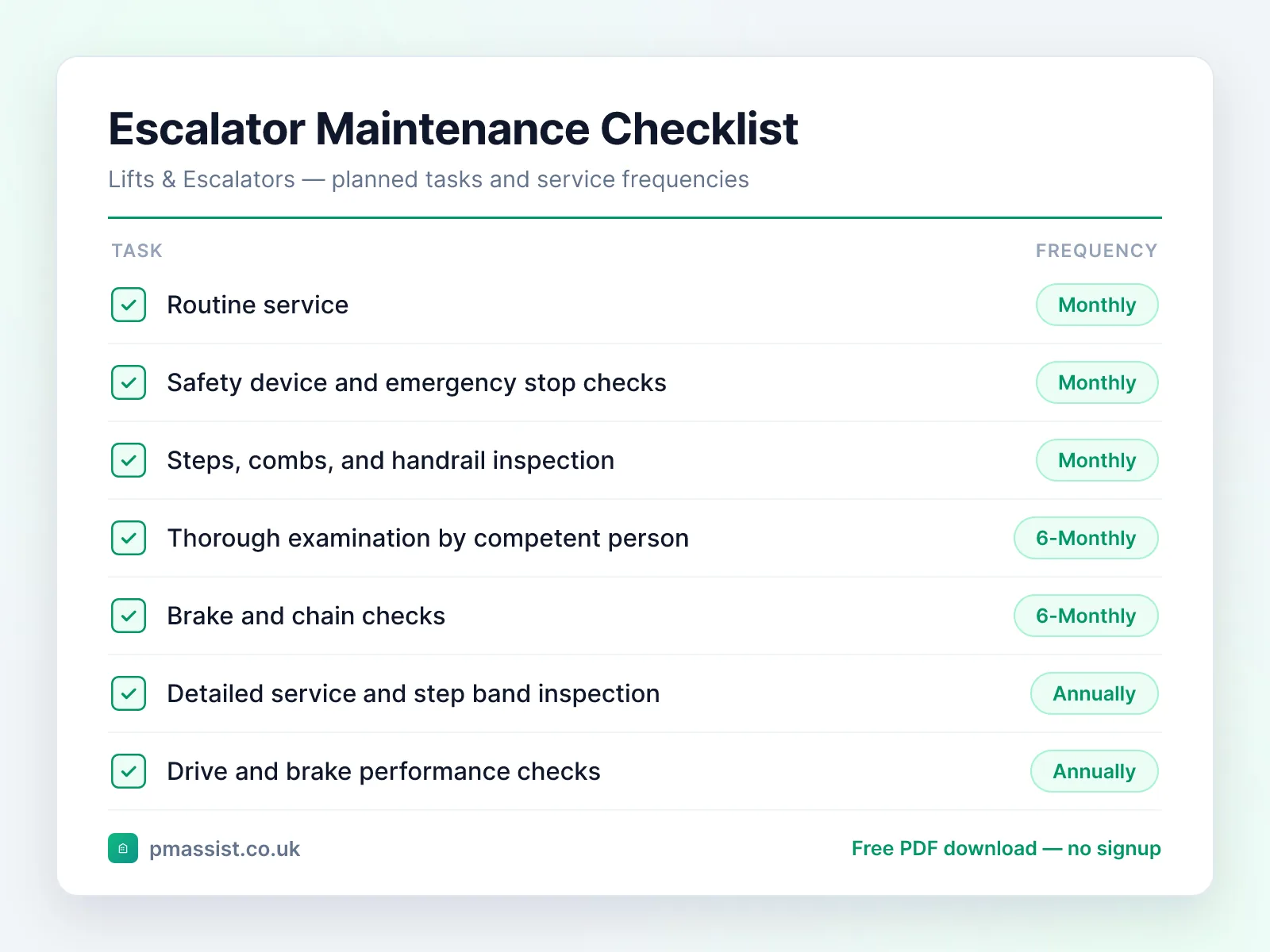
Typical maintenance frequency
Suggested intervals for escalator & moving walkway maintenance. Actual frequencies should follow manufacturer guidance and site-specific risk assessments.
Monthly
- •Routine service
- •Safety device and emergency stop checks
- •Steps, combs, and handrail inspection
- •Lubrication
Every 6 Months
- •Thorough examination by competent person
- •Brake and chain checks
- •Close any defects
Annually
- •Detailed service and step band inspection
- •Drive and brake performance checks
- •Balustrade and skirting inspection
Common faults and issues
Issues to be aware of when maintaining escalator & moving walkway equipment.
Safety and compliance notes
Key safety considerations for escalator & moving walkway maintenance. This is general guidance only — always follow OEM instructions, statutory requirements, and your organisation's safe systems of work.
Reference standards and frameworks
- United Kingdom
- LOLER 1998 statutory examinations and the BS EN 81 series
- North America
- ASME A17.1 / CSA B44 (safety code for elevators and escalators)
Frameworks commonly referenced when planning escalator maintenance programmes. Always confirm the requirements that apply to your site and jurisdiction.
Managing Escalator documentation with PM Assist
PM Assist helps FM and building operations teams search their O&M manuals and building drawings in seconds. Upload your escalator & moving walkway documentation and ask questions like “When was the last thorough examination?” or “Where are the emergency stops located?” — and get source-cited answers instantly.
The checklist tells you what to check. The manual tells you the numbers.
Ask a escalator manual a question and get the answer back with the page it came from. No signup, and you can drop in your own PDF instead of the sample.
“When was the last thorough examination?”Runs against a sample chiller manual so you can see the shape of the answer — then try it on one of yours.
Take this checklist with you
Download the branded PDF, generate a custom version for your asset, or run AI search across all your building documentation.
Related free tools
Related maintenance checklists
Passenger Lift maintenance checklist
Lifts & Escalators · 11 tasks
Goods Lift maintenance checklist
Lifts & Escalators · 10 tasks
Platform Lift maintenance checklist
Lifts & Escalators · 10 tasks
Emergency Lighting System maintenance checklist
Fire Safety · 10 tasks
Lighting Control Panel maintenance checklist
Electrical · 10 tasks
Further reading on escalator maintenance
Compliance & CAFM
Run escalator & moving walkway maintenance in PM Assist
This checklist is also a planned maintenance programme in PM Assist, included in every paid plan alongside the compliance register and mobile inspections.
- Add an escalator & moving walkway to a building's asset register and this maintenance programme is created for you, with each task on its frequency in the planner.
- Escalator & Moving Walk Maintenance is tracked on the compliance register, with the date last done, the date next due and the certificate.
- Contractors can be given a login to see their jobs and upload certificates.
Frequently asked questions
How often are escalators inspected?
What safety devices does an escalator have?
Why is escalator maintenance so safety-critical?
Manage your building documentation with AI
PM Assist gives FM teams instant access to O&M manuals, drawings, and maintenance knowledge — all searchable with AI.
- Upload and organise building documentation
- AI-powered search across all your manuals
- Source-cited answers for maintenance queries
- Team collaboration and access control
- No credit card required to start